


14 Effective Thanksgiving Marketing Ideas to Boost Your Sales in 2026
Discover creative Thanksgiving marketing ideas to engage customers, build buzz, and drive sales before Black Friday and Cyber Monday.
Cross-sell on Shopify like a pro with proven methods, funnel placement strategies, real-world examples, and tool recommendations—from simple “Frequently Bought Together” blocks to advanced personaliza
In short
Boost your Shopify sales with effective cross-selling strategies. This guide explores how to increase your average order value by 20-30% using proven cross-sell techniques, funnel placements, and real-world examples. Learn to leverage product recommendations, bundling, and post-purchase offers to maximize revenue from existing customers, enhancing both customer satisfaction and lifetime value.
Customer acquisition is getting more expensive…but that’s not the real problem.
The bigger issue is this: most Shopify stores try boosting sales by increasing traffic, while under-optimizing the value of the traffic they already have. More visitors don’t automatically mean more profit. If your average order value stays the same, growth becomes dependent on rising ad budgets.
This is where cross-selling changes the equation. Studies show that successful cross-selling can contribute 10–30% of ecommerce sales and increase average order value by 20–30%. That means a significant portion of your potential revenue doesn’t come from new customers—it comes from increasing the cart size of existing customers who are already buying through a smart cross-selling strategy.
In this guide, we’ll break down how to cross-sell on Shopify effectively—including the best methods, funnel placement strategies, real examples, and tools to implement it.
Cross-selling is the practice of recommending additional products that naturally complement the item a customer is already considering.
Instead of replacing the original choice or pushing a higher-priced alternative, it expands the purchase by providing comprehensive solutions to improve the customer experience. It builds around the customer’s initial intent rather than redirecting it.
For example, if someone is buying a DSLR camera, suggesting a memory card and a camera bag is considered cross-selling in marketing. The main product stays the same—you’re simply completing the experience.

This distinction becomes important when we compare cross-selling to another common revenue strategy: upselling.

While both sales tactics increase revenue, knowing the difference between cross-selling and upselling ensures you use the most effective approach for each situation.
At its core, cross-selling vs upselling comes down to addition versus upgrade. Cross-selling introduces complementary products that enhance the original purchase, while upselling encourages the customer to switch to a higher-tier version of the same item.
If someone is buying a smartphone, recommending a phone case is cross-selling because it expands the cart. Suggesting the same model with more storage is upselling because it elevates the original choice.
To make the distinction clearer, here’s a direct comparison:
| Feature | Cross-selling | Upselling |
|---|---|---|
| Goal | Increase order value by suggesting related products | Increase order value by encouraging a higher-end version |
| What you offer | Complementary products | A more expensive alternative |
| Example (Ecommerce) | Suggesting a phone case when someone buys a smartphone | Suggesting the premium smartphone version with more storage |
| Risk level | Low (adds small extra items) | Medium (higher price decision) |
| Impact on AOV | Moderate but consistent | Can create bigger jumps in AOV |
| When to use | When customers have already decided on main product | When customers are comparing options |
Both sales tactics have their place. But for most Shopify stores, cross-selling techniques are easier to implement, carry less decision friction, and work consistently across the funnel while increasing customer lifetime value and satisfaction.
So how do you actually apply cross-sell tactics in practice?
Let’s look at the most effective methods to cross-sell on Shopify.
If you want to cross-sell on Shopify effectively, you need more than “related products” blocks. Each method below works differently in structure, timing, and psychological impact.
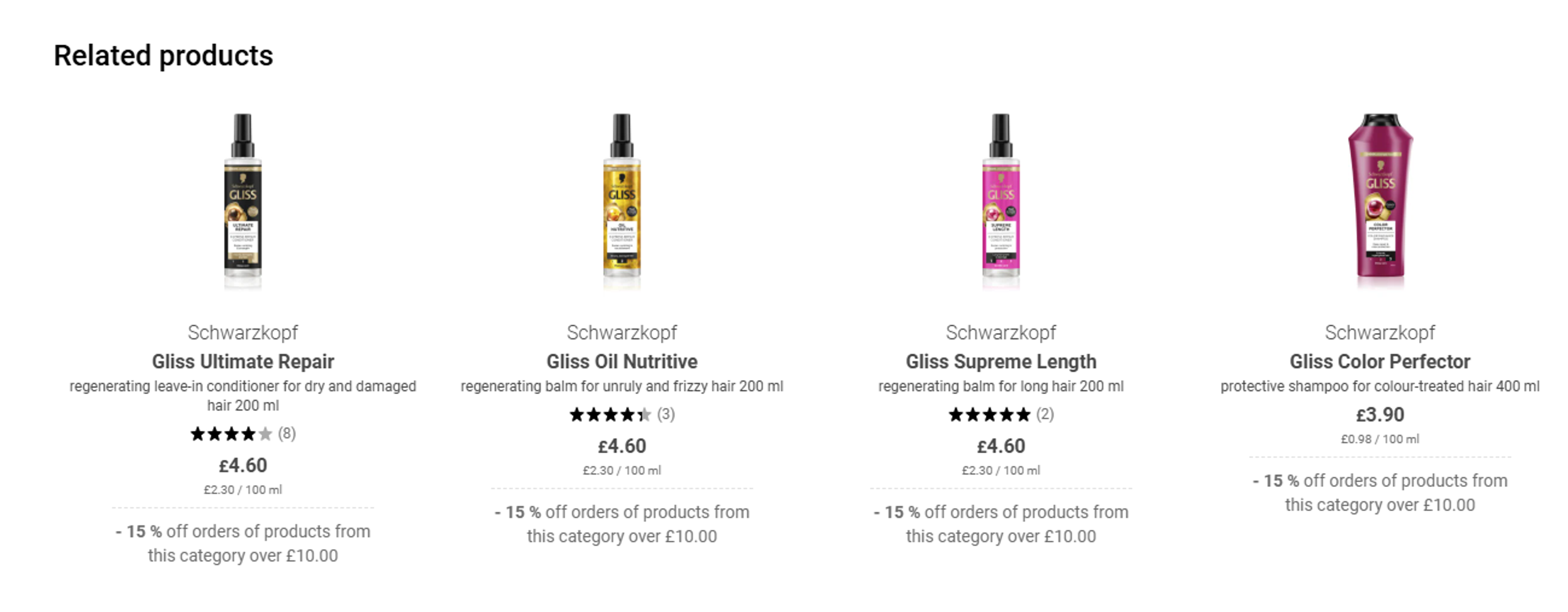
Product recommendations display related items near the main product, usually under the product description or in a “Frequently Bought Together” section. These are classic product recommendations on Shopify or other ecommerce platforms and can be rule-based or algorithm-driven.
This method leverages social proof and cognitive shortcuts. When customers see that others frequently buy certain products together, it reduces uncertainty and simplifies decision-making.
Product recommendations don’t interrupt the purchase, they enhance it.
Pro tip: Product recommendations don’t have to live under the product description. A well-timed cross-sell popup can outperform embedded widgets by capturing attention at high-intent moments.


Related or complementary products are intentionally paired items selected by you—not just algorithmically suggested.
Unlike general recommendations, these are curated combinations of relevant products that logically “complete” the main purchase.
For example:
This method relies on completion bias. Customers prefer buying a “complete solution” rather than a single standalone item.
Because the pairing feels purposeful, it increases perceived usefulness—not pressure.
Pro tip: Follow the 25% rule—keep complementary product pricing under 25% of the main item’s value to reduce friction.

Product bundling combines multiple goods into one packaged offer, often with a small discount.
Instead of suggesting separate items, you present a single bundled SKU that represents a complete set.
Example:
Bundles reduce decision fatigue and increase perceived value. Instead of evaluating multiple additional services and goods separately, the customer evaluates one packaged solution.
It shifts the mindset from “Do I need this too?” to “This is the smart option.”
Pro tip: Add product reviews or testimonials to the bundle itself—social proof reduces hesitation for higher total cart values.
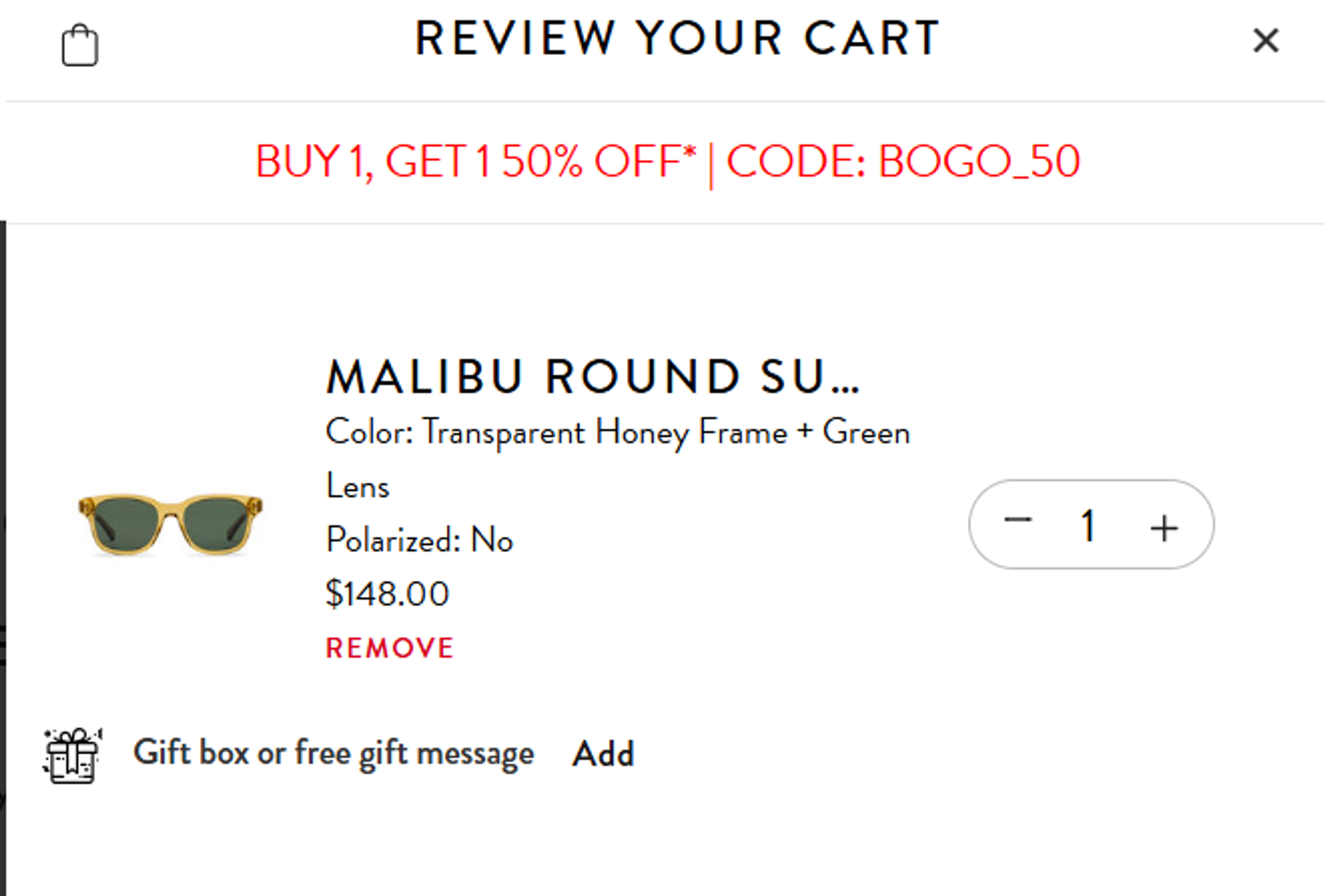
Add-ons are optional extras offered at the cart or near the purchase button, often with a simple checkbox or toggle.
These are typically low-priced, quick-decision items such as:
Unlike product recommendations (which sit on the page), add-ons are integrated directly into the buying action.
Add-ons rely on momentum. The customer has already committed mentally to purchasing products, so small additions feel incremental rather than disruptive. These are especially effective in reducing cart abandonment when implemented thoughtfully and without adding friction.
It’s micro-expansion at the point of commitment.
Pro tip: Make add-ons selectable with one click. Never redirect users to another page—friction kills impulse additions.

Post-purchase cross-selling happens after the checkout is complete—typically on the thank-you page or via one-click follow-up offers.
The transaction is already secured. The cross-sell becomes an optional extension.
These offers benefit from maximum trust and zero checkout anxiety. The purchase decision is done. Cognitive load is low.
Statistically, the probability of selling to a new customer is around 1–3%. Selling to someone who has just completed a purchase is 3–5 times more likely.
That makes post-purchase cross-selling one of the highest-leverage opportunities in the funnel.
Pro tip: Keep the offer highly relevant and time-sensitive, as these offerings can make sure your customers will keep coming back, increasing customer loyalty.
Next, let’s look at where each of these methods performs best in the Shopify funnel.
Not all cross-selling opportunities are equal. The same offer that performs well on a product page can hurt conversions at checkout. Timing, intent, and cognitive load change as customers move through the funnel.
To cross sell effectively, you need to align the method with the customer’s decision stage:
The performance differences between these stages are significant. Conversion potential, acceptance rates, and revenue lift vary depending on where the cross-sell offer appears.
The framework below breaks down how cross-selling techniques perform at each stage of the funnel and which tactics work best in each context.
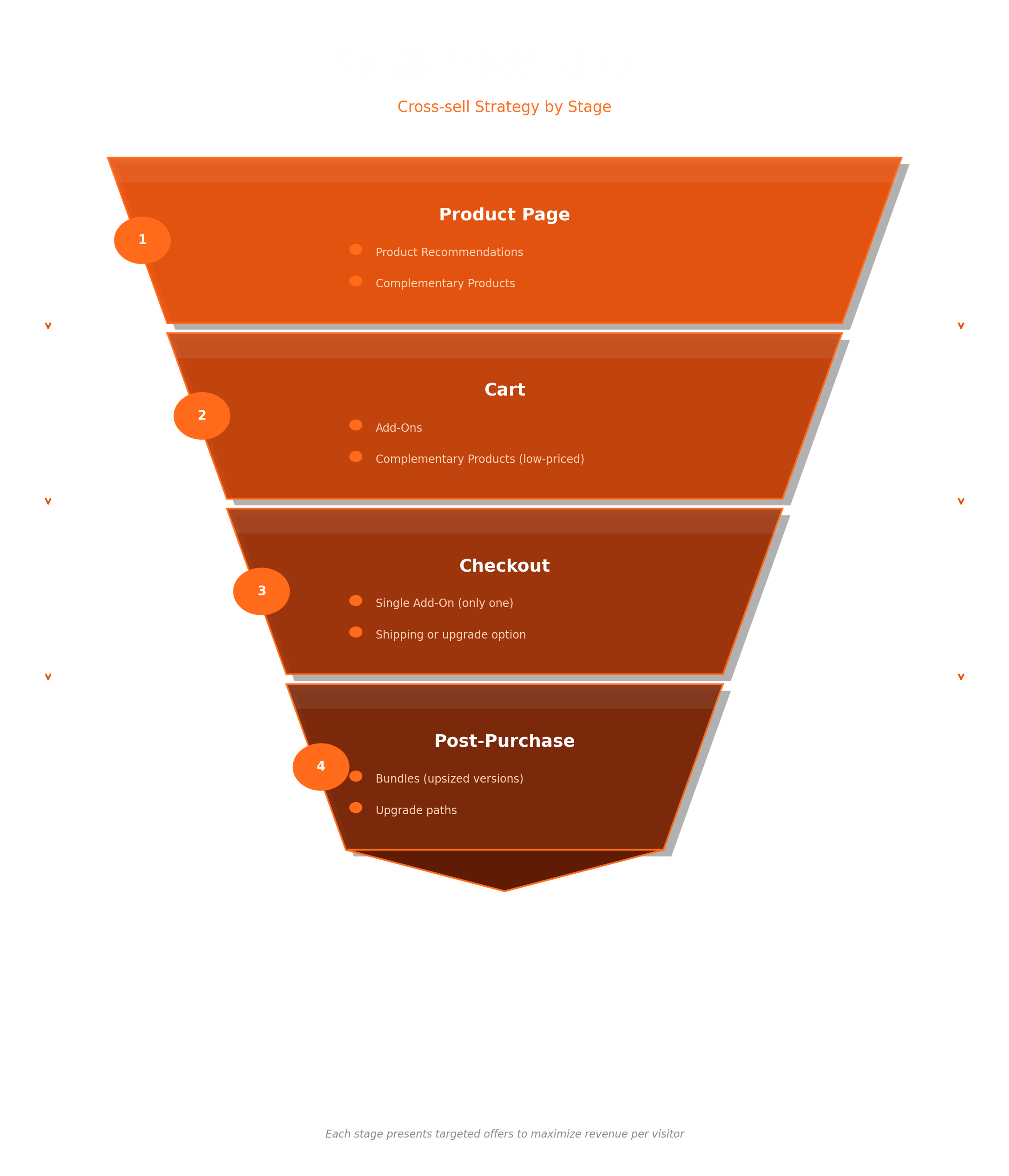
While the funnel shows how these methods align with buyer intent at each stage, the table below breaks down the performance potential and best execution tactics in more detail.
| Stage | Intent level | Avg conversion potential | Best use cases (what works best here) |
|---|---|---|---|
| Product page | Medium (Evaluation Phase) | 2–4% typical ecommerce CR Returning visitors: 8–12% | “Frequently Bought Together” Complementary accessories 1–3 related products under main item |
| Cart | High (Commitment Phase) | 10–20%+ add-on acceptance 10–15%+ potential AOV lift | Low-priced add-ons (<25% of main product value) Protection plans Small upgrades (gift wrap, warranty) |
| Checkout | Very High (Completion Focus) | Fragile stage—Minimize friction here | Single highly relevant add-on Shipping upgrade Express handling |
| Post-purchase | Maximum Trust | High acceptance potential Significant revenue lift | One-click limited-time offers Bundled refill packs Upgrade to premium version |
With the structural framework in place, the next step is to look at how successful brands apply these sales techniques in real ecommerce environments.
Understanding the theory is useful, but seeing how brands actually cross-sell on Shopify makes the strategy tangible. These brands apply ecommerce cross-selling techniques in distinct ways, shaped by their business model and customer journey.
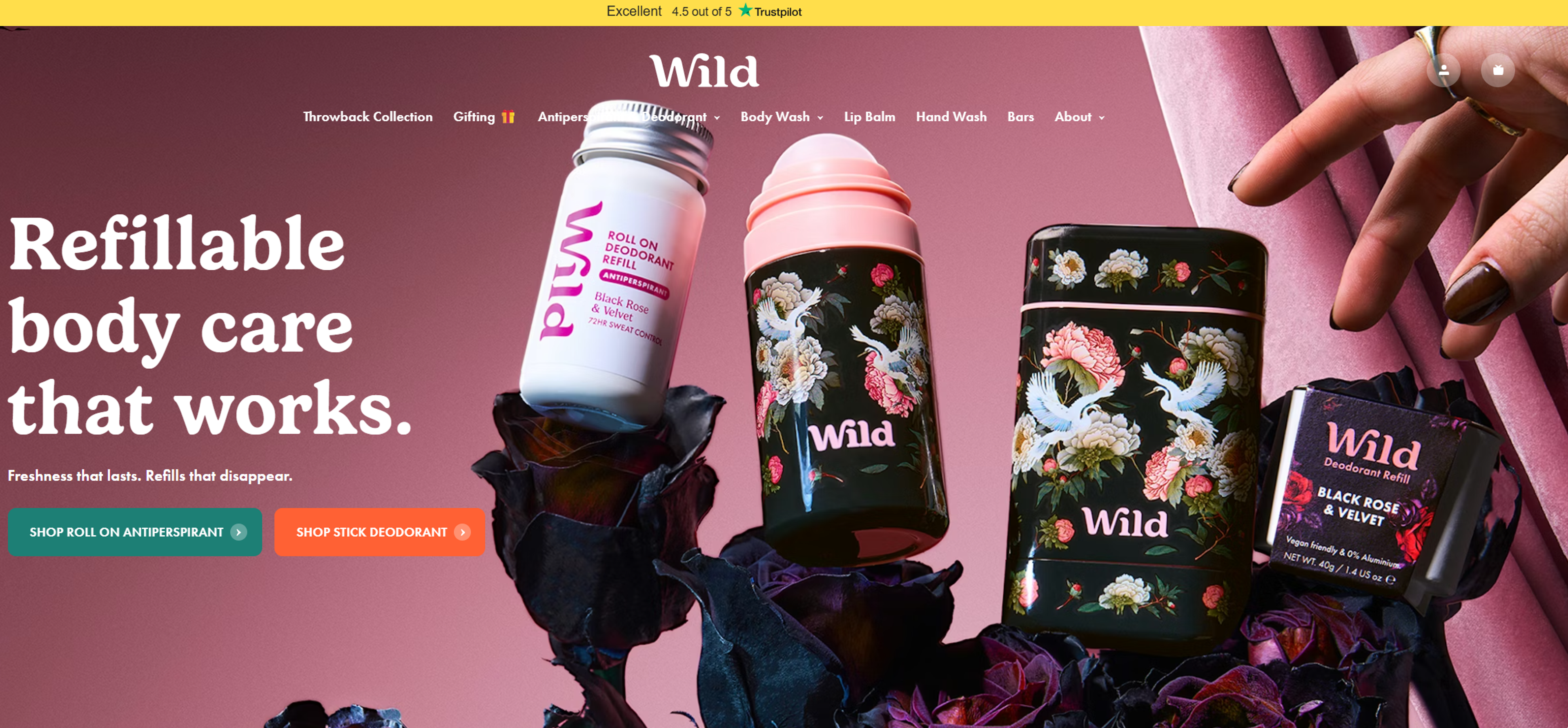
Wild is a UK-based refillable deodorant brand built around sustainability and subscription-based refills. Their business model combines one-time starter kits with recurring refill purchases.
Wild cross-sells primarily through:
Instead of overwhelming customers with multiple suggestions, they focus on logically extending the core purchase.
Primarily: Product Page
Secondarily: Post-Purchase (refill prompts & subscription nudges)
Wild’s strategy feels intuitive because it mirrors the product logic. If you buy a reusable case, you need refills. If you choose a scent, exploring additional scents feels natural.
The cross-sell doesn’t feel like an upsell—it feels like completing the system.
By aligning cross-selling with product structure rather than aggressive tactics, Wild increases cart value while preserving brand simplicity.
For a deeper strategic breakdown, see our Wild marketing analysis.

Blume is a vegan skincare brand focused on accessible self-care essentials like cleansers, serums, and SPF products. Its positioning centers on effective daily routines with gentle ingredients and eco-friendly values.
Blume emphasizes:
Rather than overwhelming shoppers with unrelated add-ons, Blume clusters products into logical combinations that feel like natural enhancements.
Primarily: Product Page
Secondarily: Cart (bundle reinforcement)
Skincare routines naturally involve multiple steps. By structuring bundles and recommendations around outcomes—like hydration + acne care—Blume reduces decision fatigue and increases perceived value. Customers feel like they’re building a routine, not being sold extras.
For a deeper strategic breakdown, see our Blume marketing breakdown.

Alani Nu is a fitness and supplement brand offering products like pre-workout, protein powders, and energy drinks. Their catalog supports stacking products for performance goals.
Alani Nu combines:
They lean heavily into lifestyle positioning and goal-based product combinations.
Primarily: Product Page
Secondarily: Post-Purchase
Fitness consumers often buy in combinations (pre-workout + shaker + protein). By structuring cross-selling around performance goals, Alani Nu makes expansion feel logical. Their post-purchase offers capitalize on high intent immediately after checkout, increasing sales without interrupting conversion.
For a deeper strategic breakdown, see our Alani Nu marketing breakdown.
Before you choose a Shopify cross-sell app, it helps to know what to look for. The right tool doesn’t just increase sales—it fits your workflow and growth stage.
This framework ensures you choose a tool that matches your current needs and growth path—from beginner installs to advanced behavioral targeting and personalized recommendations.

As one of the most recognizable cross-sell solutions, this app lets you display Amazon-style product pairings and bundled recommendations on product pages. It’s designed for quick setup and strong recommendations without heavy configuration.

Selleasy offers a full suite of cross-selling options—from product page suggestions to cart upsells and post-purchase offers. Merchants can create bundling, add-ons, and “frequently bought together” widgets, all without coding.
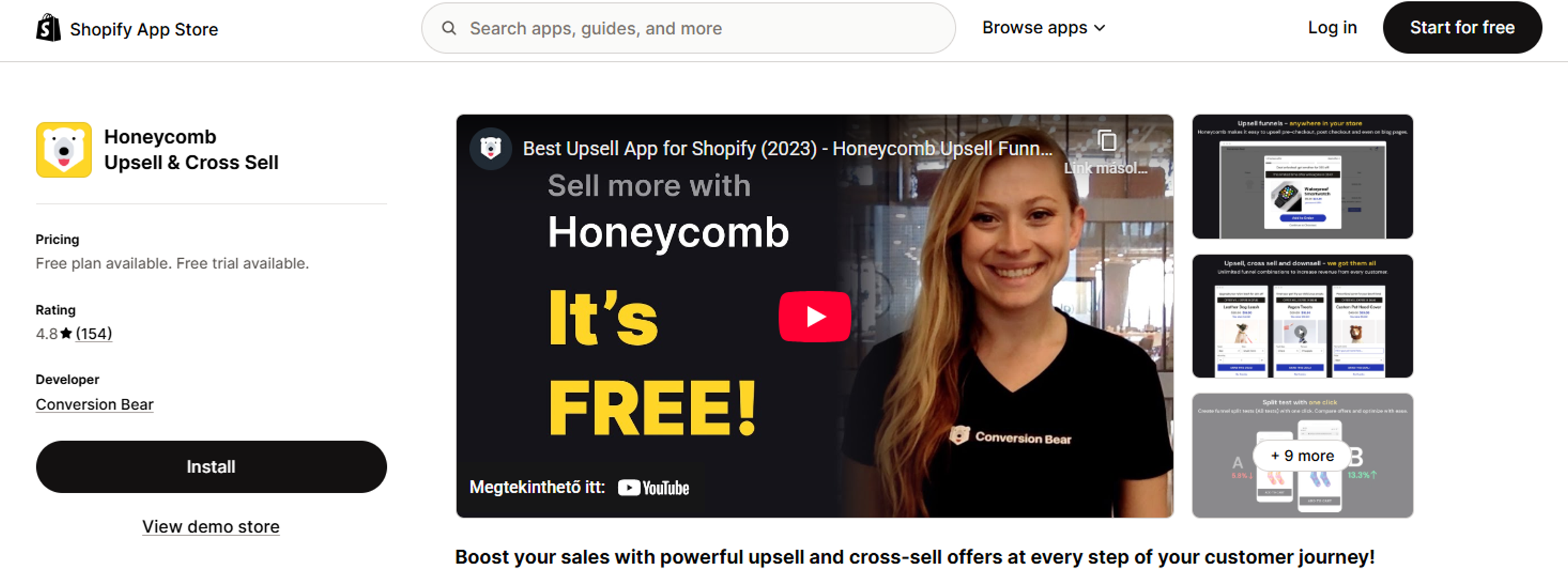
Honeycomb stands out for its customizable upsell funnels and experimentation features. Merchants can build and test targeted offers across product pages, carts, and thank-you pages, increasing relevance with AI-driven suggestions.
ReConvert is highly regarded for optimizing the thank-you page and post-purchase cross-sell flows. Its drag-and-drop funnel builder makes it easy to create one-click offers after checkout—a prime cross-sell moment.

OptiMonk is not a simple recommendations widget: it's an agentic popup builder that lets you trigger cross-sell offers based on visitor behaviour. Its AI agent, A/B testing, and product recommendation popups make it powerful for personalizing cross-sells on Shopify.
| Tool | Level | Best placement | AI personalization | Free plan | Best for |
|---|---|---|---|---|---|
| Frequently Bought Together | Beginner | Product page & cart | Yes (AI recommendations) | ❌Free trial/paid plans start ~$9.99/$19.99/mo | Simple Amazon-style product recommendations & bundles |
| Selleasy – Upsell & Cross-Sell | Beginner–Mid | Product page, cart, post-purchase | Yes (AI/automation options) | ✔ Free up to 50 orders/mo | Budget-friendly all-around upsell/cross-sell tool |
| Honeycomb Upsell & Cross-Sell | Mid | Product page, cart, post-purchase (checkout for Plus) | ✔ Yes (AI-powered recommendations) | ✔ Free tier available | Custom funnels, AI matching & A/B testing |
| ReConvert (Upsell.com) | Mid–Advanced | Cart, checkout (Plus), post-purchase | Yes (AI product suggestions) | ✔ Free trial available | One-click post-purchase funnels & thank-you page optimization |
| OptiMonk | Advanced | Full funnel (popups/cart/behavioral placements) | ✔ Yes (AI popup personalization & targeting) | ✔ Free plan available | Behavioural targeting & personalized on-site cross sells |
Cross-selling works best when it’s treated as part of your growth system, not as a last-minute revenue add-on.
When you cross-sell on Shopify strategically, each stage of the funnel has a role. Product pages guide discovery. Cart stages enable micro-expansion. Post-purchase moments unlock high-trust opportunities. The impact doesn’t come from a single tactic—it comes from how intentionally those tactics are placed.
Start simple. Test placements. Measure attach rates. Then refine your sales tactics based on customer data with segmentation and behavioral targeting as your store grows. This is how you improve cross-selling sustainably.
The best apps include tools that offer free plans or trials, such as Frequently Bought Together and Selleasy. These apps allow merchants to add product recommendations, bundles, or cart add-ons without upfront costs, making them ideal for testing cross-selling strategies before scaling.
Yes, cross selling increases average order value (AOV) by encouraging both new and existing customers to add complementary or related products to their purchase. When relevant items are suggested at the right stage of the funnel, cross-selling can generate consistent AOV growth without an increase in traffic. This is one of the most measurable outcomes of effective Shopify cross-selling.
Cross-selling and upselling serve different purposes. Cross-selling adds complementary products to expand the cart, while upselling encourages customers to upgrade to a higher-priced version. Cross-selling is often lower risk and easier to implement, especially on Shopify stores with diverse product catalogs.
You measure the success by tracking attach rate, AOV lift, revenue per visitor, and offer acceptance rate. It’s also important to analyze performance by funnel stage—product page, cart, and checkout—to identify which placements drive the highest sales impact.
Advanced apps use AI personalization and behavioral targeting to recommend products dynamically. Tools like Honeycomb and OptiMonk leverage AI-driven recommendations or behavior-based triggers to show more relevant offers, dramatically improving conversion rates and cross-sell performance.


Discover creative Thanksgiving marketing ideas to engage customers, build buzz, and drive sales before Black Friday and Cyber Monday.

Learn 5 ways ecommerce brands can turn new subscribers into recurring revenue using welcome flows, personalization, loyalty programs, re-engagement, and referrals.
In this article, we’ve compiled a list of the 25 top ecommerce apps that will help you streamline your operations, boost sales, and grow your online business.