


14 Effective Thanksgiving Marketing Ideas to Boost Your Sales in 2026
Discover creative Thanksgiving marketing ideas to engage customers, build buzz, and drive sales before Black Friday and Cyber Monday.
The popup app that worked fine at a few hundred daily sessions starts to crack under pressure at scale. This guide breaks down the 7 best Shopify popup apps for high-traffic stores.
In short
Most popup app guides treat every Shopify store the same. This one doesn't. At 50K, 100K, or 500K+ monthly sessions, the criteria that matter shift completely — a slow-loading script, a pricing model that spikes at scale, or targeting too blunt for a large, diverse audience can cost you far more than the tool's monthly fee. The short answer: OptiMonk is the strongest all-rounder for personalization at scale, Claspo offers the best value for fast-growing stores, and Triggerbee is the only tool that syncs directly with your CRM for real-time onsite targeting. But the right choice depends heavily on your traffic level, tech stack, and conversion goals — and site speed impact is the most underrated factor in the decision. This guide breaks down all seven tools through that lens.
You've put in the work—the ads, the SEO, the content—and traffic is finally rolling in. That's when a new problem emerges: the popup app that worked fine at a few hundred daily sessions starts to crack under pressure.
It slows your page, pricing looks very different at scale, and heading into Black Friday with a badly optimized popup means losing visitors at exactly the moment you can least afford it.
Choosing the best Shopify popup apps for high-traffic stores is never just about conversion rates—it's equally about site performance, pricing that doesn't spiral, and targeting sophisticated enough to serve a diverse, high-volume audience.
Shopify store owners dealing with 50K, 100K, or 500K+ monthly visitors need tools genuinely built for that scale. That’s what this guide is about: the 7 best popup tools for Shopify, assessed specifically through the lens of high-volume traffic.
Not every popup tool is built to scale. When your store crosses 50,000, 100,000, or even 500,000 monthly sessions, the selection criteria change significantly. Here's what actually matters at that level:
Every popup app adds JavaScript to your storefront. At scale, a script that loads at the wrong moment tanks your Core Web Vitals scores, which means higher CPCs, suppressed rankings, and increased bounce rates.
If you're looking for a Shopify popup app that doesn't slow down your site, prioritize tools that load asynchronously, after your Largest Contentful Paint (LCP) has already fired.
Pricing that feels manageable at 10,000 sessions per month can look very different at 300,000—whether it's pageview-based, session-based, or flat-rate. Before committing, run the math at your current traffic and at 2–3x that volume. Know exactly what happens when you hit the plan limit: do campaigns pause, or do overage charges kick in?
Generic popups actively hurt conversion rates when your audience is large and diverse. The tools that excel at popup conversion rate optimization offer advanced targeting—letting you build targeting rules based on traffic source, UTM parameters, cart value, device, geography, and customer behavior—so you can run targeted campaigns where each segment sees a message that's actually relevant to them.
High traffic is a testing advantage most stores underuse. With 100,000+ monthly visitors, you can reach statistical significance in days. Look for tools that handle significance properly, support multivariate testing, and tie results back to revenue, not just click rates.
At scale, syncing reliably with Klaviyo, your SMS platform, and your analytics stack isn't optional. Dropped subscribers or duplicate records compound fast under high volume. Prioritize native integrations over generic webhooks: your email and sms opt-in flows are only as good as the data that makes it cleanly into your automation features and welcome sequences.
Black Friday and Cyber Monday bring traffic in sudden, unpredictable spikes, not just more of the same. The top Shopify popup tools at scale have infrastructure built for these peaks and documented track records of handling them without performance degradation.
With those criteria in mind, here is our breakdown of the 7 best Shopify popup apps for high-traffic stores—assessed specifically through the lens of scale, performance, and pricing at volume.
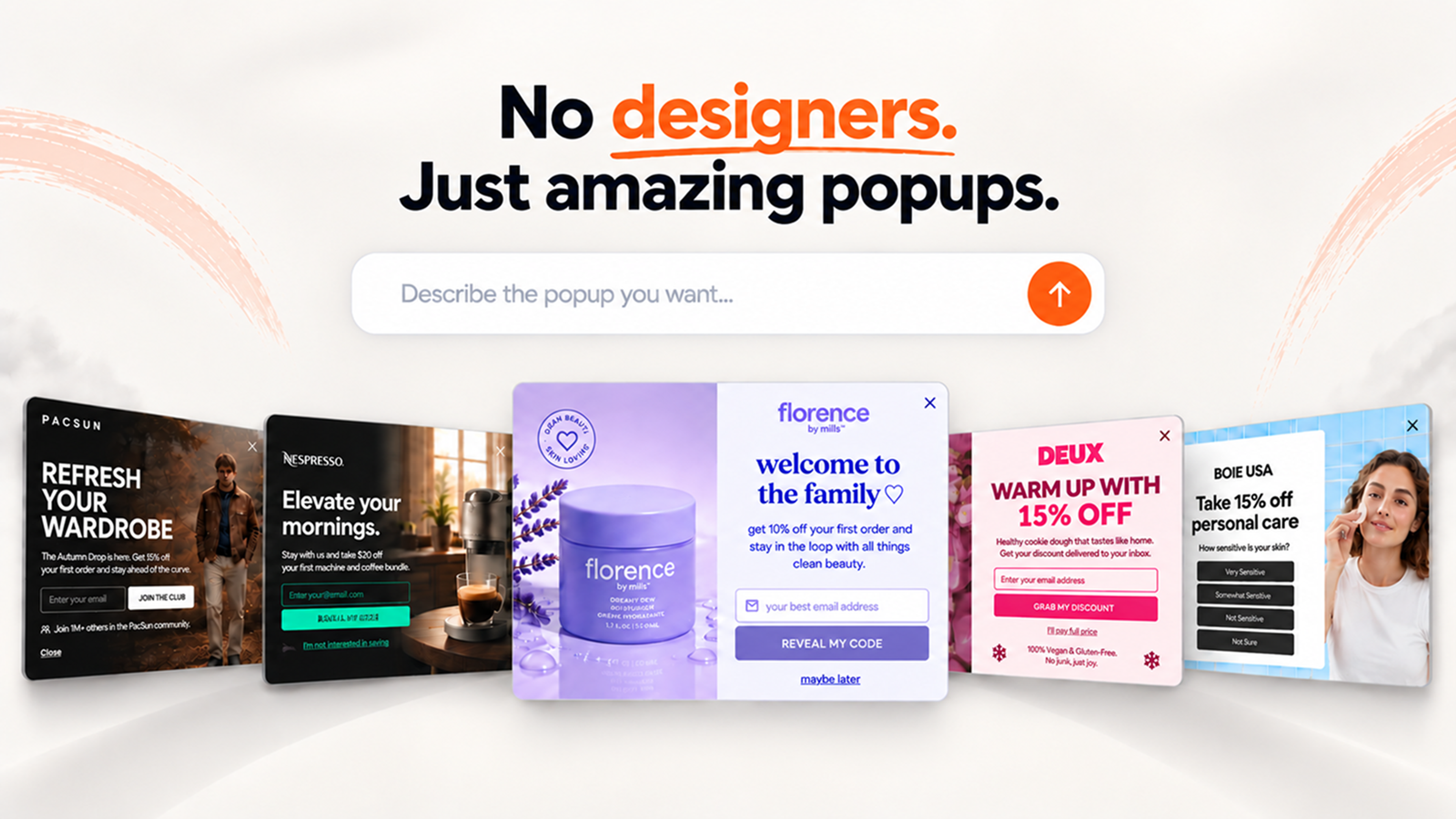
Best for: High-traffic stores with a CRO focus that want an AI agent to design and test their popups
Pricing: Free up to 10,000 pageviews/month. Paid plans from $19/month billed yearly, with higher pageview tiers on the Growth and Premium plans.
OptiMonk is one of the most established names among Shopify popup apps for high-traffic stores.
Its AI agent designs, writes and A/B tests each popup, and advanced targeting matches popup content to each visitor's traffic source, country, cart or the pages they view, so a Google Shopping visitor can see something completely different from someone who arrived via a blog post.
Critically for high-traffic stores, OptiMonk loads its script after LCP to protect Core Web Vitals scores.
Built-in A/B testing tracks statistical significance, and revenue attribution connects sign-ups and popup interaction directly to sales, not just opt-in rates.
Integrations: Klaviyo, Omnisend, HubSpot, Shopify Flow, Zapier, and more.
Main features at a glance:
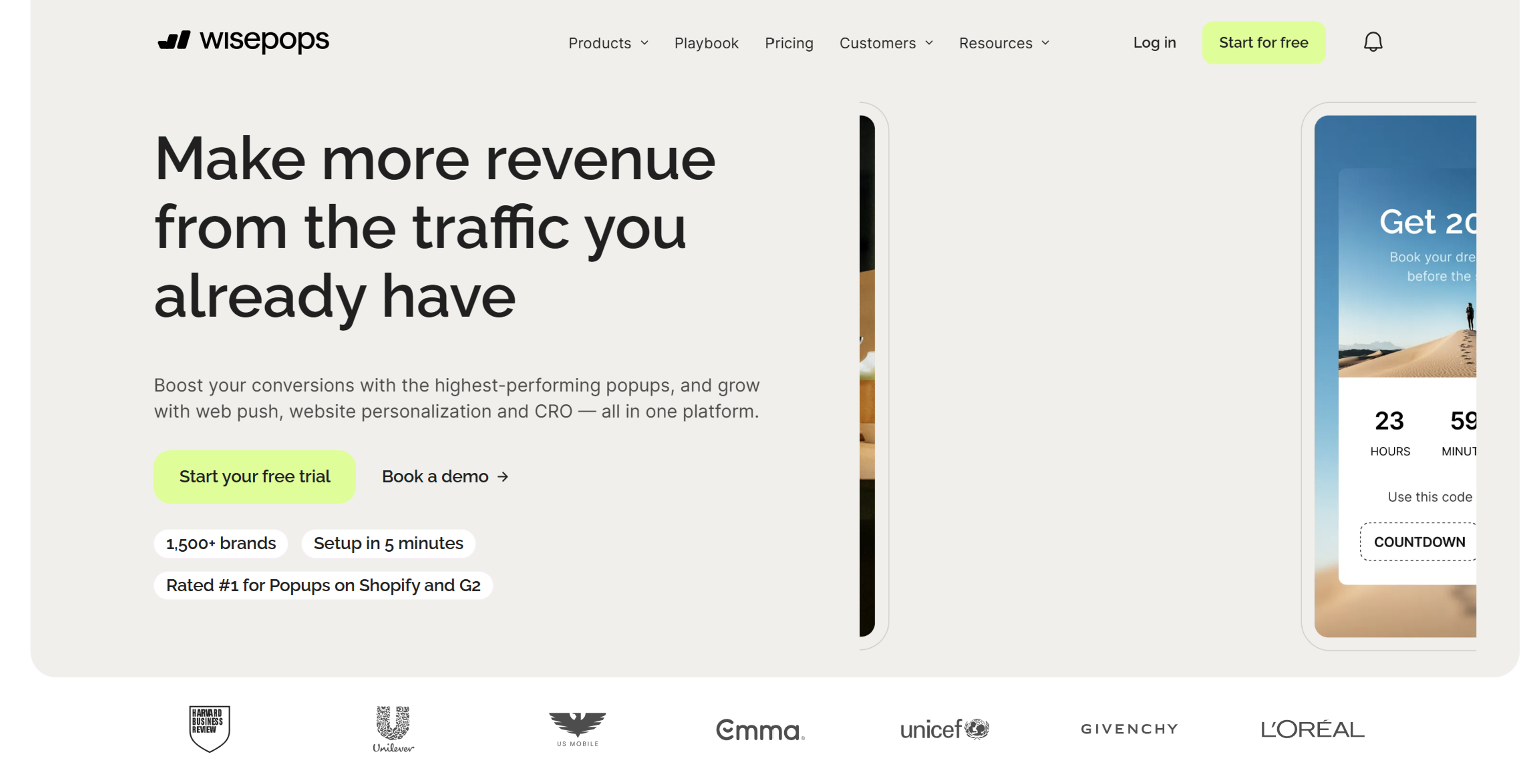
Best for: Large stores focusing primarily on popups, embedded content, and web push notifications
Pricing: From $49/month, pageview-based. Overage available on a pay-as-you-go basis. Campaigns pause by default when the limit is hit.
Wisepops is a premium customer engagement platform that goes beyond traditional popup apps to include embedded content blocks, full screen overlays, and web push notifications.
The challenge with Shopify popups for large stores is often coordination, as they need to engage visitors across multiple formats and surfaces. Wisepops handles all of them from a single interface.
The platform offers advanced targeting, and campaigns can be filtered by behavior, traffic source, device, UTM, and location. It also includes AI-powered product recommendations and cart abandonment recovery, so promotional messages adapt to what each visitor is most likely to buy.
For stores running coordinated email and sms acquisition, Wisepops handles both channels from the same campaign interface.
Integrations: Klaviyo, Shopify Flow, Segment, Google Analytics, Salesforce, Zapier, and more.
Main features at a glance:
Best for: Multi-channel subscriber growth and sophisticated audience segmentation
Pricing: From $39/month (visitor-based, scales by monthly unique visitors). Free plan available up to 2,000 visitors/month.
Justuno is one of the stronger email capture popup tools for stores that need precise targeting logic.
Campaigns are built around targeting rules based on behavioral data, geolocation, session activity, and funnel stage—and the platform's visual funnel view tracks every customer interaction to show exactly how visitors move through your conversion flow, making it easy to identify where a popup should appear and what it should say.
The user friendly interface and drag-and-drop popup builder make it accessible without dedicated development resources, while the Plus plan adds AI product recommendations that surface relevant products inside popup content—a meaningful step up from basic popups with static discount offers.
Among Shopify popup apps focused on segmentation depth, Justuno stands out for stores running targeted campaigns across multiple audience segments.
Integrations: Klaviyo, Attentive, SMSBump, Postscript, HubSpot, Google Analytics, Zapier, and more (100+ total).
Main features at a glance:
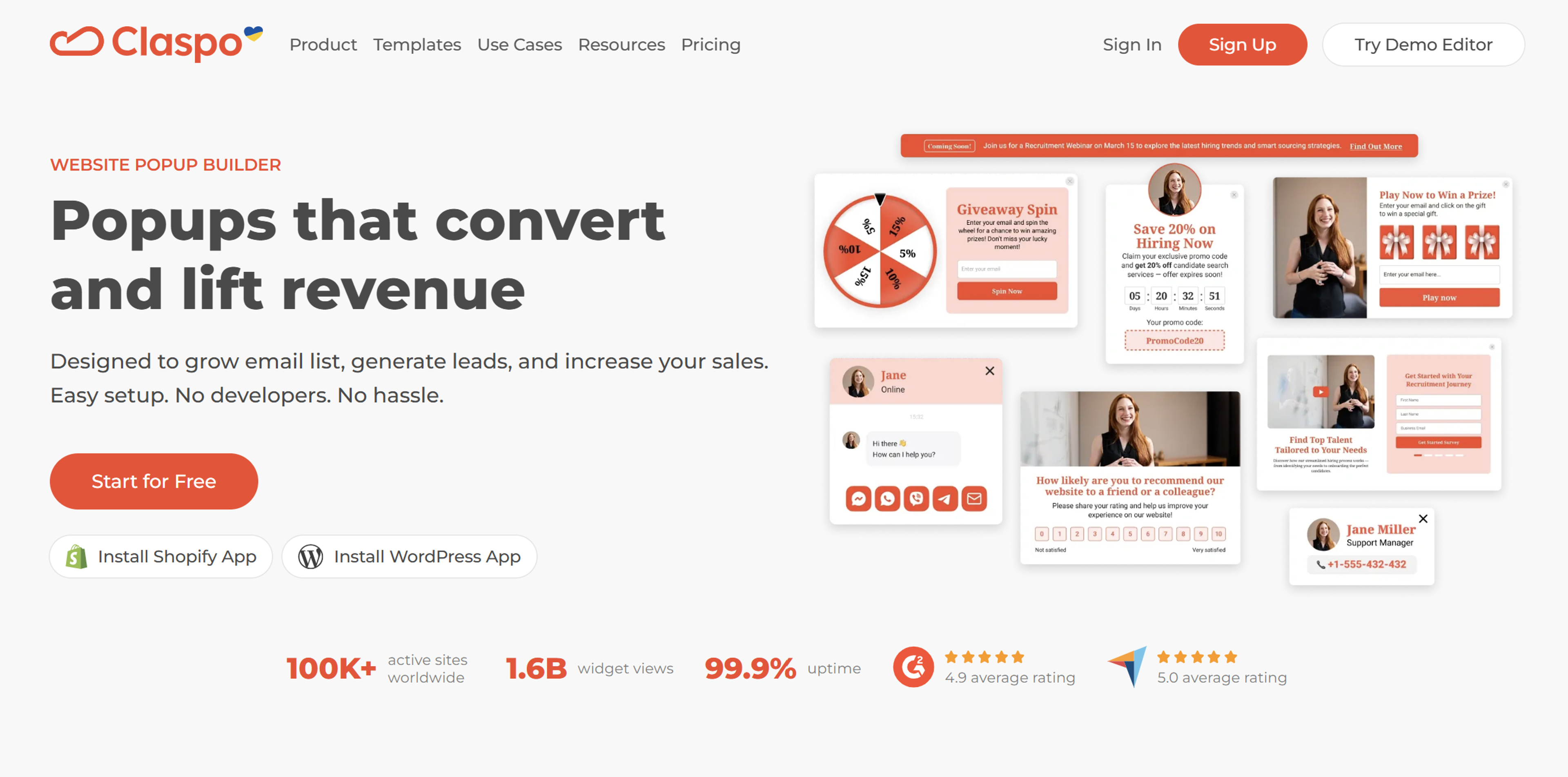
Best for: Fast-scaling mid- and high-traffic stores that need strong features without overpaying
Pricing: Free plan available with no time limit and full feature access up to 50,000 pageviews/month. Paid plans from $39/month.
Claspo stands out for two reasons:
A standout feature for international stores is automatic language translation—merchants selling across multiple markets can increase sign-ups in every locale without building separate campaigns for each language.
Rather than juggling multiple tools for different markets, Claspo handles it natively through its no-code popup builder, making it a practical choice for stores running opt-in popups across multiple regions.
Integrations: Klaviyo, ActiveCampaign, GetResponse, Omnisend, HubSpot, Zapier, and more.
Main features at a glance:
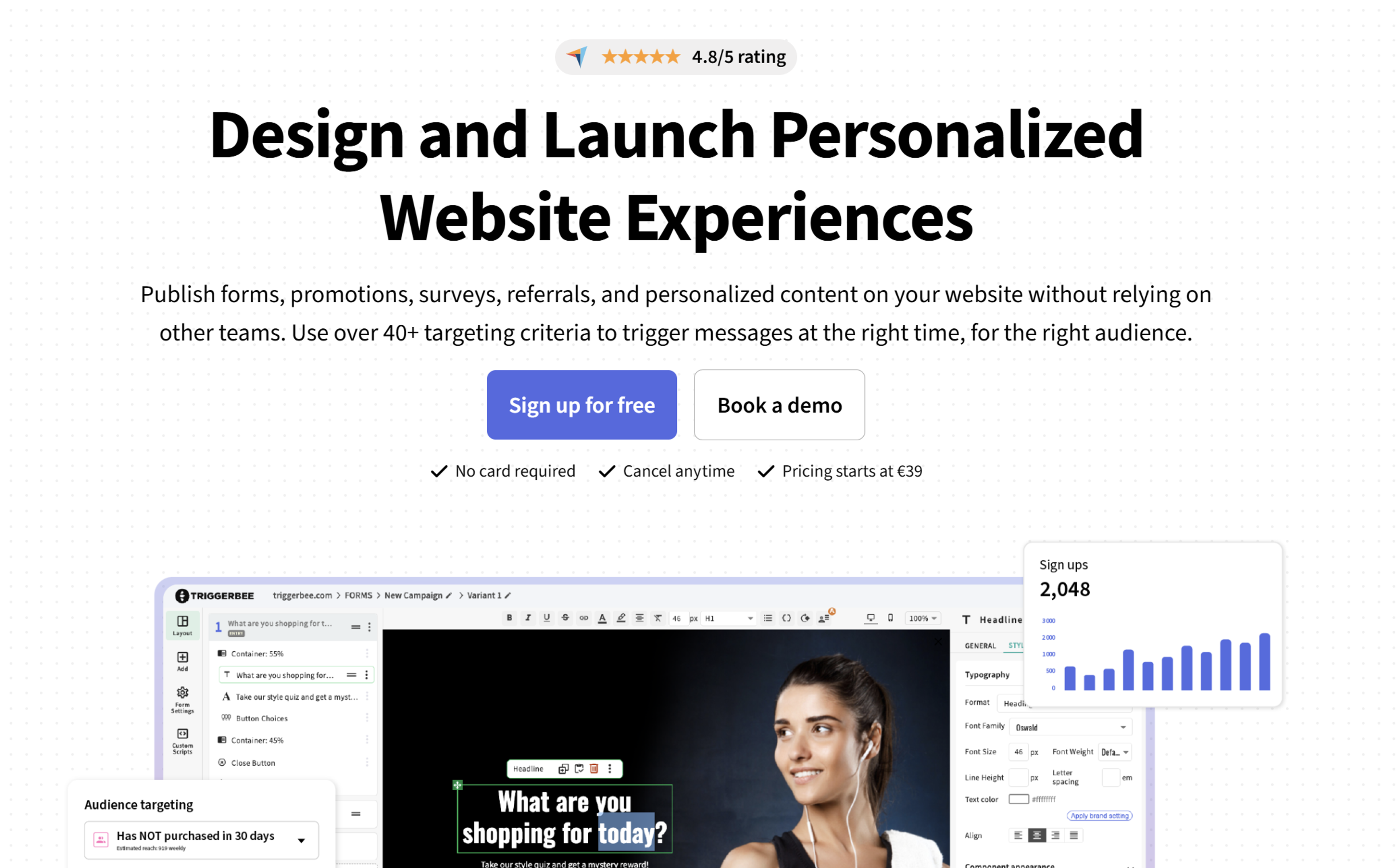
Best for: High-traffic stores that want real-time, CRM-driven personalization for their onsite campaigns
Pricing: €49/month (pageview-based, monthly billing). Essential plan covers up to 50,000 pageviews/month; Pro plan covers up to 250,000 pageviews.
Triggerbee doesn't get the same recognition as its US-based competitors in most Shopify popup app comparison roundups—largely because it comes from the Scandinavian market—but for high-traffic stores with a CRM-first operation, it deserves serious attention.
Rather than building targeting rules from session behavior alone, it syncs directly with your CRM to pull live customer data (segments, tags, purchase history, LTV tiers) meaning your popup strategy and email strategy can finally operate from the same data.
Its pricing model is equally distinctive. Among popup apps for stores with 100k+ visitors, Triggerbee stands out for its pageview-based pricing starting from €49/month — but unlike most competitors, the Success plan includes overage grace for unexpected traffic spikes, meaning you won't get hit with sudden cost jumps when a campaign overperforms. For high-traffic stores, that predictability is a significant advantage.
Integrations: Klaviyo, Rule (native Scandinavian ESP), ActiveCampaign, Salesforce, HubSpot, Zapier, and more.
Main features at a glance:
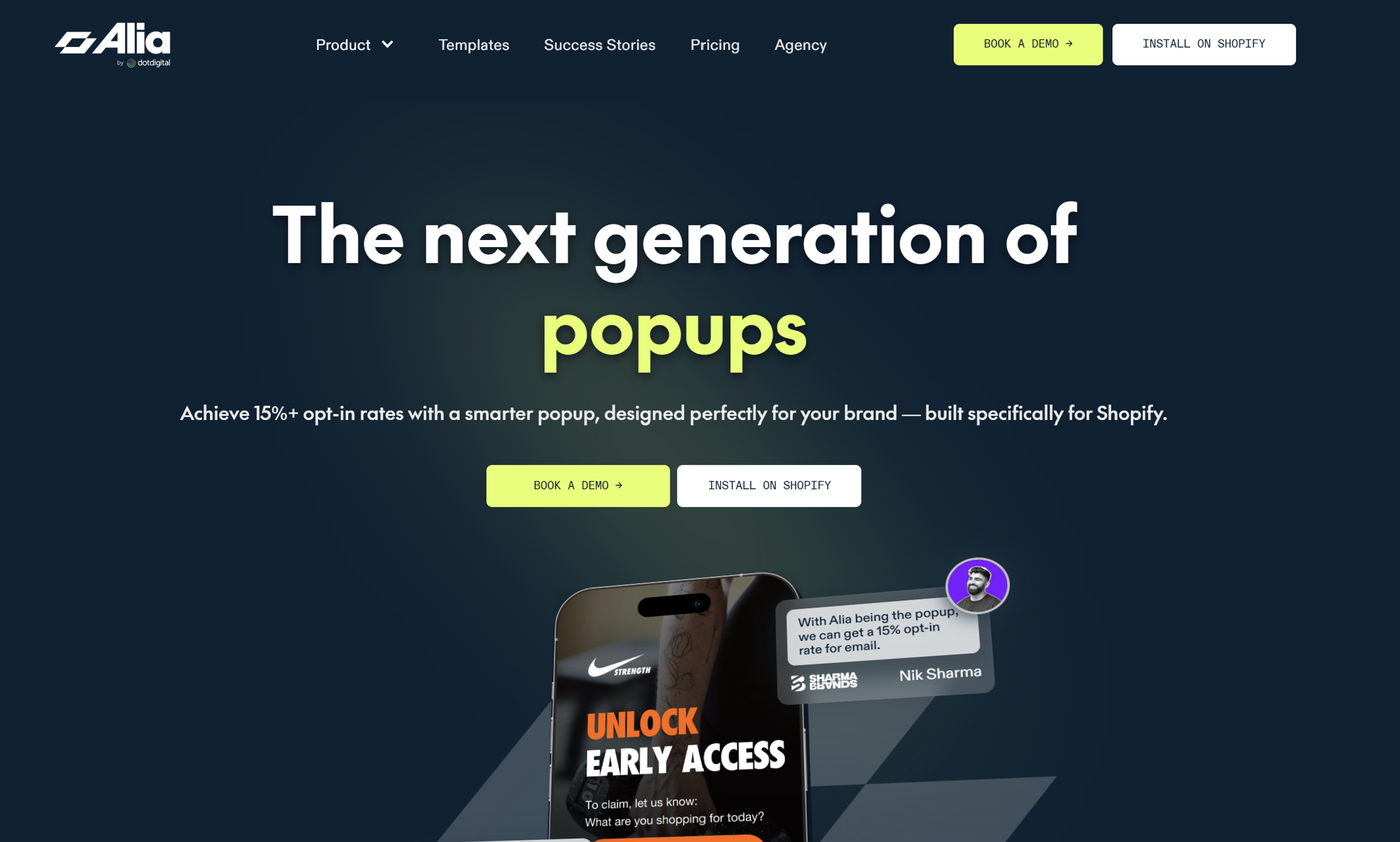
Best for: Shopify stores focused on maximizing email and SMS acquisition at scale
Pricing: From $100/month (visitor-based, scales by monthly traffic). 14-day free trial on Basic; 30-day trial on Fully Managed.
Alia is built exclusively for Shopify with a single goal: maximize lead capture and the number of visitors who hand over their email or phone number.
What sets it apart is how it approaches that goal. Rather than standard email popups or SMS popups with a discount offer, Alia creates interactive brand storytelling flows that introduce visitors to your products before asking for the opt-in. Visitors who arrive informed convert better than ones who've simply been offered 10% off.
Among Shopify popup apps focused on acquisition, the results Alia reports are hard to ignore. Multiple case studies report opt-in rates above 15% (strong numbers for any email capture popup) and Four Sigmatic reported 454% more email and sms sign-ups after switching.
The platform's AI continuously runs A/B tests, generating variants, selecting winners, and restarting automatically, so high-traffic stores benefit from a compounding optimization loop with zero manual input.
Integrations: Klaviyo, Attentive, Postscript, SMSBump, Yotpo, Omnisend, and more (notably SMS-heavy compared to other tools in this list).
Main features at a glance:
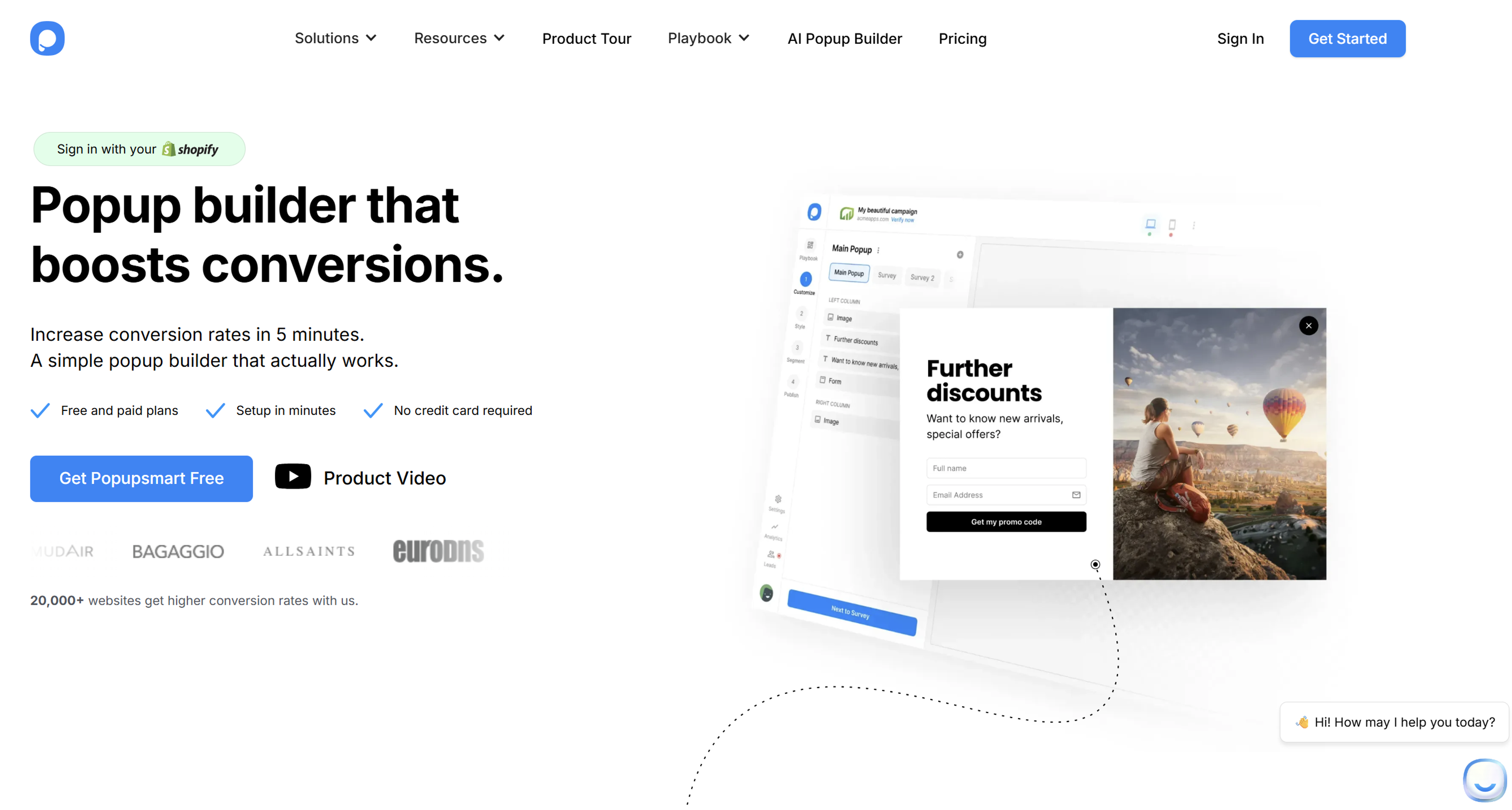
Best for: Stores that prioritize minimal setup, clean UX, and fast page loading at scale
Pricing: From $39/month, pageview-based. Auto-extend available: $10 per additional 10K pageviews, capped at $99 up to 250K extra pageviews, then $99 per additional 250K beyond that.
Popupsmart is a lightweight Shopify app whose core advantage is performance: its script footprint is among the smallest in the category, specifically optimized to load without impacting page speed.
For high-traffic stores actively managing Core Web Vitals, especially those running paid search where landing page experience affects Quality Scores, this makes it a practical, low-risk choice.
The AI layer focuses on content generation: GPT-assisted text and image suggestions (HPT) help teams build campaigns faster without dedicated copywriting resources. The no-code popup builder is fast, most campaigns go live within minutes.
If you've been working through the best Shopify popup tools in 2026 and simplicity is your priority, Popupsmart is the answer. It delivers clean performance without the configuration complexity of the deeper personalization platforms.
Integrations: Klaviyo, ConvertKit, ActiveCampaign, HubSpot, Google Analytics, Zapier, and more.
Main features at a glance:
The Shopify popup apps in this guide all handle scale—but they make very different trade-offs on pricing, targeting depth, and site speed. Here's how they stack up side by side.
| Tool | Best for | From | Pricing basis | When you hit the limit | AI scope |
|---|---|---|---|---|---|
| OptiMonk | CRO with popups designed by an AI agent | $19/mo | Pageviews | Campaigns pause—upgrade or wait for reset. Pay-as-you-go available on larger plans on request. | AI agent that designs, writes and A/B tests popups |
| Wisepops | Multi-channel engagement | $49/mo | Pageviews | Pauses by default; pay-as-you-go overage available (not via Shopify billing) | Popups + AI product recommendations + AI cart recovery |
| Justuno | Complex segmentation | $39/mo | Visitors (monthly unique) | Auto-extend on = charged for extra visitors. Auto-extend off = campaigns stop for the rest of the month. | Popups + AI product recommendations (Plus plan) |
| Claspo | Best value at scale | $39/mo (free up to 50K pageviews) | Pageviews | Upgrade to next 50K pageview tier required; free plan gets a 14-day Pro trial before committing | AI translation, smart sequencing |
| Triggerbee | CRM-driven personalization | €49/mo | Pageviews | Pro plan: some slack given, then campaigns pause until next month. Success plan: automatic upgrade after 3 months. | Popups + onsite personalization driven by live CRM data |
| Alia | Maximum opt-in rates | $100/mo | Visitors | Plan upgrade required | AI A/B testing + smart triggering |
| Popupsmart | Speed + fast deployment | $39/mo | Pageviews | Auto-extend on = $10/10K extra PVs (capped at $99 up to 250K). Auto-extend off = campaigns pause. | GPT-assisted content generation |
Every popup adds a JavaScript snippet to your website. At low visitor numbers, that addition is barely measurable.
When you have tens of thousands of sessions per month, it compounds, and the effects are very real:
This is the real reason the search for a Shopify popup app that doesn't slow down your site matters more at scale.
A tool that costs $49/month but quietly adds 0.3 seconds to your LCP can cost you far more than that in lost organic traffic and paid search efficiency. Before installing any Shopify popup app, here's exactly what to check.
The FAQ section at the bottom of this article explains each of these in more detail if you want to go deeper.
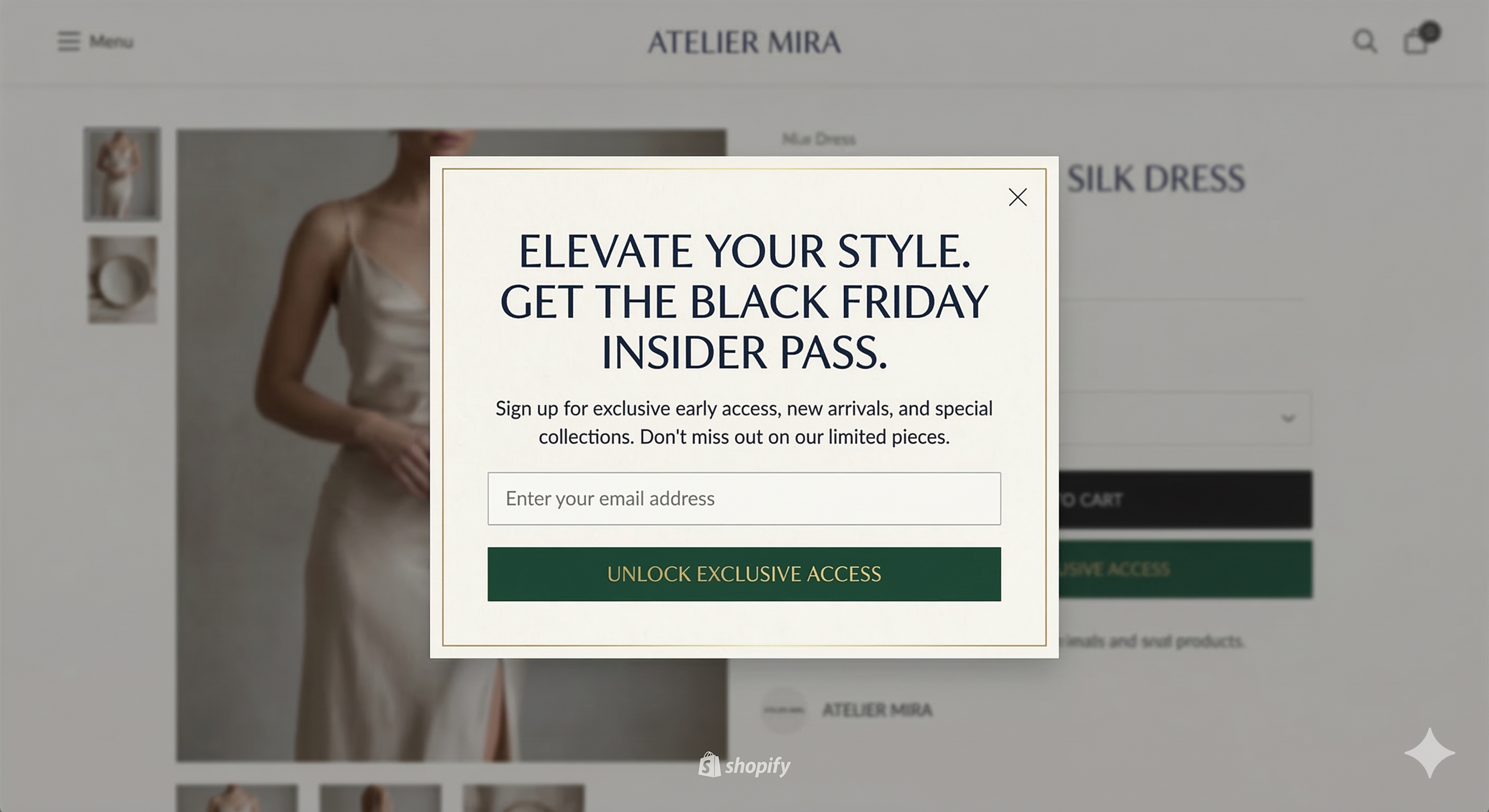
Black Friday and Cyber Monday (BFCM) are the highest-stakes days of the year for ecommerce stores. They’re also the days when a poorly configured popup app is most likely to cause serious damage. The sudden traffic spike stresses servers, plan limits, and integrations with downstream platforms like Klaviyo or your SMS provider, and not all Shopify popup apps handle that pressure equally well.
Earning the title of best popup tool for high-traffic Shopify stores means performing on your busiest day, not just your average one. A tool that holds up fine at normal volume can behave very differently when traffic multiplies by 5 or 10 overnight. Here's what to test and prepare 2–3 weeks before any major sales event:
OptiMonk, Wisepops, and Claspo all have documented track records for successfully handling BFCM-scale traffic events and have published case studies from merchants who ran campaigns through major ecommerce peaks. If stability during flash sales is a top priority, these are the three platforms with the most publicly verifiable evidence of performing at that scale.
The best Shopify popup apps for high-traffic stores all make different trade-offs: the right one depends on your traffic level, your team's capacity, your tech stack, and your conversion goals.
Whichever option you choose, remember that a popup app is only as effective as the strategy behind it. The infrastructure is the easy part; the offer, the timing, the segmentation logic and the follow-up sequence are what actually drive revenue. If you want to see what an AI agent can do for your popups, you can start with OptiMonk for free.
Asynchronous (async) loading means a script runs in the background, independently of the main page content. When a popup script loads asynchronously, it doesn't block your page from rendering—your product images, text, and other content load at their normal speed, and the popup script loads separately, in parallel. Non-async scripts, by contrast, pause the browser's rendering process while they load, which directly delays everything visible on the page.
A CDN (Content Delivery Network) is a network of servers distributed across multiple geographic locations. When a popup tool uses CDN delivery, the images, fonts, and other assets used in popups are served from whichever server is closest to the visitor, reducing load times for users in different countries. Without CDN delivery, all assets come from a single server location, which can add noticeable latency for international visitors.
Go to pagespeed.web.dev and enter your store URL. Google will return a score and a breakdown of specific metrics. The ones to focus on for popup impact are:
Run the test once before installing your popup tool, and again after—the before/after comparison tells you exactly what impact the tool is having.
When it comes to popup apps for stores with 100k+ visitors, OptiMonk and Wisepops are the most battle-tested options with documented performance at this scale. If your priority is CRM-synced personalization, Triggerbee is worth evaluating seriously. If maximizing email acquisition is the primary goal, Alia's AI-driven opt-in optimization is hard to beat at that traffic volume.
It depends entirely on the Shopify app and how it's configured. A popup app that loads asynchronously, after LCP, and delivers assets via CDN will have minimal measurable impact on page speed. A tool with a render-blocking script, large asset files, and no CDN delivery can add several hundred milliseconds to your load time, which matters for both SEO rankings and paid search Quality Scores. Always test with PageSpeed Insights before and after installation.
The depth of targeting rules and advanced targeting varies significantly across Shopify popup apps. Entry-level tools typically offer basic conditions like exit intent, time-on-page, and device type. The tools in this guide go considerably deeper—Triggerbee and Justuno both support 20–40+ targeting conditions, including CRM-synced segments, real-time cart abandonment data, UTM parameters, and weather. For high-traffic stores where segmentation drives revenue, this difference is meaningful.


Discover creative Thanksgiving marketing ideas to engage customers, build buzz, and drive sales before Black Friday and Cyber Monday.
Learn 5 ways ecommerce brands can turn new subscribers into recurring revenue using welcome flows, personalization, loyalty programs, re-engagement, and referrals.

In this article, we’ve compiled a list of the 25 top ecommerce apps that will help you streamline your operations, boost sales, and grow your online business.