


14 Effective Thanksgiving Marketing Ideas to Boost Your Sales in 2026
Discover creative Thanksgiving marketing ideas to engage customers, build buzz, and drive sales before Black Friday and Cyber Monday.
12 AI tools for online stores, grouped by the job they do, with prices checked on each vendor's site in October 2026.
In short
AI tools for ecommerce each handle one task: converting visitors, winning back shoppers, answering questions, writing content or guarding margins. Choose the task that costs your store the most sales first, start on free plans, and pay for a tool only when it earns its price.
Most stores don't need more AI tools. They need one in the spot where sales slip away: the visitor who leaves without buying, the cart nobody comes back to, the question nobody answers at midnight.
The best AI tools for ecommerce in 2026 are the ones that fix one of these leaks. Below are 12 we'd shortlist, grouped by the job they do, with prices checked on each vendor's own site in October 2026.
We're OptiMonk, so we list ourselves first. Every price below is from the vendor's own page.
| Tool | Job | Free plan | Entry paid plan | Best for |
|---|---|---|---|---|
| OptiMonk | Convert: popups, list building | Yes (10,000 pageviews/mo) | Essential: $19/mo billed yearly ($29 monthly) | Stores that want popups designed and tested by an AI agent |
| Rebuy | Convert: upsells, cart, recommendations | No (14-day trial) | From $25/mo per package (500 orders/mo) | Shopify stores raising average order value |
| Algolia | Convert: site search | Yes (10K searches/mo) | Grow: $0.50 per 1K searches over the free 10K | Stores with large or technical catalogs |
| Klaviyo | Bring back: email and SMS flows | Yes (250 active profiles, 500 emails/mo) | $20/mo for 500 active profiles | Stores building flows on purchase data |
| Omnisend | Bring back: email, SMS, push | Yes (250 contacts, 500 emails/mo) | Standard: $16/mo for 500 contacts | Smaller stores that want email and SMS on a budget |
| Tidio (Lyro) | Answer: AI support agent | Yes (50 conversations/mo) | Starter: $29/mo ($24.17 billed yearly) | Small teams with repeat support questions |
| Yotpo | Reassure: reviews, loyalty | Yes (Reviews up to 50 orders/mo; Loyalty free plan) | Reviews Starter: $89/mo (up to 500 orders/mo) | Stores with steady order volume |
| Jasper | Save time: on-brand copy | No (7-day trial) | Pro: $59/mo billed yearly ($69 monthly) | Teams writing a lot of product and campaign copy |
| ChatGPT or Claude | Save time: general assistant that runs other tools | Yes | Claude Pro: $17/mo billed yearly ($20 monthly); ChatGPT Plus: $20/mo | Everyday writing and analysis, plus running connected tools from one chat |
| Shopify Sidekick | Save time: AI assistant in Shopify admin | Included with your Shopify plan | — | Every Shopify store, before paying for anything else |
| Conjura | Protect margin: profit analytics | No | Essentials: $299/mo (up to $2M yearly GMV) | Brands checking profit per product |
| Prisync | Protect margin: competitor prices | No (14-day trial) | Professional: $99/mo (100 products) | Stores selling products other retailers also sell |
Tools bill by pageviews, orders, searches, profiles, contacts, conversations or products, so compare the cost at your own volume.
Online stores use AI for four jobs: converting visitors, recovering shoppers who leave, answering questions, and cutting the time spent on copy and reports. Ecommerce AI works best when it's tied to one of these jobs, not added because a tool has an AI badge.
Converting visitors. AI picks which products, search results or offers a shopper sees, based on what they browse and what's in their cart. This is where a store's conversion rate moves, which is why most of our list sits here. For the bigger picture, read about the impact of AI on CRO.
Bringing shoppers back and answering them. Email tools time messages to each shopper's behavior, and AI support agents answer order questions at any hour. Saving time and margin. Writing assistants draft copy, and analytics tools answer "which products make money?"
The bigger shift in 2026 is who does the work. Some tools give you a draft. Others do the job and report back: an agent that designs and publishes a popup, or a support agent that closes a ticket on its own.
Many tools also connect to ChatGPT, Claude or Cursor through MCP (Model Context Protocol), so you can run them from the assistant you already use. We note which ones do.
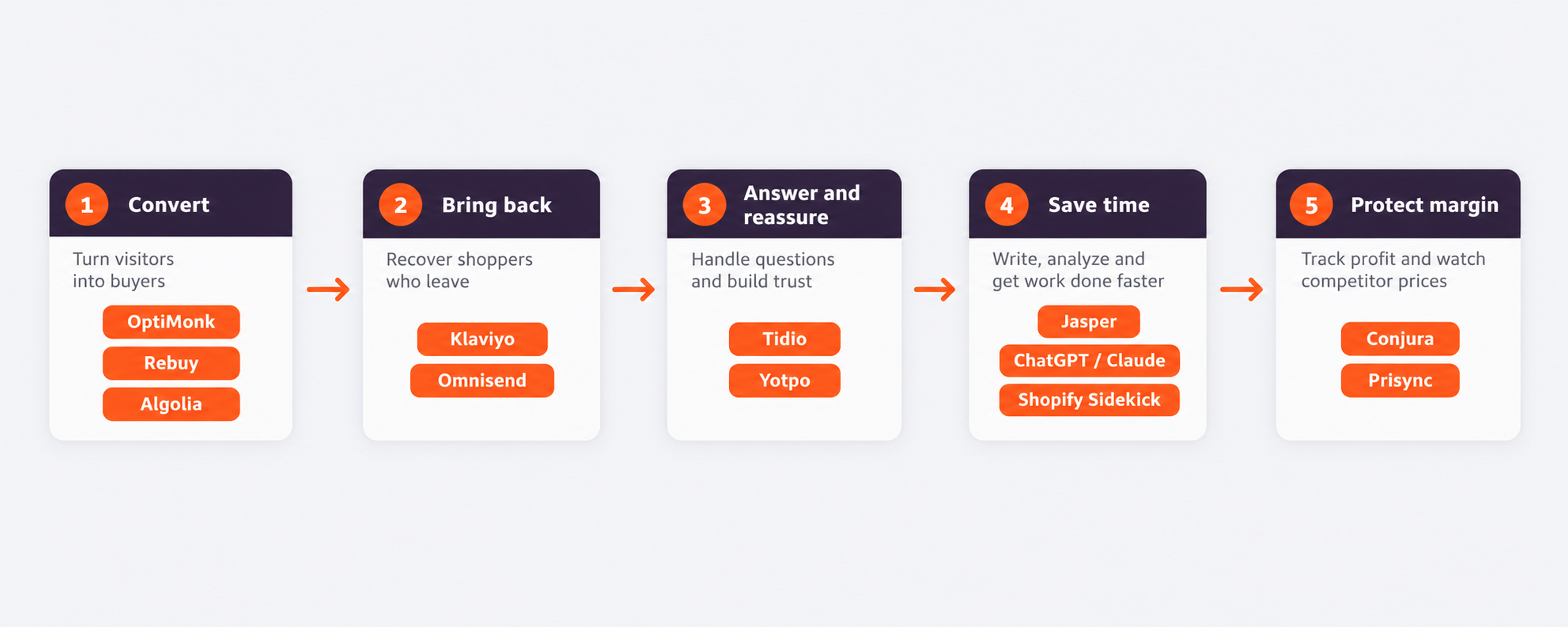
We picked tools an online store can set up and run on its own, and compared them on four things:
Check what your platform already includes before you pay for a tool. On Shopify, Sidekick comes with your plan.
We left out SEO writing, AI photo and video, fraud and inventory tools: they sit outside the five jobs below. For the non-AI basics, see the best ecommerce apps.
These three tools act on the visit itself, while the shopper is still on your store.
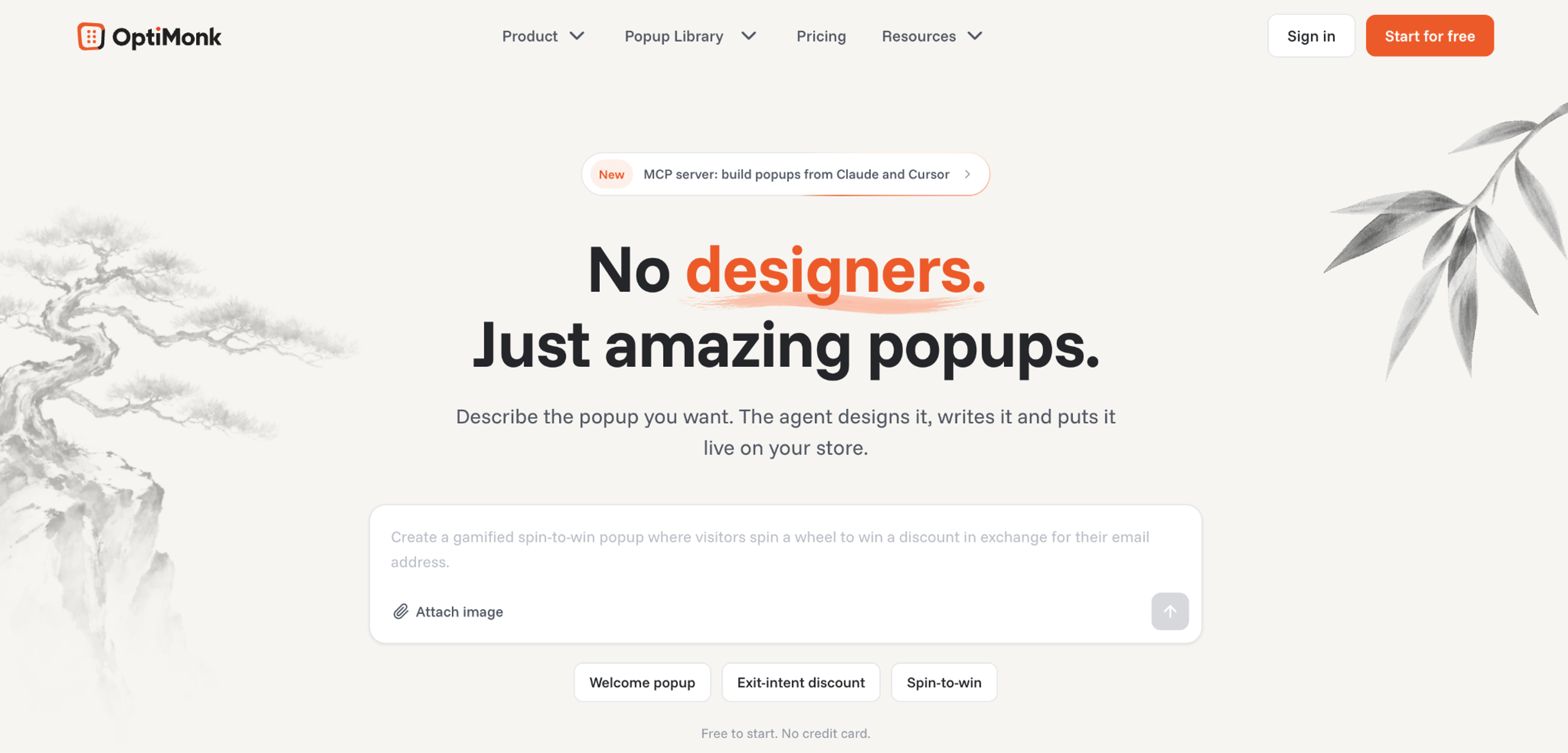
Best for: stores that want targeted popups without a designer, with A/B tests built in.
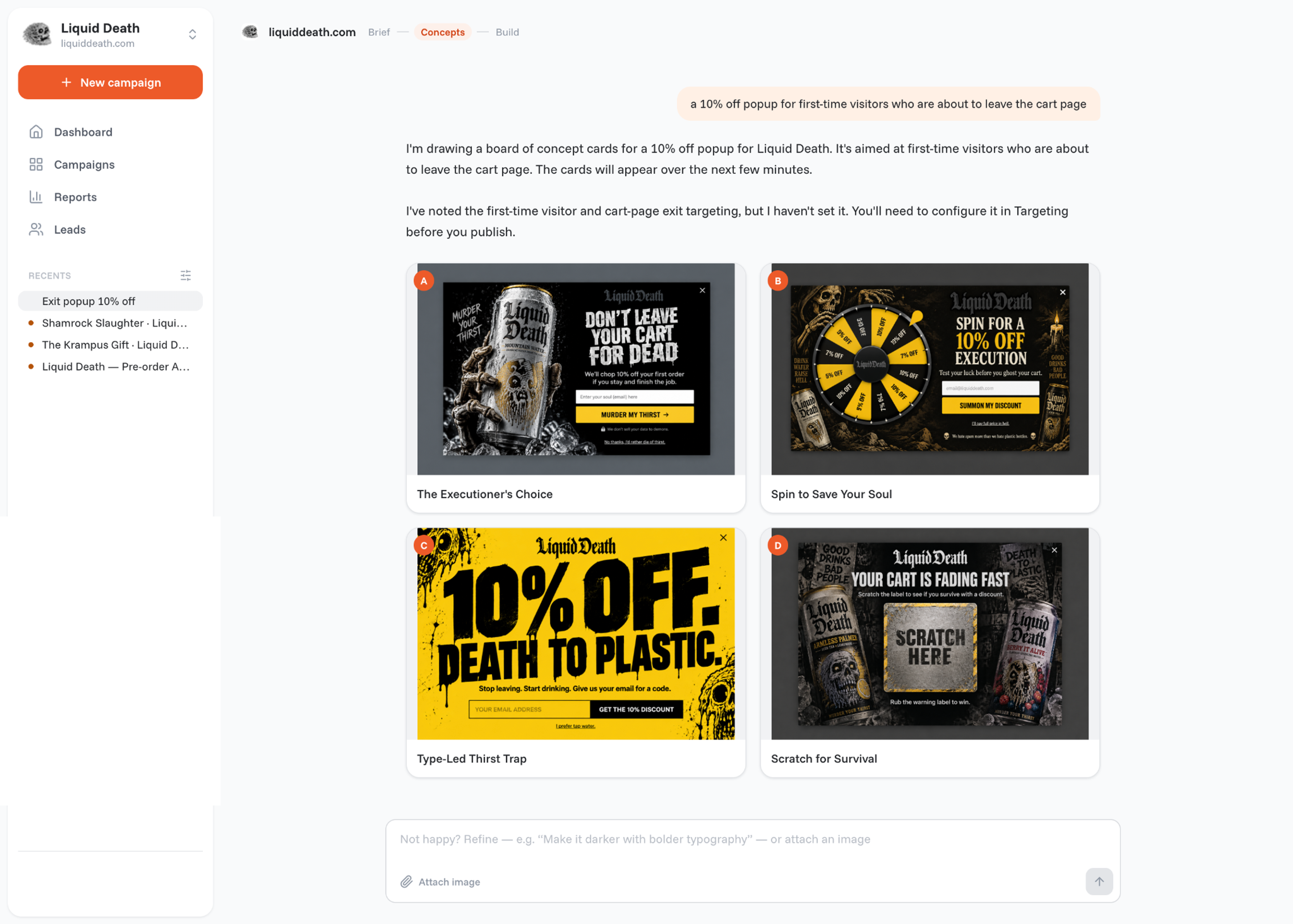
OptiMonk is an agentic popup builder for online stores. Describe the popup you want in one sentence, for example "10% off for first-time visitors who are about to leave the cart page". The agent draws four concepts in your brand's colors, fonts and logo, and builds a separate mobile version for each popup.
Pick one concept, or pick two and OptiMonk builds both and runs them as an A/B test. Then set the targeting (exit intent, cart value, cart contents, returning visitors and more) and put it live. To change something, ask the agent ("make the headline shorter"), or fine-tune it by hand in the visual editor.
It doesn't stop at publish. Ask the agent for an A/B test idea and it suggests variants with a preview of each. You can add a holdout test, a "Control (no popup)" group, to measure each popup against showing nothing, and revenue analytics show what each campaign and variant earned.
You can also build popups from Claude, ChatGPT or Cursor through the OptiMonk MCP server. See AI assistants.
Formats: card popups, fullscreen, lucky wheel and scratch card.
Pros
Cons
Pricing (OptiMonk's pricing page, Oct 2026): Free plan (10,000 pageviews/month). Paid plans from $19/month billed yearly ($29 monthly). See pricing.
Pro tip: start with one popup for first-time visitors, such as a welcome discount on exit intent. Once it has data, ask the agent for an A/B test idea and let the results decide what you build next.

A fullscreen popup designed for Liquid Death, for shoppers about to leave: the 10% offer is the whole design, in the brand's own loud voice. See this popup
More options: our list of AI popup tools, or browse the popup library for ideas.
Best for: Shopify stores that want to raise average order value with upsells and a smarter cart.
Rebuy adds AI product recommendations, upsells and cross-sells across a Shopify store: in a slide-out cart, at checkout and after purchase. It's sold in four packages: Cart & Merchandising, Checkout & Post-Purchase, Search & Collections, and Flows & A/B Testing.
Pros
Cons
Pricing (Rebuy's pricing page, Oct 2026): packages are priced by your store's monthly Shopify orders: one package starts at $25/mo at 500 orders and $141/mo at 3,000 orders, and at 10,000 orders you talk to sales. Bundles save 10% for two packages, 20% for three and 30% for all four; yearly billing saves another 10%. Rebuy Monetize, which shows other brands' offers on your thank-you page, is free. Packages come with a 14-day free trial.
Pro tip: start with one package, usually the cart, and measure the change in average order value before you add more.
For how recommendations work on and off site, see product recommendations and these website personalization examples.
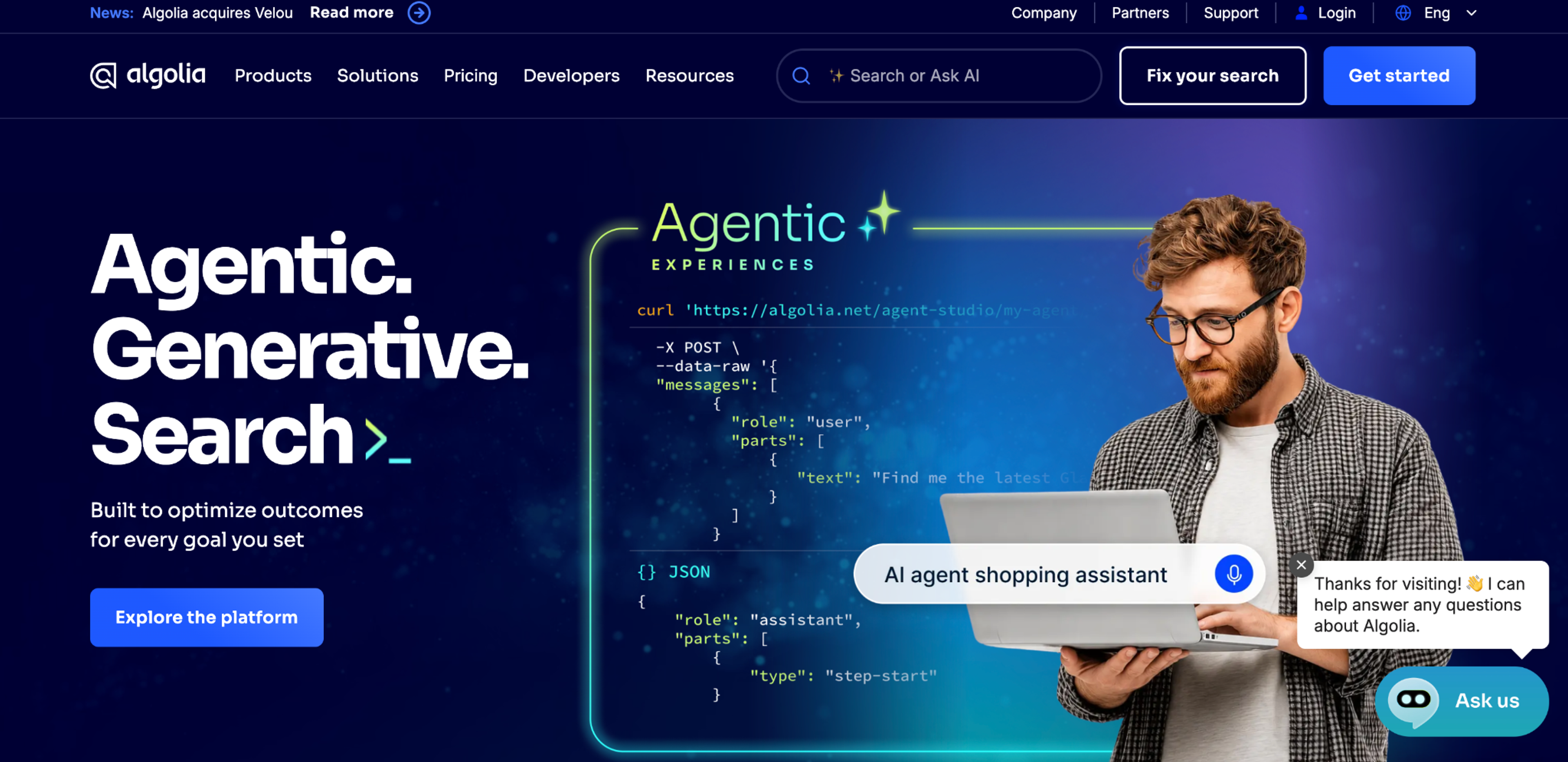
Best for: stores with large or technical catalogs, where shoppers struggle to find the right product with filters.
Algolia is a search engine you add to your store. Its AI features rank results by what converts and handle vague or misspelled queries.
Algolia also offers an MCP server (in beta). It lets AI assistants search your catalog, so your products can be found outside your own site.
Pros
Cons
Pricing (Algolia's pricing page, Oct 2026): Free: 10K search requests and 50K records a month. Grow: 10K searches included, then $0.50 per 1K. Grow Plus: 10K included, then $1.75 per 1K, adding AI Ranking, AI Synonyms and advanced personalization. Elevate: custom annual plan with NeuralSearch.
Pro tip: clean up product titles and attributes before you switch on AI ranking. Better product data gives better results on your site and in AI assistants.
For more ways to improve product pages with AI, see our list of AI tools for product page optimization.
Most visitors leave without buying. The popup grows the list; the email tool works it.
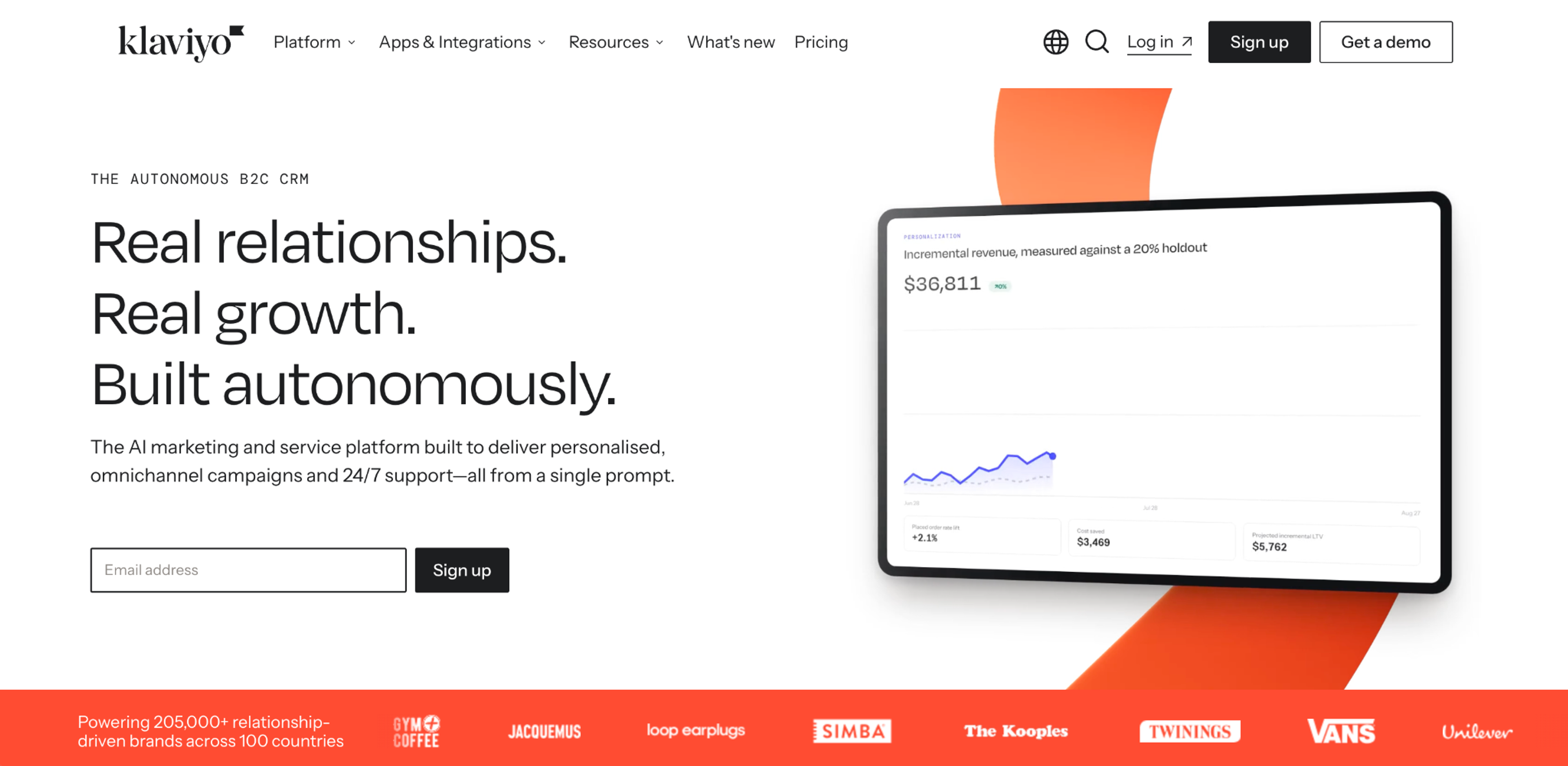
Best for: stores that want email and SMS flows built on purchase and browsing data.
Klaviyo is an email and SMS platform built for ecommerce. Its flows (abandoned cart, browse abandonment, welcome, win-back) run on store data, and its AI agents include Composer for building campaigns and Customer Agent for answering shoppers.
Klaviyo has an MCP server too. Connect it to Claude or Cursor and ask for a campaign performance report or a new campaign draft from the chat.
Already on Klaviyo? OptiMonk can show or hide popups by Klaviyo lists and segments, so subscribers don't see a signup popup again.
Pros
Cons
Pricing (Klaviyo's pricing page, Oct 2026): Free for up to 250 active profiles and 500 email sends a month, with $5 of mobile messages a month. Paid plans start at $20/mo for up to 500 active profiles and grow with your list: $150/mo at 10,000 and $720/mo at 50,000 active profiles.
Pro tip: suppress profiles that haven't opened or clicked in months. Klaviyo bills by active profiles, so a cleaner list costs less.
To see why shoppers leave in the first place, read why shoppers abandon their carts.
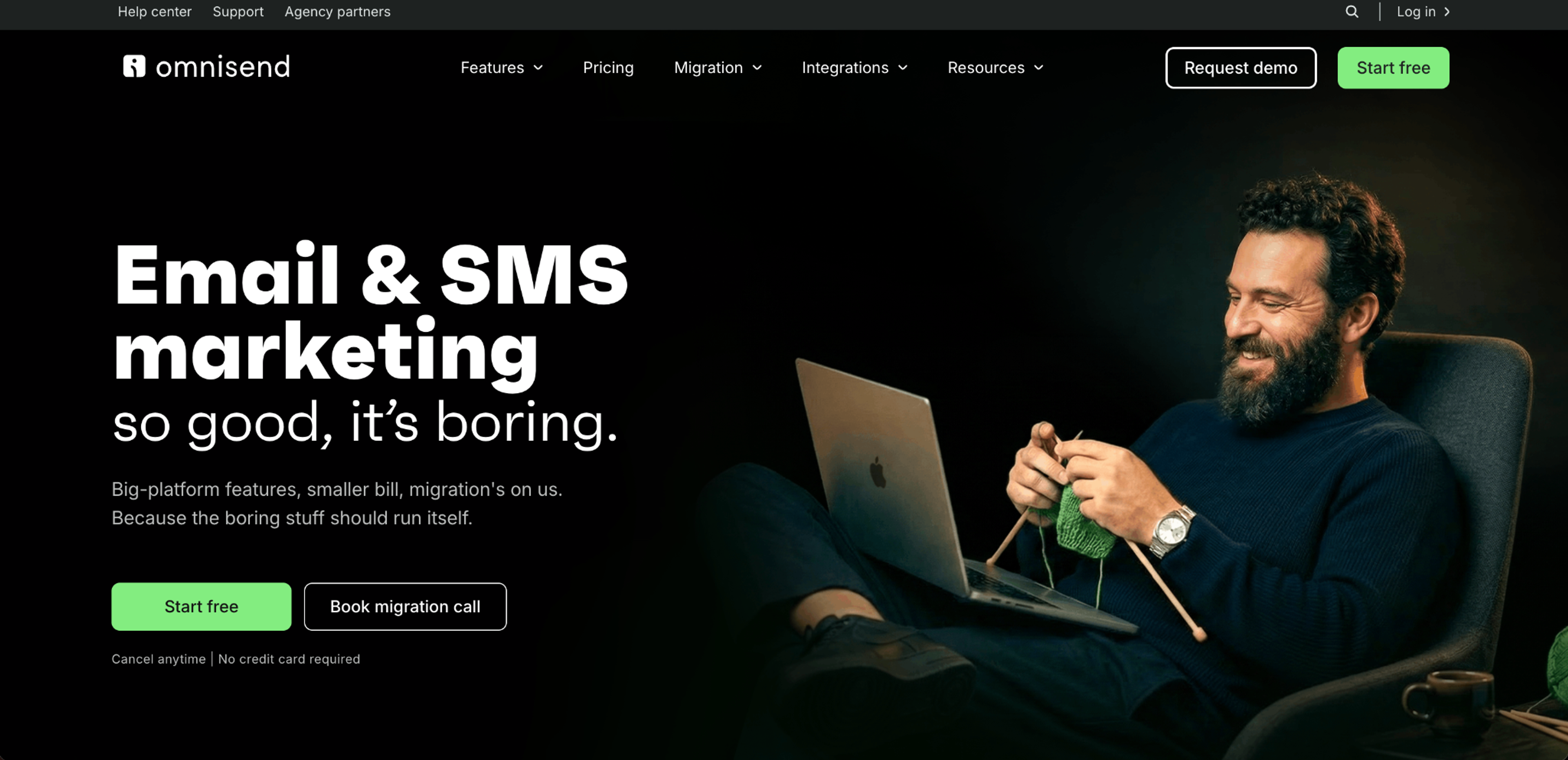
Best for: smaller stores that want email, SMS and push notifications without a big monthly bill.
Omnisend covers email, SMS and web push in one platform, with ready-made ecommerce automations. Its AI tools include Forms AI and Reports AI on every plan, plus a product recommender and personalized send time on Pro.
Omnisend lists an MCP connection on its pricing page, so you can check performance, create campaigns and manage segments from your AI tool.
Pros
Cons
Pricing (Omnisend's pricing page, Oct 2026): Free: 250 contacts, 500 emails and 500 web push notifications a month. Standard: from $16/mo (up to 500 contacts and 6,000 emails a month). Pro: from $59/mo, with unlimited emails. Prices grow with your list: at 3,501–4,000 contacts, Standard is $63/mo and Pro $80/mo; at 50,001–55,000 contacts, $450/mo and $784/mo. Paying three months upfront saves 30%.
Pro tip: set up the abandoned cart automation first, then add SMS once you know your email baseline. For context on SMS, see these SMS marketing statistics.
A shopper with an open question, or no proof that others liked the product, often leaves.
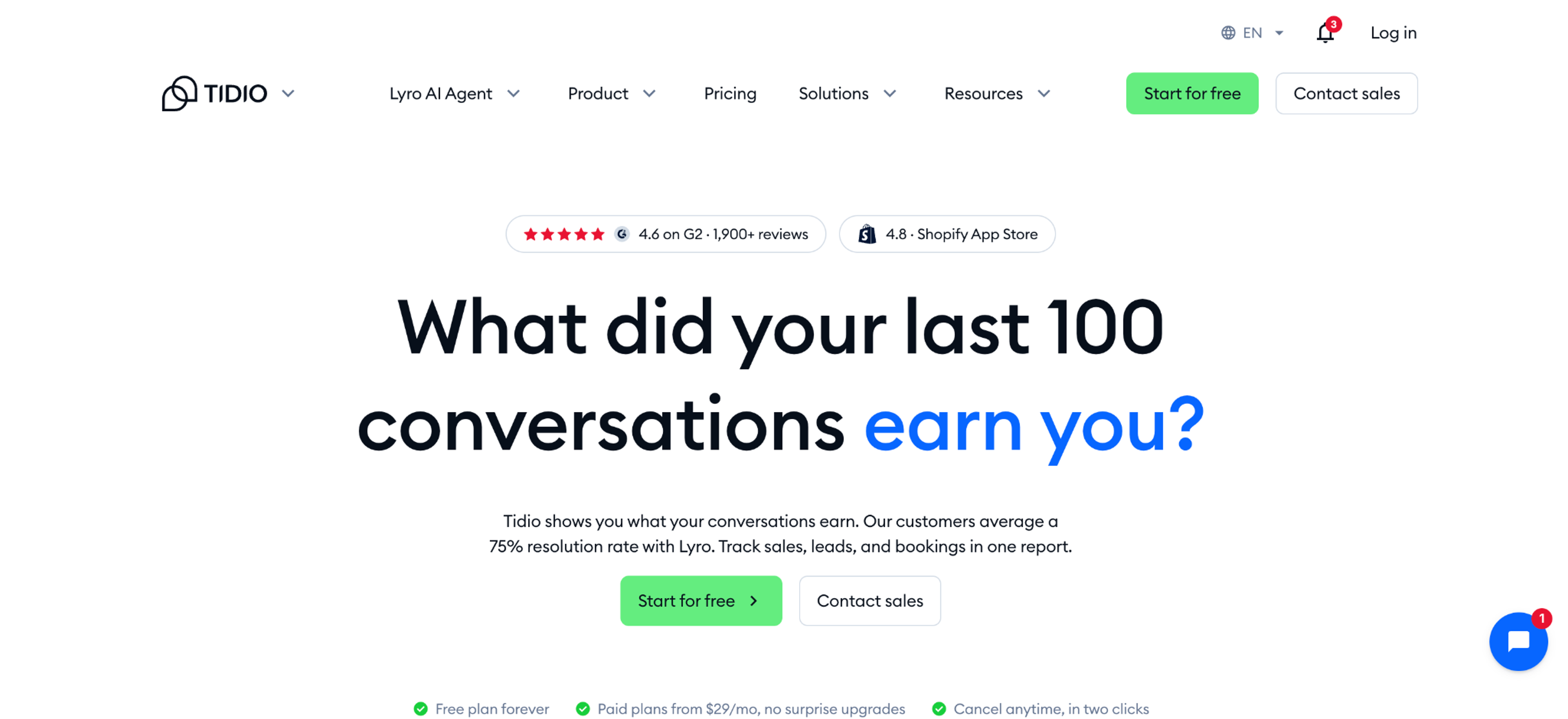
Best for: small and mid-sized stores with many repeat questions about orders, shipping and returns.
Tidio is a customer support platform with Lyro, an AI agent that answers questions from your FAQ and store content and hands off to a person when needed. Tidio says its customers average a 75% resolution rate with Lyro.
Pros
Cons
Pricing (Tidio's pricing page, Oct 2026): Free: $0 with 50 billable conversations a month and your first 50 Lyro conversations (one-off). Starter: $29/mo for 100 conversations ($24.17/mo billed yearly, two months free). Growth: $59/mo for 250 conversations ($49.17/mo billed yearly). Lyro AI Agent: from $39/mo for 50 Lyro conversations ($32.50/mo billed yearly), $75/mo for 100. Flows, its proactive chat automation, is priced on top, from $29/mo for 2,000 visitors reached. Paid plans have a 7-day free trial.
Pro tip: upload your most common questions before launch, then read Lyro's first conversations and fill the gaps in its answers.
For more options, see the best AI chatbots for Shopify.
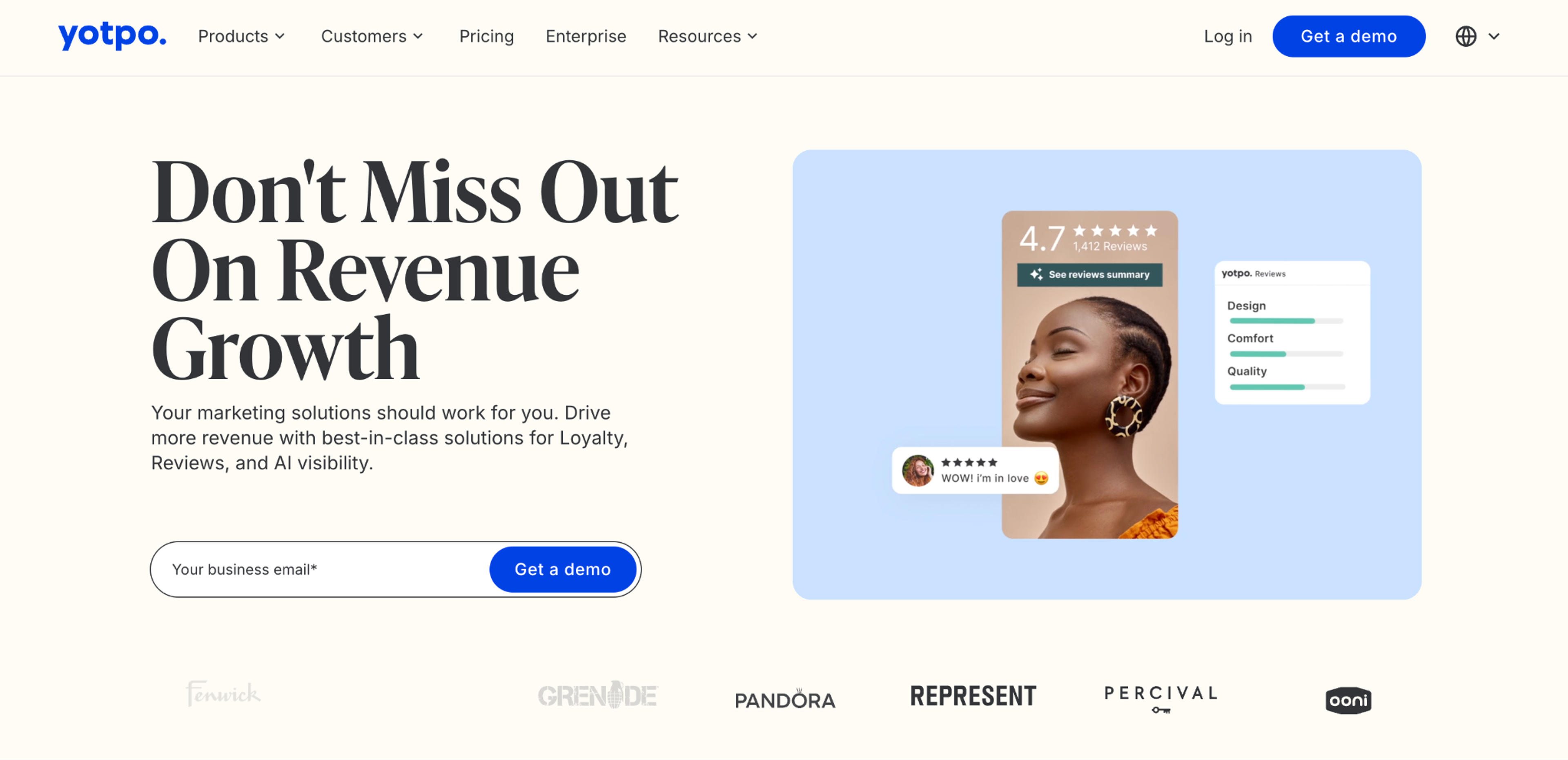
Best for: stores with steady order volume that want reviews and a loyalty program from one vendor.
Yotpo collects product reviews and runs loyalty and referral programs. Its AI tools help shoppers write more useful reviews (Pro) and summarize reviews on product pages (Premium).
Pros
Cons
Pricing (Yotpo's pricing page, Oct 2026): Reviews: Free for up to 50 orders a month; Starter $89/mo and Pro $169/mo up to 500 orders a month (Pro is $269/mo at 1,000 orders); Premium and Enterprise custom. Loyalty & Referrals: Free, then Pro from $199/mo. A Reviews and Loyalty bundle starts at $368/mo.
Pro tip: ask for the review when the product has arrived, not when the order ships. Reviews also work on site: see these social proof popups.
These three tools take copy, reports and admin tasks off your plate.
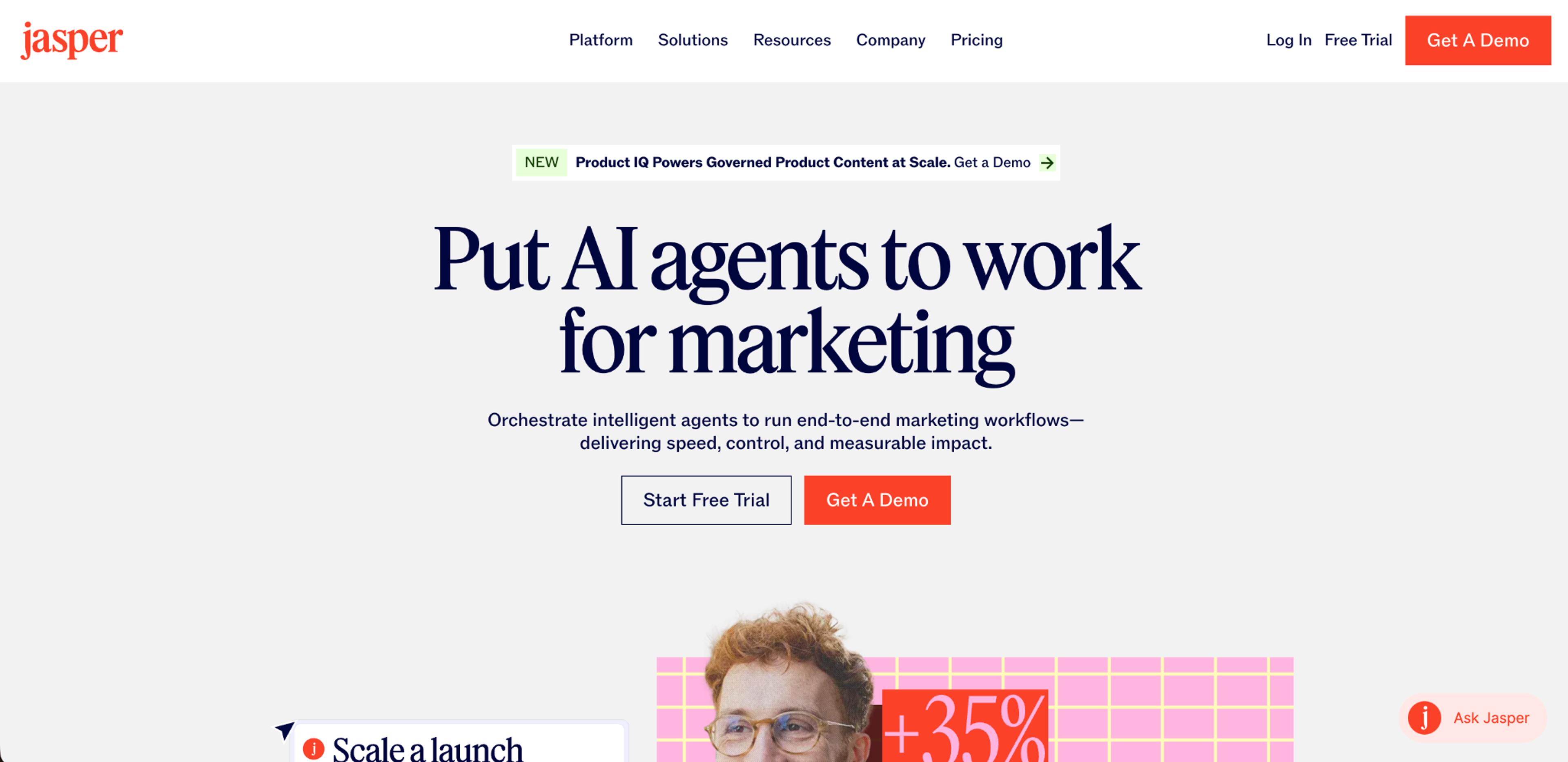
Best for: teams writing a lot of product descriptions, ads and emails in one brand voice.
Jasper is an AI writing platform for marketing teams. You set up Brand Voices, Knowledge assets and Audiences once, and its agents use them for every product description, ad and email.
Pros
Cons
Pricing (Jasper's pricing page, Oct 2026): Pro: $59/mo per seat billed yearly, or $69/mo billed monthly, with a 7-day free trial. Business: custom pricing.
Pro tip: set up Brand Voice and Knowledge before you write anything. The first outputs show whether the setup is right.
Best for: everyday writing and analysis, and running your other tools from one chat.
General AI assistants draft product descriptions, summarize reviews and analyze exported sales data. With connectors (MCP), they also run other tools: from one chat you can build an OptiMonk popup or pull a Klaviyo report.
Pros
Cons
Pricing (vendors' pricing pages, Oct 2026): Claude: Free; Pro $17/mo billed yearly ($20 monthly); Max from $100/mo. ChatGPT: Free; Go $8/mo; Plus $20/mo; Pro from $100/mo (US prices; local prices differ).
Pro tip: connect the tools you already pay for before you add new ones. Then ask for the job, not the text: "build an exit-intent popup for my store" instead of "write popup copy".
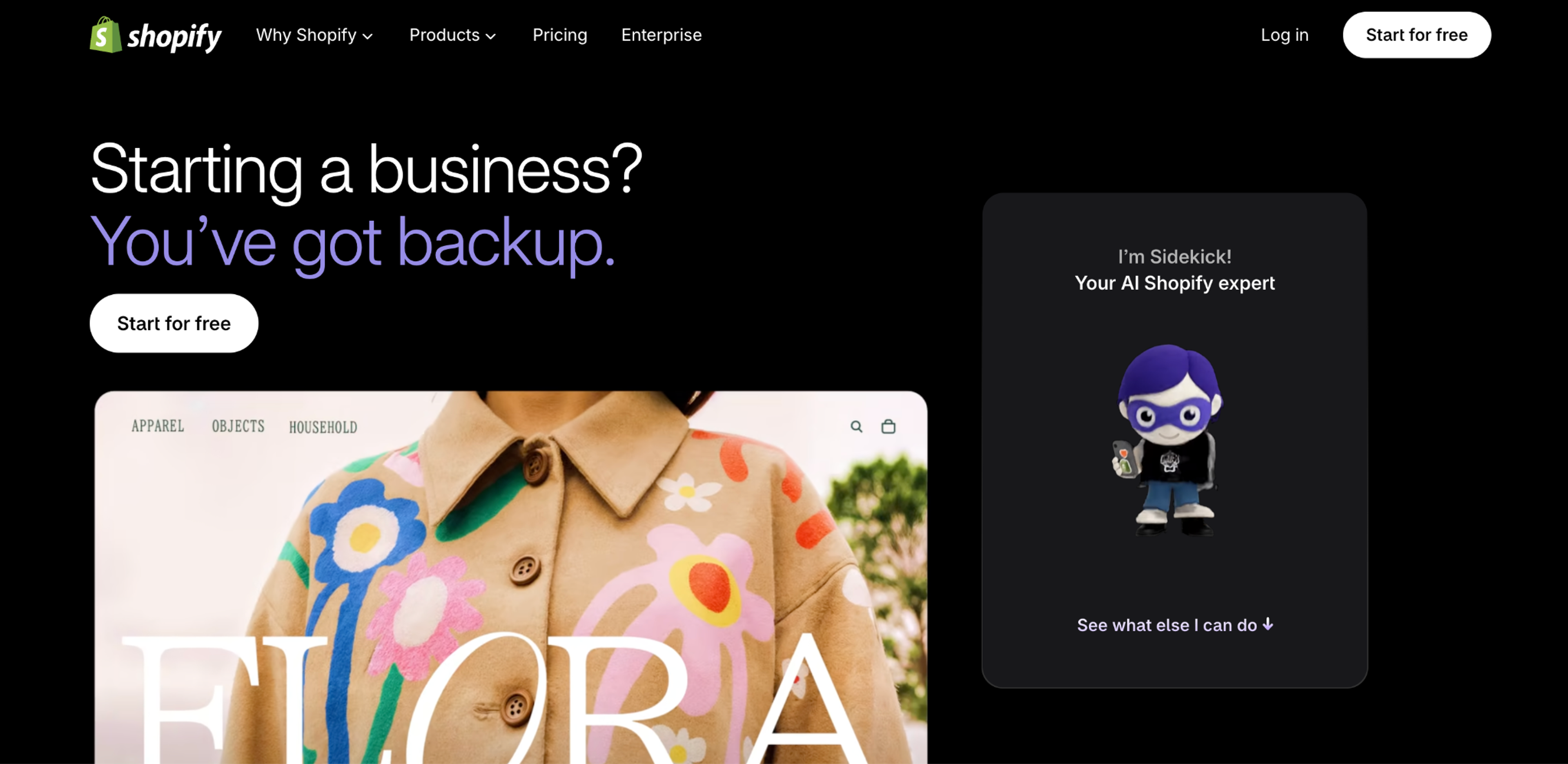
Best for: every Shopify store, as the first AI tool to try.
Sidekick is the AI assistant inside your Shopify admin. It works with your store data and takes action in the admin: it writes product descriptions, sets up discounts, builds collections and gives you a weekly performance summary.
Pros
Cons
Pricing (Shopify's Sidekick page, Oct 2026): Shopify says Sidekick "is included with your Shopify plan", with features and usage limits that vary by plan.
Pro tip: ask Sidekick for a weekly summary first, then compare it with last month's to see where sales moved.
On Shopify, our Shopify marketing guide covers the rest of the stack.
Revenue isn't profit. These two tools show what each product earns and keep your prices competitive.
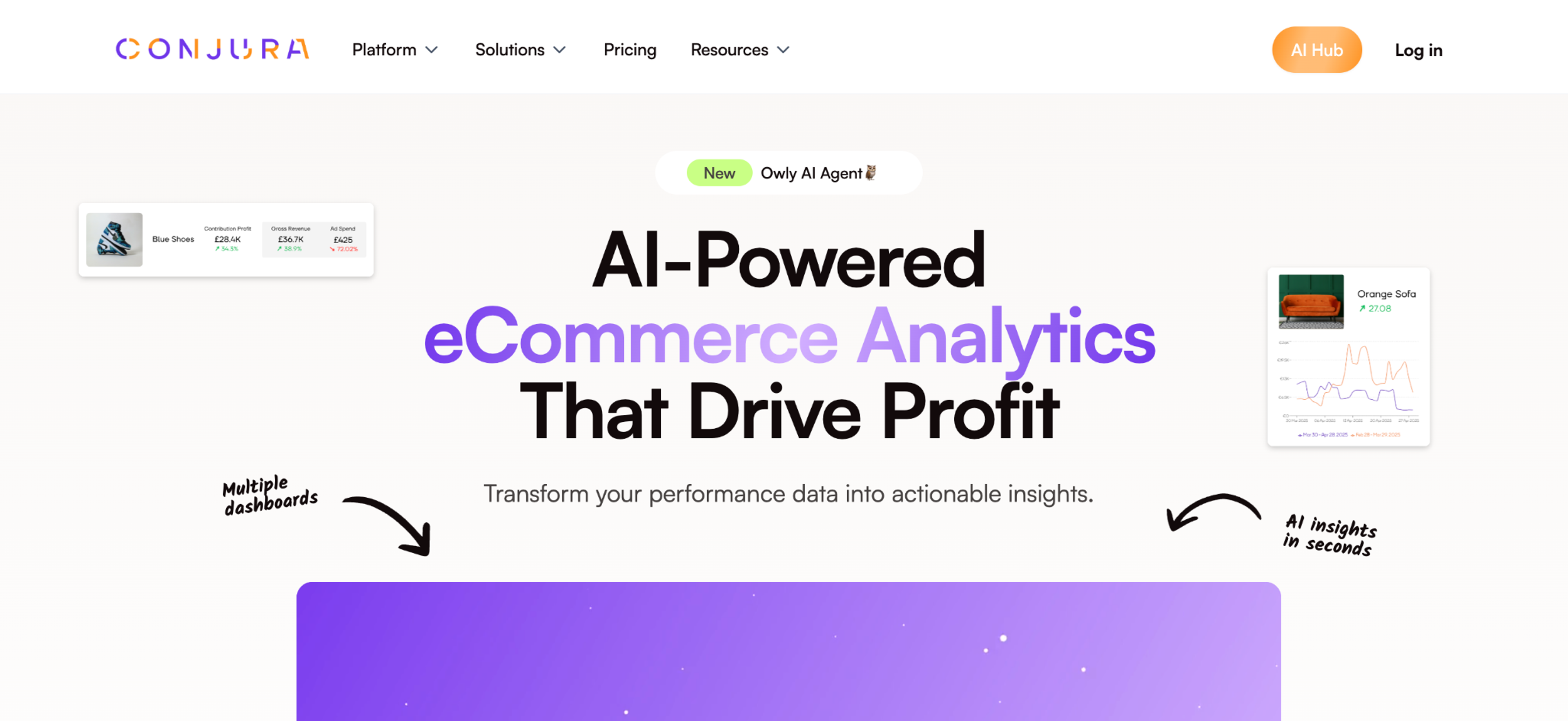
Best for: brands that want to know which products make money after ad spend, shipping and returns.
Conjura is a profit analytics platform for ecommerce. It connects your store and ad platforms and shows contribution profit per product. Its Owly AI add-on answers questions about your business in plain English and builds reports.
If Meta catalog ads are a big part of that spend, pair the profitability data with an AI catalog creative tool like OptiQube, which generates lifestyle and badge versions of every product image so the creative isn't the reason a profitable SKU underperforms.
Pros
Cons
Pricing (Conjura's pricing page, Oct 2026): priced by your store's yearly gross merchandise value (GMV). Up to $2M: Essentials $299/mo and Growth $499/mo; $2–5M: $399 and $599; $5–10M: $599 and $799; $10–20M: $899 and $1,099. Scale: price on request. Annual billing gives two months free. Owly AI add-on: from $199/mo, with 200 credits.
Pro tip: run the profit report on your top sellers before you plan your next ad budget.
Best for: stores selling products that other retailers also sell.
Prisync tracks competitor prices and stock, and from the Premium plan, adjusts your prices by rules you set (match, beat by a percentage, keep a minimum margin).
Pros
Cons
Pricing (Prisync's pricing page, Oct 2026): URL-based plans: Professional $99/mo (up to 100 products), Premium $199/mo (up to 1,000 products, with the dynamic pricing engine), Platinum $399/mo (up to 5,000 products). 14-day free trial.
Pro tip: set a margin floor before you switch on automatic price matching.
Start with the free stack: Shopify Sidekick (in your Shopify plan), OptiMonk Free for popups, Klaviyo or Omnisend Free for email, Tidio Free for support and Yotpo Reviews Free for reviews. That covers converting, recovering, answering and reassuring with no software bill.
As you grow, add tools in this order:
For the full plan, start with our guide to ecommerce conversion optimization, then compare CRO tools for online stores.
There's no single best tool; the best one does the job your store is losing the most sales on. If visitors leave without buying, start with OptiMonk. If they don't come back, Klaviyo or Omnisend; if they ask questions nobody answers, Tidio; if you don't know which products make money, Conjura.
Yes. Shopify Sidekick is the AI assistant built into the Shopify admin, included with your plan. OptiMonk, Klaviyo, Omnisend, Tidio and Yotpo are also in the Shopify App Store. Rebuy is built for Shopify too, but its App Store listing is currently unavailable, so you sign up on Rebuy's own site.
Most have a free plan or trial, and most entry plans cost $16 to $99 a month; profit analytics is the exception, with Conjura from $299 a month (as of October 2026). Free plans exist for 7 of these 12 tools: OptiMonk, Algolia, Klaviyo, Omnisend, Tidio, Yotpo and ChatGPT or Claude, and Sidekick comes with your Shopify plan. Prices grow with traffic, orders, contacts or seats, so check the cost at your own volume.
Yes, through connectors built on MCP (Model Context Protocol). OptiMonk, Klaviyo, Algolia (in beta) and Omnisend offer MCP connections, so you can build a popup, pull an email report or search your catalog from one chat. Check each tool's docs for which AI clients it supports.
Not many. Set up email flows early, since an abandoned cart flow starts working as soon as you have traffic, and add a welcome popup to grow the list it sends to. Tools that need data, like profit analytics, can wait until you have enough orders.
You don't need all twelve tools. Look at where your store loses the most sales right now: visitors who leave without buying, shoppers who never come back, or questions nobody answers. Pick the one tool that fixes that job, give it a few weeks, then add the next.
If it's visitors leaving without buying, your first OptiMonk popup is one sentence away: describe it, and the agent designs it for your brand, with a separate mobile version.
Free to start. No credit card.


Discover creative Thanksgiving marketing ideas to engage customers, build buzz, and drive sales before Black Friday and Cyber Monday.

Learn 5 ways ecommerce brands can turn new subscribers into recurring revenue using welcome flows, personalization, loyalty programs, re-engagement, and referrals.
In this article, we’ve compiled a list of the 25 top ecommerce apps that will help you streamline your operations, boost sales, and grow your online business.