


14 Effective Thanksgiving Marketing Ideas to Boost Your Sales in 2026
Discover creative Thanksgiving marketing ideas to engage customers, build buzz, and drive sales before Black Friday and Cyber Monday.
Let's dive into the impact of AI on ecommerce and take a look at the top 11 AI tools for ecommerce that can help you drive sales in 2026.
In short
The best AI tools for ecommerce in 2026 aren't about having more tools. They're about matching the right tool to the right problem. This guide covers 11 hand-picked picks across five categories: content creation, conversion and personalization, customer support and retention, analytics and advertising, and email and CRM. Start with whichever category is costing you the most right now, get it working, then build from there.
At some point, every ecommerce team ends up with the same problem: too many tools, not enough clarity on what's actually driving growth. AI promised to simplify things. Often it just added more subscriptions.
This guide is structured differently. Instead of handing you a flat list of AI tools for ecommerce and leaving you to figure out how the pieces fit, we've organized 11 hand-picked tools across five strategic categories: each one mapped to a specific job your store needs done, from converting first-time visitors to owning the post-purchase relationship.
Here's what the right stack of AI tools for ecommerce actually looks like.
77% of ecommerce professionals now use AI daily. The question is no longer whether to use it, it's whether the tools you've picked are actually doing the right jobs.
Most stores end up with a scattered collection of AI ecommerce software: an AI chatbot here, an email tool there, a content generator nobody quite remembers signing up for.
The brands pulling ahead aren't using more AI. They're using it more deliberately by mapping each tool to a specific problem, from converting first-time visitors to reclaiming time lost to tasks that never needed a human in the first place.
Here are the five areas where deliberate use of ecommerce AI tools pays off most clearly:
Short on time? Here's a snapshot of all 11 tools organized by category, with the key AI feature and pricing for each, so you can quickly spot which AI ecommerce software fits your stack.
| Tool | Category | Best for | Key AI feature | Pricing |
|---|---|---|---|---|
| Jasper | Create Content | AI copywriting at scale | Learns your brand voice and applies it consistently across every content type | From $49/mo |
| Frase | Create Content | SEO content optimization | Analyzes top-ranking pages and scores your content against them in real time | From $49/mo |
| OptiMonk | Convert & Personalize | Popups & A/B testing | An AI agent that designs, builds and A/B tests popups from a one-sentence brief | Free plan; from $19/mo billed yearly |
| ConversionBox | Convert & Personalize | AI visibility & product discovery | AI Visibility Audits to track engine citations, plus conversational AI Search & Shopping Assistant | Commerce & enterprise plans based on catalog and traffic |
| Algolia | Convert & Personalize | AI site search & product discovery | NLP understands shopper intent beyond keywords, and surfaces products in AI assistants | Free tier; AI features contact for quote |
| Tidio | Support & Retain | AI customer support | Lyro AI resolves up to 67% of customer queries end-to-end without human input | From $29/mo (Lyro add-on from $39/mo) |
| Yotpo | Support & Retain | Reviews & loyalty | AI summarizes review sentiment and suggests loyalty rewards to maximize repeat purchase | Free loyalty plan; Reviews contact for quote |
| Conjura | Analytics & Advertising | Profit-focused analytics | Owly AI answers plain-English profit questions at SKU level, after all costs | From $299/mo |
| Prisync | Analytics & Advertising | Competitor pricing & dynamic pricing | Tracks competitor prices in real time and auto-adjusts yours based on rules you define | From $99/mo |
| Klaviyo | Email & CRM | Data-driven email & SMS | Predictive analytics estimates LTV and churn risk to power smarter segmentation | Free plan; Email from $20/mo |
| Omnisend | Email & CRM | Ecommerce email & SMS automation | AI writes campaign copy and builds dynamic segments from real-time store behavior | Free plan; Standard from $16/mo |
The tools above cover every stage of the customer journey. Here's how they fit together:
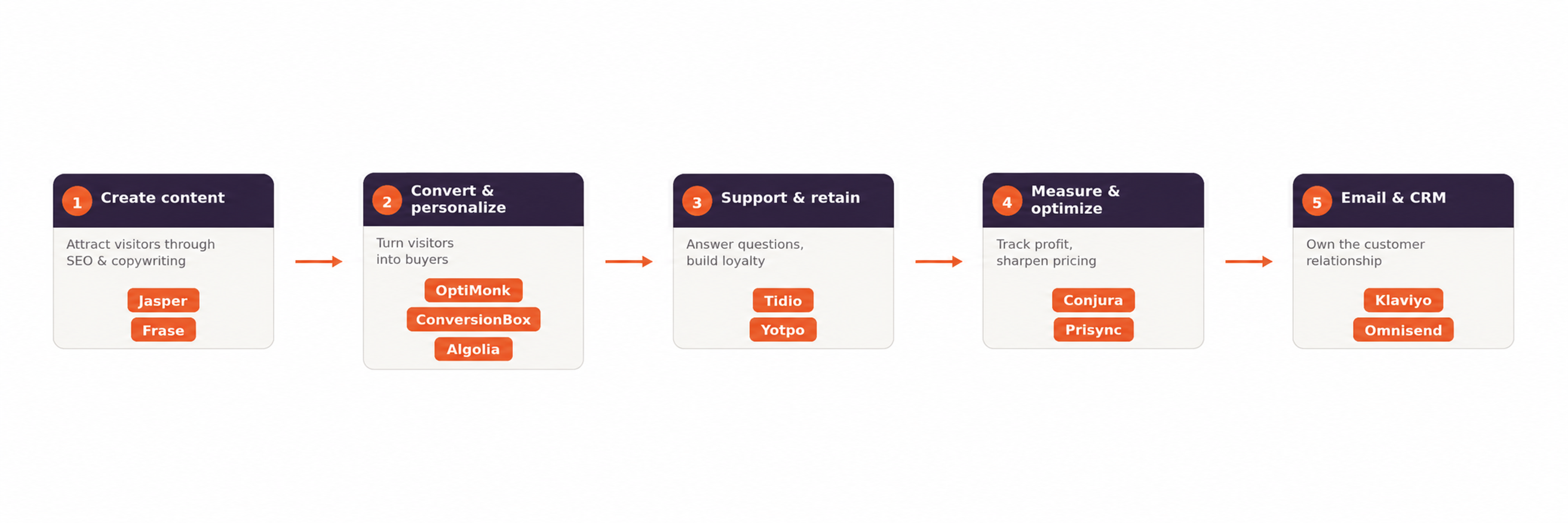
Let's look at what each tool actually does, who it's best suited for, and how to get the most out of it from day one.
Every customer journey starts somewhere. More often than not, it starts with content. A blog post that answers a question, a product description that nails exactly what the shopper needed to hear, a video that shows the product in action.
What you put out, how you write it, and what you show shapes whether someone ever lands on your store in the first place. Most marketing teams know this, and most of them also know they never have enough time to produce it all.
The tools in this category tackle that in three very different ways: AI copywriting for marketing teams, and SEO-first content optimization.
Jasper is an AI copywriting platform built specifically for marketing teams, not a general-purpose writing assistant, but a tool that learns your brand's voice, audience, and product knowledge, then applies that context consistently across every piece of content it generates.
For ecommerce teams producing high volumes of product descriptions, ad copy, email campaigns, and blog content, it removes the blank-page problem without sacrificing brand consistency.
Best for: Ecommerce marketing teams who spend too much time on content, whether that's producing high volumes of product descriptions and ad copy or crafting long-form buying guides that eat up hours per piece, and want to maintain consistent brand voice without it all falling on one person.
Pricing: From $49/month (Creator); from $69/month (Pro); Business custom
Pro tip: Invest time in setting up Brand Voice and Knowledge Assets before generating a single piece of content. It's the difference between outputs that need heavy editing and outputs you can publish with light review. Most teams who underuse Jasper skipped this setup step.
Writing great content is only half the job: if it doesn't rank, nobody reads it. Frase is an SEO content platform that bridges the gap between writing and ranking: it analyzes what's already performing for any keyword, tells you exactly what your content needs to cover to compete, and scores your draft in real time as you write against those benchmarks.
For ecommerce teams investing time in content, it's the difference between publishing into the void and publishing with a genuine shot at organic traffic.
Best for: Ecommerce brands and content teams for whom organic search is a meaningful traffic source, particularly those publishing buying guides, comparison content, or category pages, who want to research, write, and optimize in one workflow rather than juggling multiple SEO tools.
Pricing: From $49/month (Starter, 1 seat, 10 articles/month); from $129/month (Professional, 3 seats, 40 articles/month); 7-day free trial, no credit card required
Pro tip: Use Frase's AI visibility tracking to see which of your existing articles are already being cited by AI assistants. These are your highest-value pages to refresh and expand, since they're already trusted sources for AI-generated answers.
Once your content is in place and shoppers are landing on your store, the next job is making sure they find what they're looking for, and that your site is working as hard as possible to turn that visit into a purchase.
The tools in this category use AI to personalize the experience in real time, matching each visitor to the right product, offer, or message based on their behavior and intent.
OptiMonk is an agentic popup builder for Shopify and other ecommerce stores. You describe the popup you want, and the AI agent designs it on brand, writes the copy, builds a mobile version and sets the targeting. It's for marketers who want a store that converts better without a designer or a developer.
Best for: Growing ecommerce stores with solid traffic but untapped conversion potential, especially in fashion, beauty, supplements, and home goods, who want to run serious campaigns without a dedicated team or developer.
Pricing: Free plan with every feature (10,000 pageviews/month). Paid plans from $19/month billed yearly ($29 monthly).
Pro tip: Start with one popup for first-time visitors, such as a welcome discount on exit intent. Once it has data, ask the agent for an A/B test idea and let the results decide what you build next.
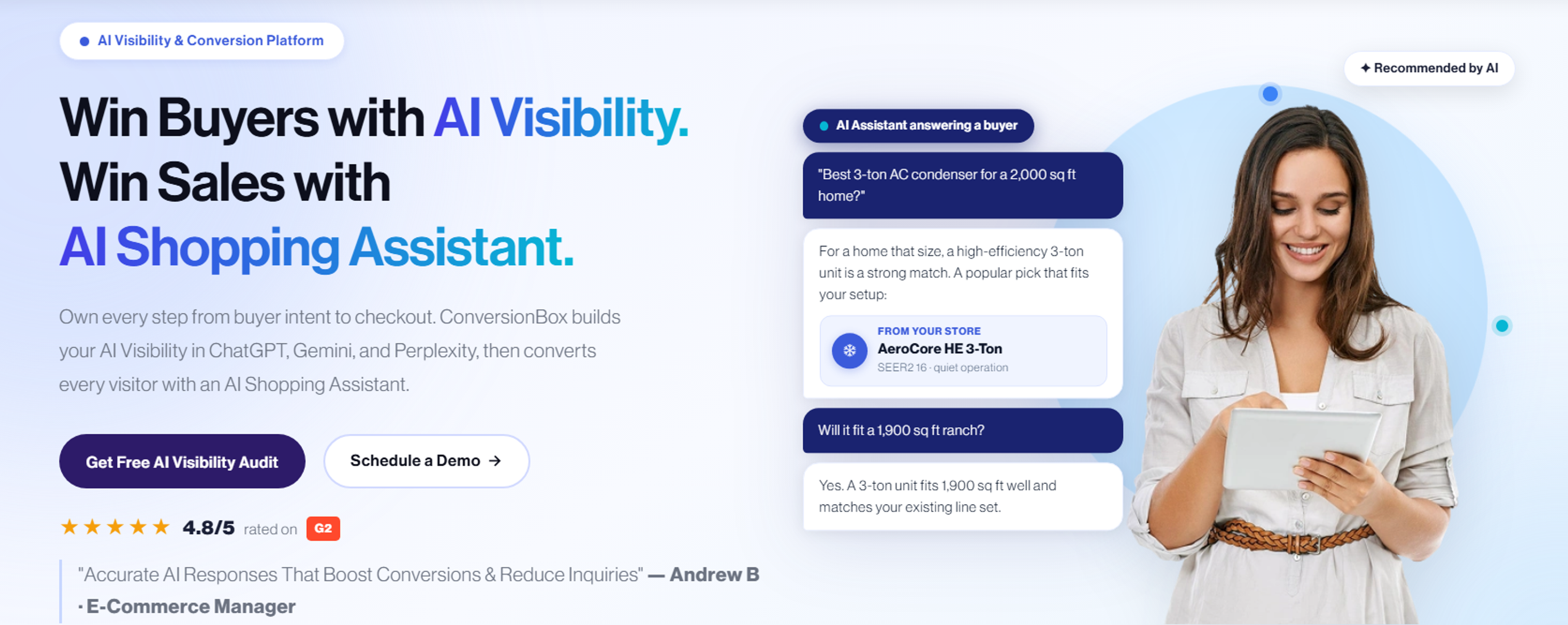
ConversionBox is an AI Visibility and Conversion Platform built for brands that need to win buyers before they visit the website and convert them after they arrive. It connects AI visibility across ChatGPT, Gemini, and Perplexity with AI-powered search and guided selling inside your store, across every stage where discovery, confidence, and purchase decisions happen.
If your products are missing from AI recommendations, ConversionBox shows you where visibility is being lost, identifies the content and citation gaps holding you back, and gives you a prioritized plan to improve. When buyers reach your website, its AI Search and Shopping Assistant help them find, compare, and choose the right product with confidence.
Best for: Ecommerce and B2B brands with large or complex catalogs that want one platform to improve AI discoverability, on-site product discovery, conversion rates, average order value, and revenue attribution.
Pricing: Commerce and enterprise plans are available based on your catalog, traffic, use case, and selected capabilities.
Pro tip: Start with the AI Visibility Audit to find where buyers and AI engines lose your brand. Then connect those insights to AI Search and the Shopping Assistant so you can improve the full journey from buyer intent to checkout.
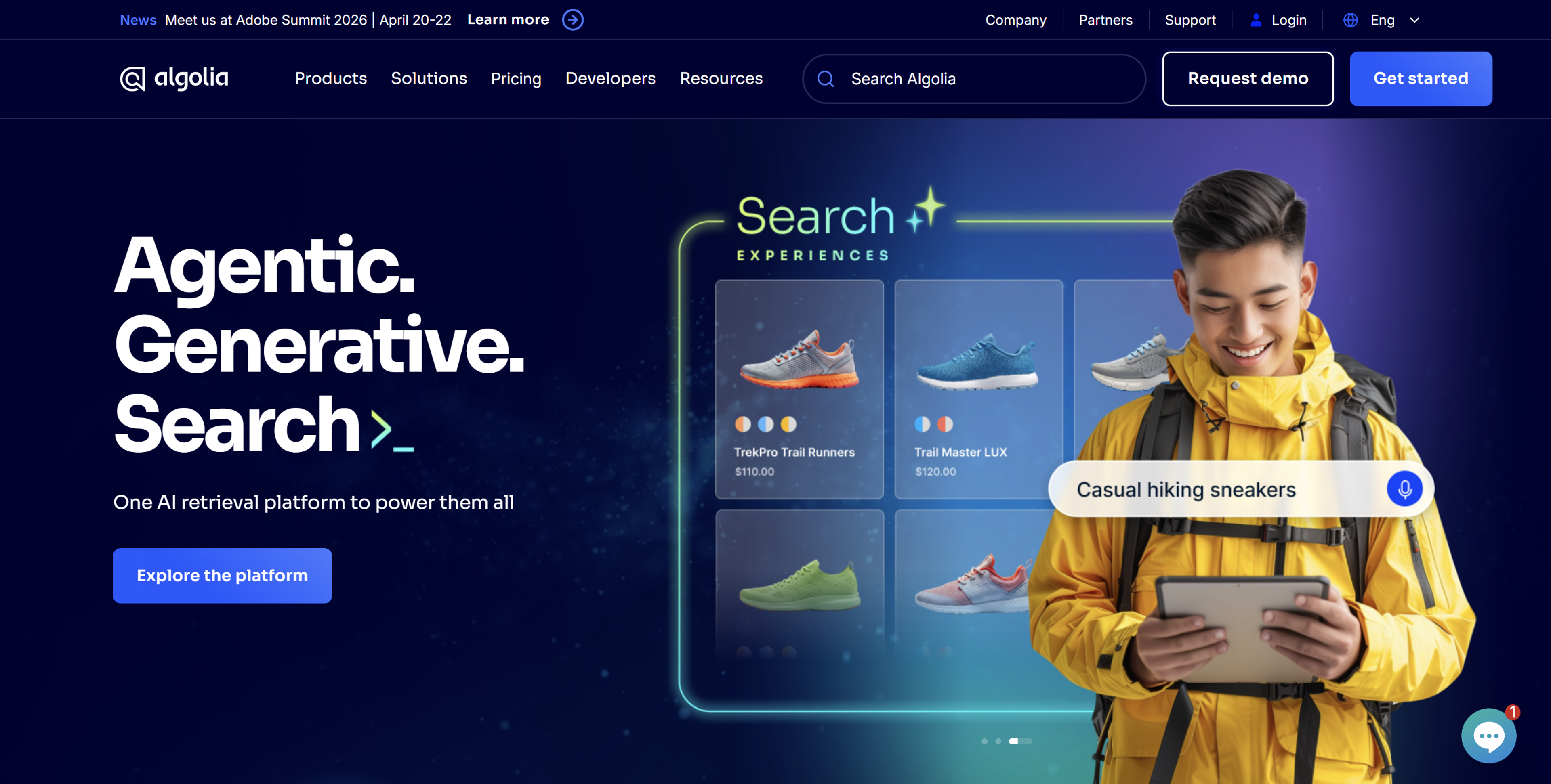
Algolia is two things: the most powerful search engine you can add to your store, and the infrastructure that makes your products discoverable through AI assistants like ChatGPT and Perplexity.
The on-site search understands what shoppers mean, not just what they type. But the bigger opportunity is outside your store. As more shoppers use AI tools to find products, Algolia's MCP Server connects your catalog to those systems so your products show up in the answer.
Best for: Ecommerce stores with large catalogs where products are technically similar or closely related, such as electronics, auto parts, supplements, or industrial supplies, where shoppers struggle to find the right variant through traditional filters and where showing up in AI assistant answers could be a genuine competitive advantage.
Pricing: Free tier available; paid plans usage-based from $0.50/1K searches; AI features and NeuralSearch require Grow Plus or Elevate — contact for quote
Pro tip: Connect your catalog to Algolia's MCP Server sooner rather than later. Not because the AI needs time to learn, but because your product data probably needs cleanup first. The better your titles, descriptions, and attributes, the more accurately AI assistants will surface your products when shoppers ask relevant questions.
Your content brought them in, your conversion tools guided them to the right product — but there's still a gap between browsing and buying.
This category covers both sides of that gap: answering the last-minute questions that turn hesitation into a purchase, and everything that happens after: keeping customers happy, building loyalty, and giving them a reason to come back.
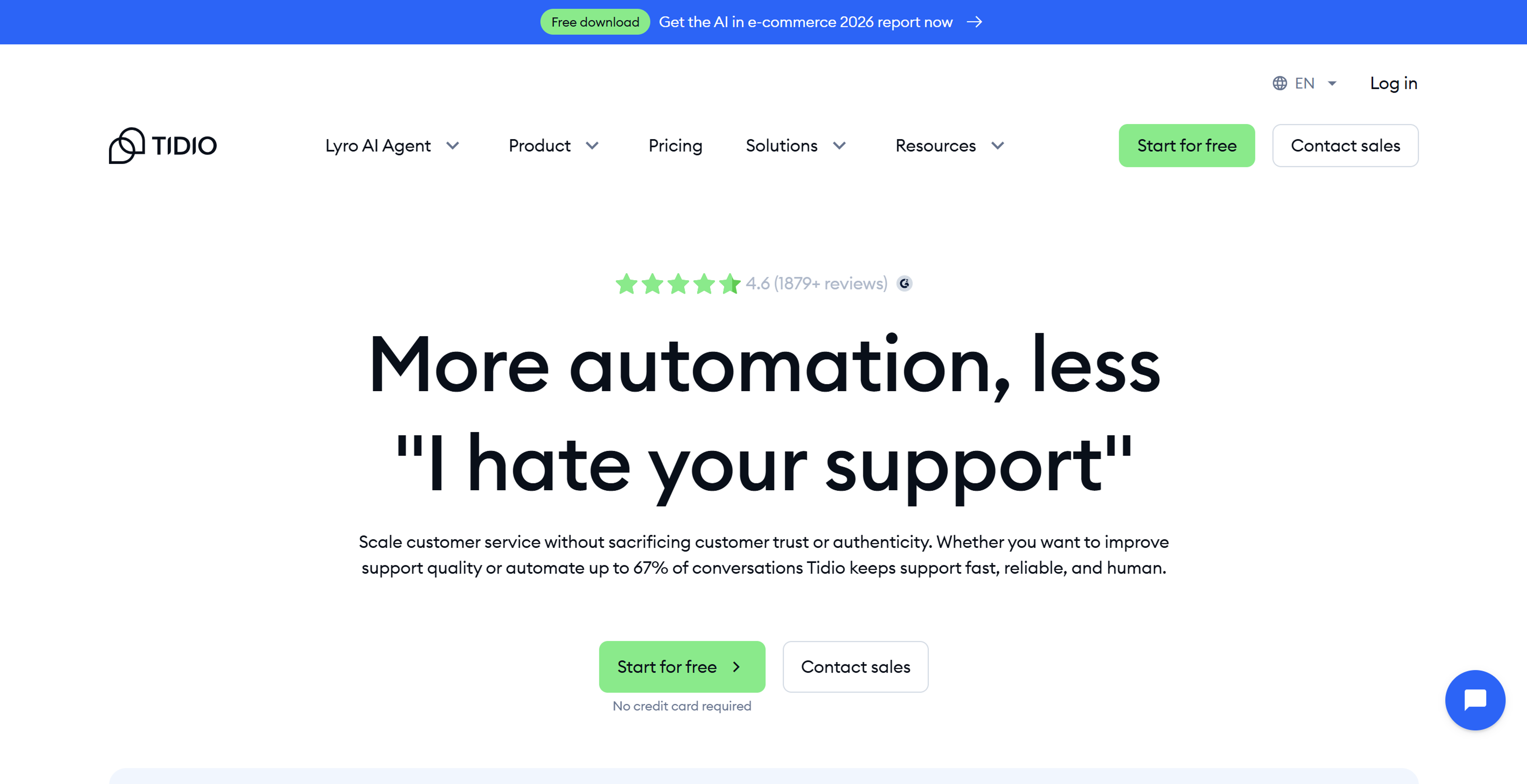
Tidio is a customer support platform built around Lyro, its AI agent that handles customer questions end-to-end without human involvement.
Where most chatbots hand off to a human agent the moment a question gets slightly complex, Lyro is designed to resolve a much wider range of queries autonomously — order status, returns, product questions, shipping timelines — so your support team only deals with the cases that genuinely need them.
Best for: Small to mid-sized ecommerce stores looking for AI-powered customer service that can handle the majority of support volume autonomously, including order tracking, returns, and FAQs, without sacrificing response quality.
Pricing: From $29/month; Lyro AI is a separate add-on from $39/month for 50 conversations, expect $68+/month for meaningful AI support volume
Pro tip: Feed Lyro your most frequently asked questions before launch. The more context it has from day one, the higher its autonomous resolution rate will be from the start, which means fewer escalations to your team during the learning period.
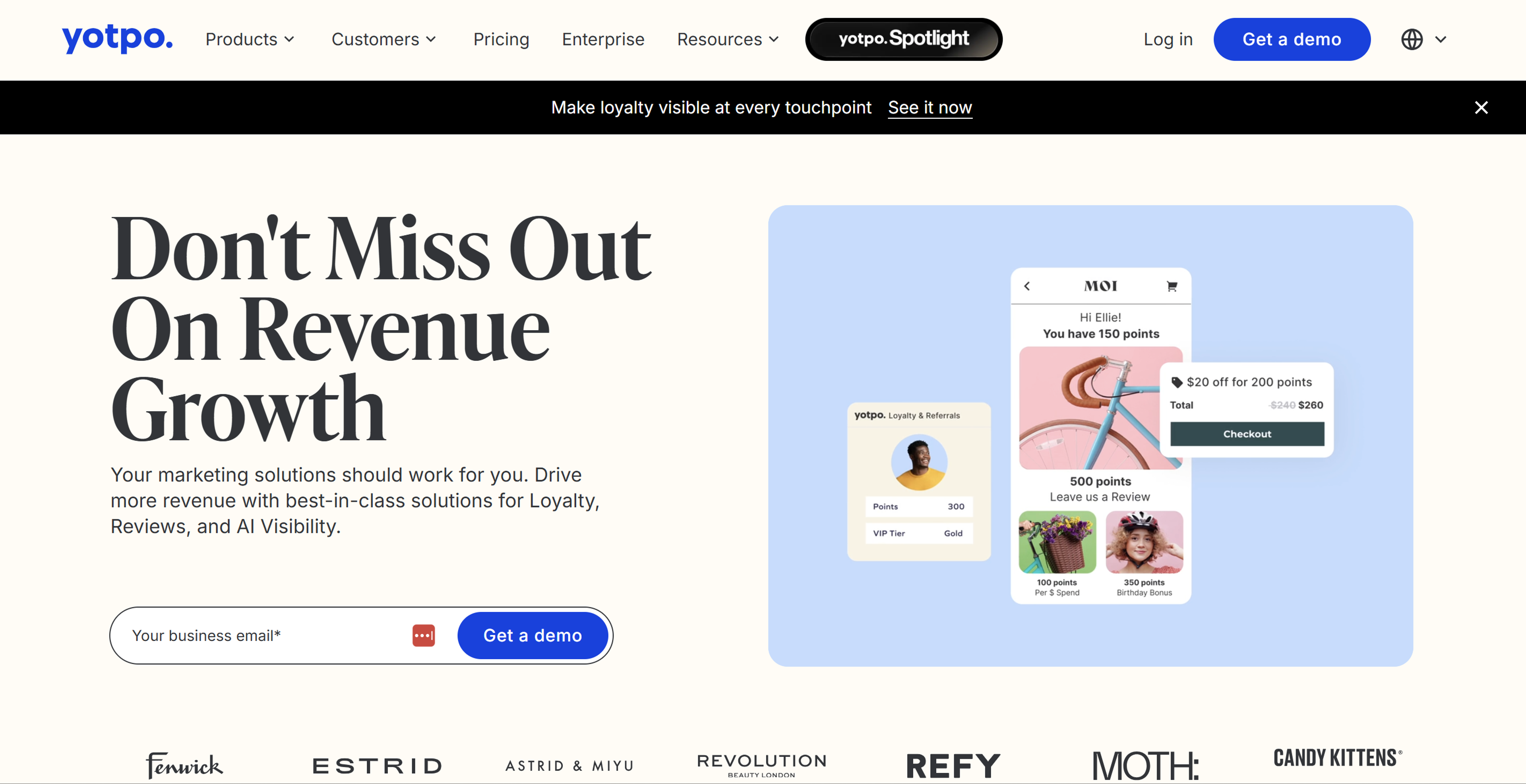
Yotpo handles the post-purchase loop that most ecommerce brands underinvest in: collecting reviews, turning them into social proof that drives future purchases, and rewarding loyal customers through a points and referral system.
It's not a conversation tool. It works quietly in the background, building the kind of trust and repeat purchase behavior that paid ads can't buy.
Best for: Ecommerce stores doing enough order volume to generate a steady flow of reviews, particularly in beauty, supplements, fashion, and home goods, who want to build trust through social proof and create a loyalty program that keeps customers coming back without relying solely on discounts.
Pricing: Free plan available for Loyalty; Reviews pricing is order-volume based, contact for quote
Pro tip: Connect your reviews and loyalty program from day one. Customers who earn loyalty points are significantly more likely to leave a review when asked, and review-writers who feel rewarded are more likely to refer friends. The two products are much more powerful together than separately.
Every decision you've made so far — what to write, how to price it, which ads to run, which customers to focus on — was based on some level of assumption. This category is what replaces those assumptions with answers.
These tools tell you which products are genuinely profitable after costs, which customers are worth investing in, and where your ad spend is doing real work versus going to waste. And increasingly, they don't just surface the insight: they act on it.
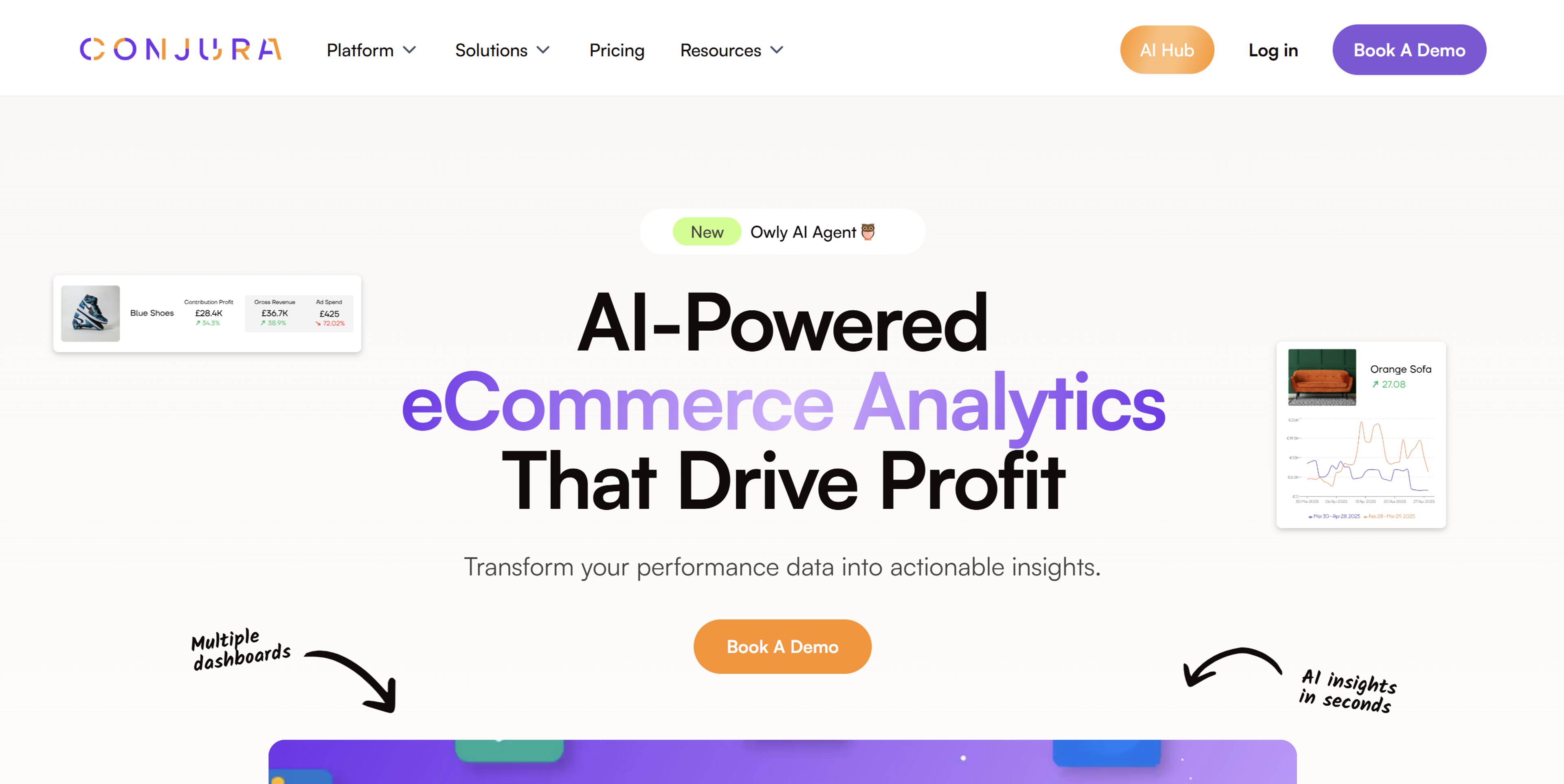
Conjura is built around a single question most analytics tools can't answer cleanly: which products are actually making money?
Not just generating revenue, but profitable after you factor in ad spend, shipping, returns, and COGS. Its SKU-level contribution profit view changes how you think about merchandising, pricing, and ad strategy, because a bestseller that costs more to sell than it makes isn't a bestseller at all.
Best for: DTC brands and multi-channel retailers who suspect some of their best-selling products are quietly unprofitable, particularly those running Google Shopping, Meta catalog ads, or selling across multiple marketplaces, who want to make merchandising and ad decisions based on margin rather than revenue.
Pricing: From $299/month for brands under $2M GMV (Gross Merchandise Value), scales with GMV; contact for quote
Pro tip: Run Conjura's SKU-level profitability report on your top 20 products first. Most brands find at least two or three "bestsellers" that are actually margin-negative once ad spend is factored in. That finding alone tends to justify the platform cost within the first month.
Prisync is a dynamic pricing and competitor price tracking software that does one thing and does it well: it tracks what your competitors are charging and lets you automatically adjust your prices in response.
For ecommerce brands in competitive categories where pricing is a genuine factor in whether a shopper buys from you or someone else, it removes the need to manually monitor competitor prices and react. The platform does it for you, within rules you define.
Best for: Ecommerce brands selling products that are also available from other retailers, such as electronics, sports equipment, branded goods, or consumables, who need dynamic pricing software to stay competitive without monitoring prices manually all day.
Pricing: From $99/month (100 products); from $199/month (1,000 products); from $399/month (5,000 products), 14-day free trial, no credit card required
Pro tip: Start with dynamic pricing rules that protect your margin floor rather than just matching the lowest price. Racing to the bottom is easy, but the real value is finding the sweet spot where you're competitive enough to win the sale without giving away margin you didn't need to.
Analytics tells you what's working. Email is how you act on it. Once you know which customers are worth retaining, which segments are most likely to buy again, and what behavior patterns predict lifetime value, an AI powered CRM and email platform is what lets you do something with that knowledge; at scale, automatically, and without paying for every touch.
The tools in this category are purpose-built AI email marketing ecommerce solutions, which means the automations, segmentation, and integrations all start from how people actually shop rather than how businesses generally communicate.
Klaviyo is the email and SMS platform that most serious ecommerce brands end up on eventually. Its edge isn't just automation: it's that every flow, segment, and campaign is built on top of a detailed customer data layer that tracks purchase history, browsing behavior, predicted lifetime value, and more.
That means your "abandoned cart" email isn't just triggered by a cart: it's personalized based on what the shopper actually looked at, what they've bought before, and how likely they are to convert.
Best for: Ecommerce brands that have outgrown basic email tools and want an AI powered CRM and email platform where every campaign and automation is driven by actual customer behavior, particularly those on Shopify who want email, SMS, and customer analytics in one place.
Pricing: Free plan (up to 250 active profiles); Email from $20/month; Email + SMS from $35/month, pricing scales with active profile count
Pro tip: Clean your list regularly. Klaviyo bills based on active profiles, not just the contacts you email. Suppressing unengaged subscribers (anyone who hasn't opened or clicked in 90+ days) keeps your costs in check and improves your deliverability at the same time.
Omnisend covers the same core territory as Klaviyo: email automation, SMS, segmentation, and ecommerce flows, but at a price point that makes it genuinely accessible for smaller and mid-sized stores.
It's not a stripped-down version of a bigger platform; all features are available on every plan including the free tier, with costs scaling based on how many contacts you're reaching rather than which feature tier you're on.
Best for: Small to mid-sized ecommerce stores that want email, SMS, and automation without paying for features they don't need yet, particularly those just moving beyond basic newsletter tools who want proper ecommerce flows set up quickly.
Pricing: Free plan available; Standard from $16/month; Pro from $59/month. All features available on every plan, costs scale with contact count
Pro tip: Start with the abandoned cart flow before anything else: it's the single highest-ROI automation in ecommerce, and Omnisend's pre-built version takes about 20 minutes to set up and activate. Once it's running, you'll have a real baseline for what the platform can generate before investing time in more complex sequences.
AI for online stores won't fix a broken ecommerce strategy, but it will accelerate a good one. The stores pulling ahead right now aren't necessarily the ones with the biggest budgets or the most tools. They're the ones who identified where they were losing the most — whether that's traffic, conversions, repeat purchases, or margin — and applied the right tool to the right problem at the right moment. If you're still mapping out where your store loses sales, start with our guide to ecommerce conversion rate optimization.
That's a harder question than "which AI tools should I use?" But it's the one worth answering first. Once you know where the gap is, the tool choice becomes obvious. And once the tool is in place and working, the compounding effect is real. Better content brings more traffic, better conversion tools make that traffic count, better retention tools make each customer worth more over time.
Pick your starting point. Get it working. Then build from there.
The best ecommerce AI tools in 2026 depend on where you are in the customer journey. For content, Jasper and Frase. For conversion, OptiMonk, ConversionBox, and Algolia. For support and retention, Tidio and Yotpo. For analytics, Conjura and Prisync. For email, Klaviyo and Omnisend. The best starting point is whichever category is costing you the most right now.
Look at the cost of the problem it solves, not just the subscription fee. If you're spending 10 hours a week on support tickets that Tidio could handle autonomously, the question isn't whether $68/month is expensive: it's what your time is actually worth. The tools that pay for themselves fastest are the ones solving a problem you're already paying to ignore.
Not all of them, but a few make sense from day one. Klaviyo or Omnisend are worth setting up early because email flows like abandoned cart work better the longer they've been running. Frase is useful as soon as you're publishing content. The tools that need scale to work — like Conjura's SKU-level profit analysis — are better saved for when you have enough data to make them meaningful.
Choosing from the best AI tools for ecommerce starts with the category where you're losing the most. If you have traffic but poor conversions, OptiMonk. If you're drowning in support tickets, Tidio. If you're publishing content that isn't ranking, Frase. If you don't know which products are actually profitable, Conjura. The right first tool is the one that solves a problem you're already feeling.
Yes, and this is one of the most compelling cases for the best AI tools for ecommerce being accessible to teams of any size. A two-person team using Jasper for content, OptiMonk for CRO, and Klaviyo for email can execute what used to require a department. The gap that remains is strategy and taste: knowing what to create, who to target, and what actually matters to your customer. AI handles the execution. The thinking, the strategy, and the judgment behind it: that's still entirely human.


Discover creative Thanksgiving marketing ideas to engage customers, build buzz, and drive sales before Black Friday and Cyber Monday.

Learn 5 ways ecommerce brands can turn new subscribers into recurring revenue using welcome flows, personalization, loyalty programs, re-engagement, and referrals.
In this article, we’ve compiled a list of the 25 top ecommerce apps that will help you streamline your operations, boost sales, and grow your online business.