


Tarte Cosmetics Marketing Breakdown: How a 25-Year-Old Beauty Brand Keeps Making Products Feel Viral
How Tarte turns founder storytelling, creator trips, TikTok virality, and smart on-site funnels into a repeatable beauty marketing growth engine.
Learn how Made In Cookware built a winning DTC marketing strategy using chefs, content, and trust to scale into a premium global brand.
In short
Made In Cookware built a successful DTC marketing strategy by focusing on real chef adoption instead of paid endorsements. By combining professional credibility, educational content, and a high-converting website experience, the brand built trust before purchase. The key takeaway: winning DTC brands are built on authentic credibility, not just advertising.
The premium cookware market has a credibility problem. Most brands borrow a chef's face, put it on a box, and call it a DTC marketing strategy. Made In took the opposite approach. It started inside professional kitchens and worked its way outward, building a consumer brand on genuine chef adoption rather than paid endorsements.
Founded in 2017 by Jake Kalick and Chip Malt, Made In grew out of Kalick's family restaurant supply business, which has been running since 1929.
The premise was straightforward: cookware good enough for the world's best professional kitchens would earn the trust of home cooks who actually care about cooking.
That premise has proven correct. The brand now counts:
For a premium DTC brand barely seven years old, that's not just growth. That's validation.
So how did Made In Cookware grow so fast? Here's a closer look at the DTC marketing strategy that's powering it.
Most DTC brands manufacture a story. Made In inherited one.
Jake Kalick's family has been supplying professional kitchens since 1929. That means Made In didn't launch as a startup chasing credibility, it launched as a fourth-generation business deciding, for the first time, to sell directly to consumers.
That distinction matters more than it sounds. When Made In says its pans are crafted to the standards of the world's best chefs, it's not just a brand storytelling tagline. It's literally the same supply chain that has served professional kitchens for decades. The claim is verifiable because the history is real.
Their tagline — "The Cookware Chefs Actually Use" — is a direct challenge to how the rest of the category operates. Most chef partnerships are paid. Made In's chefs are customers.
They buy the product. They use it in their restaurants every night. That difference is invisible in the marketing but immediately obvious to anyone who looks closely.
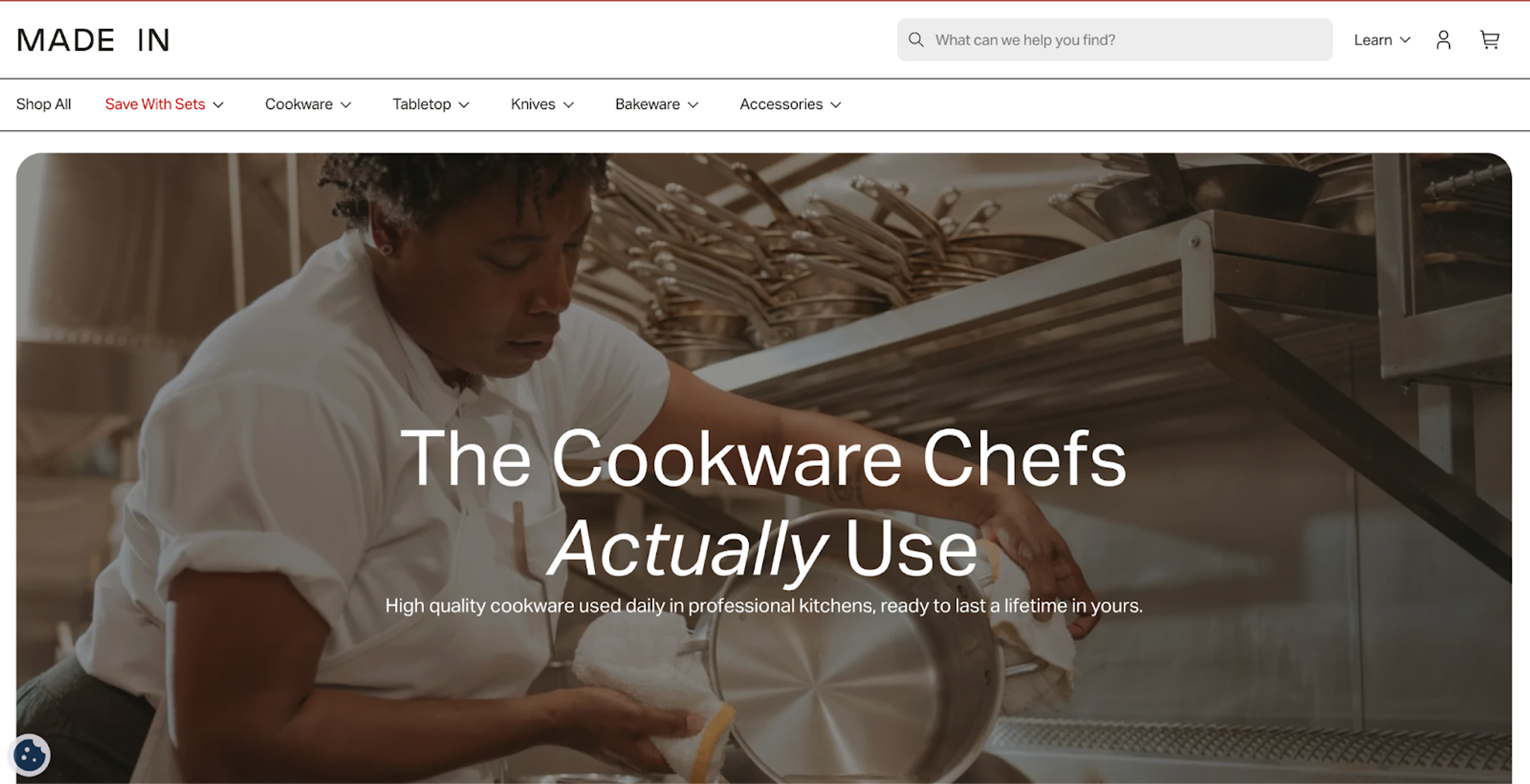
It's also why the brand converts skeptical buyers so well. Home cooks who care about cooking are exactly the audience most likely to do their homework and most likely to reward a brand that holds up under scrutiny.
Compare this to Caraway, which disrupted the same category around the same time but from a completely different angle:
Two very different bets on brand storytelling and what makes a home cook trust a brand. Both worked, which tells you something interesting about how fragmented that trust can be.
Chip Malt has a phrase for it internally: "Chefs are the new athlete."
It's a deceptively simple reframing of influencer marketing strategy. Professional chefs occupy the same cultural role for food that athletes occupy for sportswear, they're the credibility signal that aspirational consumers look to when deciding what equipment is worth buying. Made In saw that before the rest of the category did.
But the strategy isn't what you'd expect.
Rather than running a traditional influencer marketing strategy — signing one or two celebrity names and calling it a chef partnership — Made In built a network of over 3,000 chef customers across 17 countries, from Grant Achatz at Alinea in Chicago to Mashama Bailey at The Grey in Savannah to Fermín Núñez at Suerte in Austin.
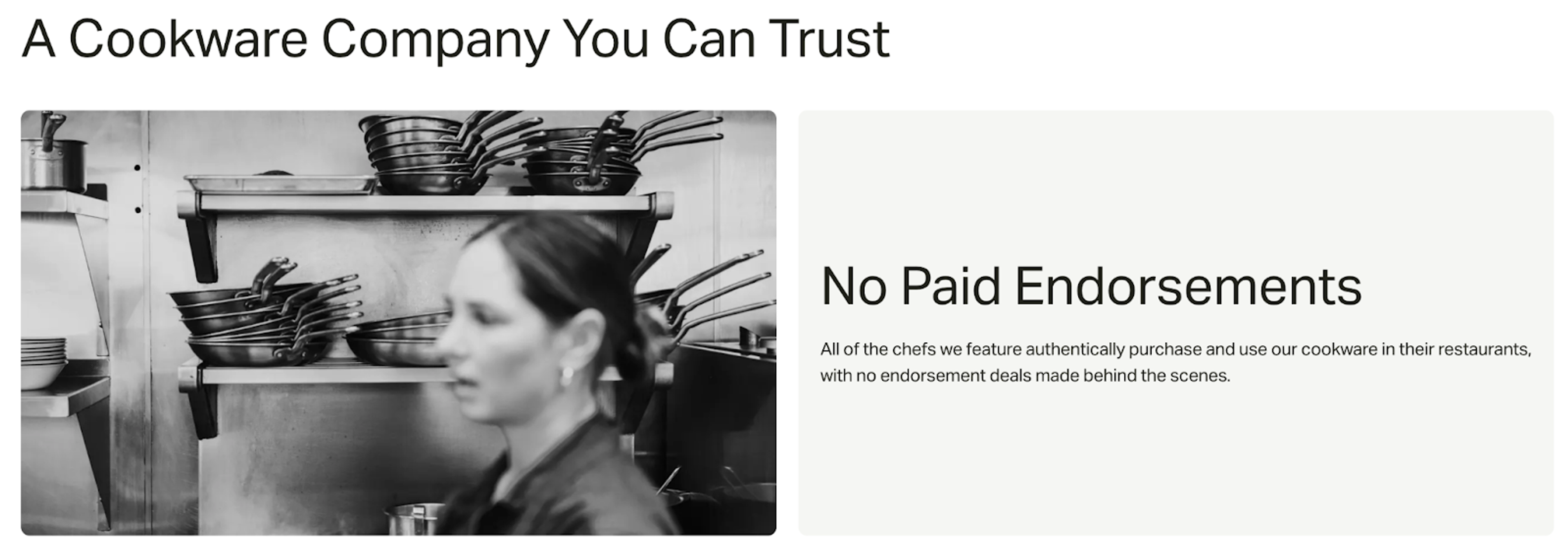
None of them are paid endorsers. They're customers.
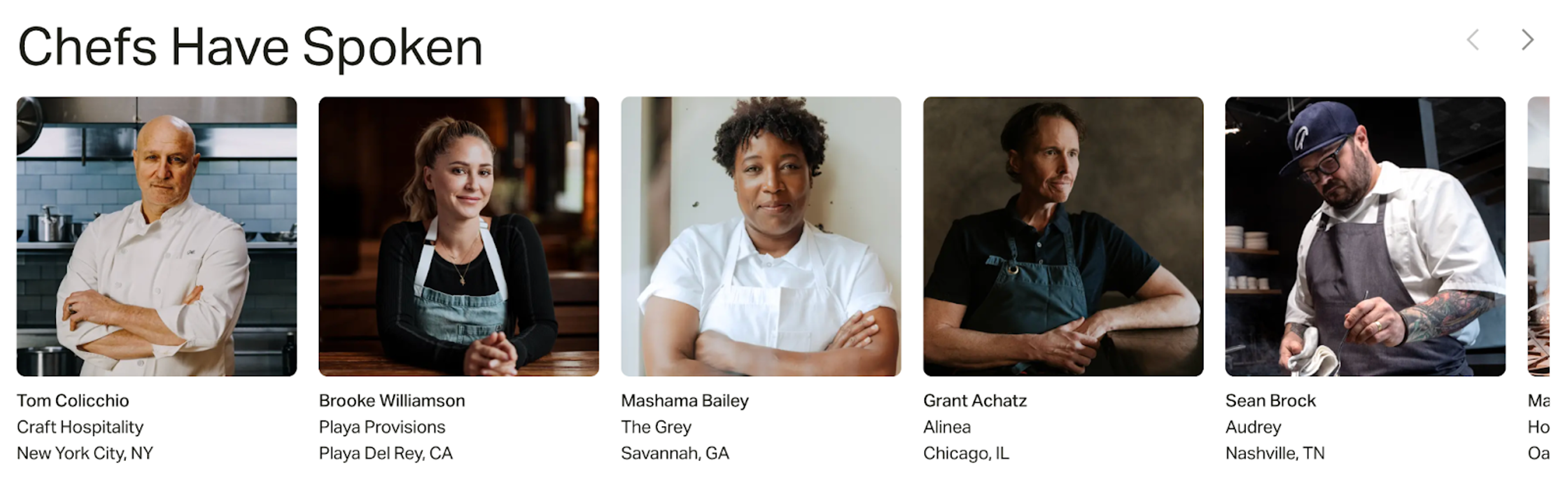
When Tom Colicchio became an early investor and advisor, it was because he'd already tried the pans in his own kitchen. That sequence — product first, relationship second — is the detail that makes the whole network believable.
And it goes further than validation. Nancy Silverton co-designed the bread knife. Colicchio collaborated on a skillet and roasting pan. Chef recipe content lives directly on the product pages, turning what could be a dry technical description into an actual dish you might cook tonight.
That's the flywheel: each chef validates the brand for the next one, and each collaboration makes the product more credible to the home cook watching from the outside. It compounds in a way that a paid campaign simply can't.
In 2023, Made In took their content marketing for ecommerce to the next level, building a professional video studio inside its Austin headquarters.
Black marble countertops, a six-burner range, a full lighting rig. Not a set dressed to look like a kitchen — an actual working kitchen where chefs come to cook, and the cameras happen to be running.
The decision to go in-house was deliberate. By the time the studio opened, Made In had built an in-house content team for ecommerce with editorial backgrounds from publications like Bon Appétit.
The result: a content marketing for ecommerce approach that reads like it comes from a food publication, not a cookware brand and production costs that run at least $500,000 a year cheaper than contracting an external agency.
But the more important decision was what the content is actually about. Made In doesn't make videos about pans. They make videos about cooking: how to care for carbon steel, the difference between a saucepan and a saucier, how to get a proper sear on stainless steel. The product is present, but it's never the point.
That reframe — cooking education brand that happens to sell cookware — is what makes the content strategy stick. A viewer who learned to season a carbon steel pan from a Made In video has a relationship with the brand that no ad impression can manufacture.
The clearest proof of this is their partnership with Jamie Tracey, the "Anti-Chef" on YouTube. Tracey has no professional training.
He films himself attempting complex recipes by Julia Child and Gordon Ramsay, struggling through them in real time, using Made In along the way.
It works precisely because it isn't a sales pitch. It's someone actually learning to cook, which is exactly what Made In's audience is trying to do.
Made In treats creative collaborations the way fashion brands treat seasonal drops, not as endorsement deals, but as launch events with their own story, their own window, and their own scarcity mechanic.
The Tom Colicchio collection is the clearest example. A seasoned skillet and roasting pan, co-designed with a chef who was already a customer and investor. The product has a backstory that holds up because it's true, and a limited run that creates urgency without a discount code in sight.
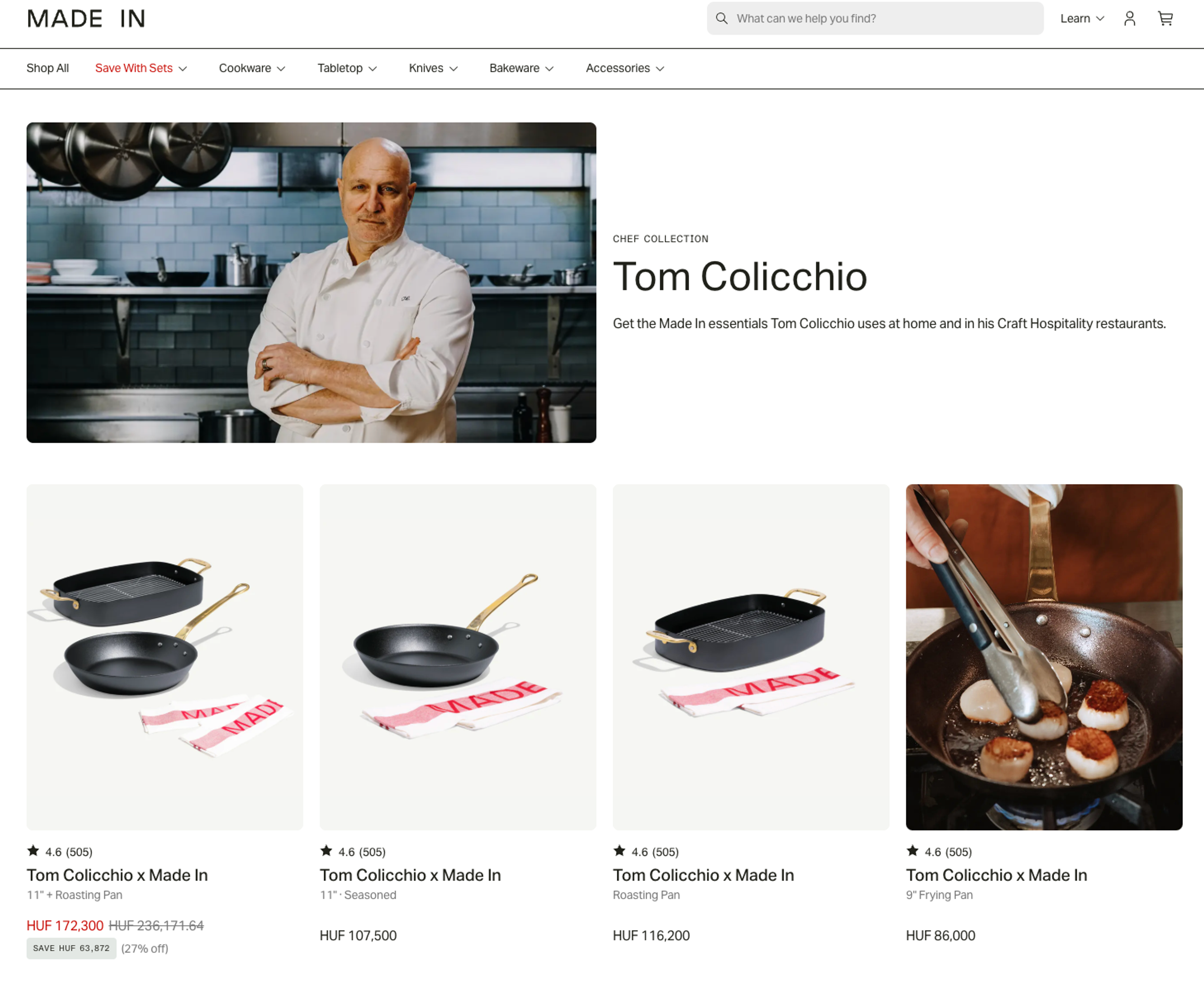
The Wrangler collaboration pushed the concept further. Denim chef jackets and knives with denim handles, products that have almost nothing to do with cookware and everything to do with brand identity.
It worked precisely because it was strange enough to be interesting and coherent enough to make sense.
Then there's the Eric Wareheim steak knife set. Wareheim is a filmmaker and comedian, not a chef, but his food obsession is well-documented and completely genuine.
That's a different kind of credential than a Michelin star, and it reaches a different part of Made In's audience. Someone who would never click on a Tom Colicchio campaign might buy a knife set because Eric Wareheim designed it.
Each collaboration earns press, social content, and new audience exposure at the same time. And because every partner is a genuine enthusiast rather than a paid face, the story holds up the moment anyone looks closely, which, with limited-edition drops, they always do.
Scroll through Made In's Meta ads, and the first thing you notice is what's missing. No flash sales. No "limited time" discount banners. No glossy studio lighting that looks nothing like the organic feed sitting next to it.
The strategy runs across three distinct objectives:
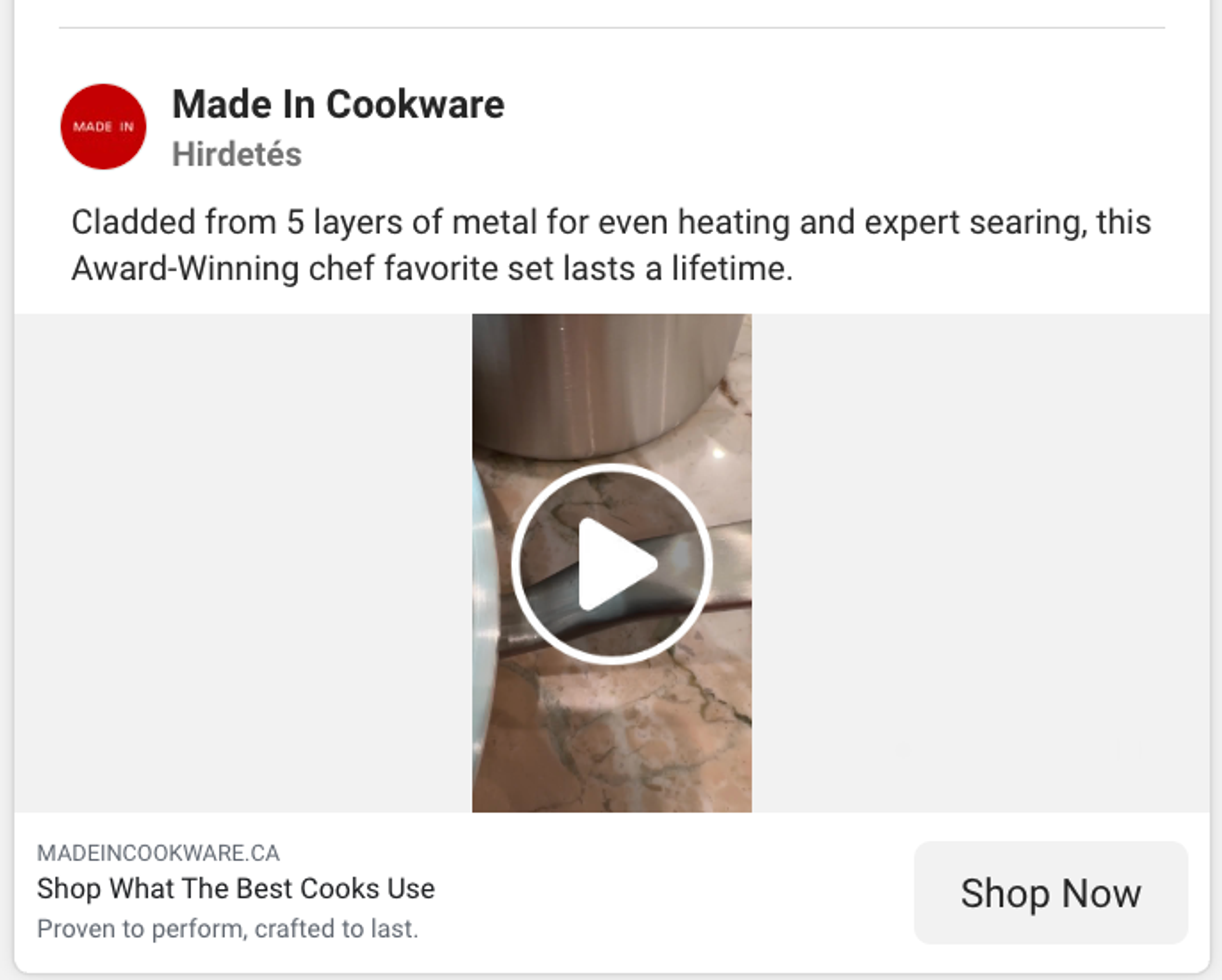
The first targets buyers who already want premium cookware but haven't committed to a brand — leading with chef authority and the "Award-winning cookware, trusted by millions" frame.
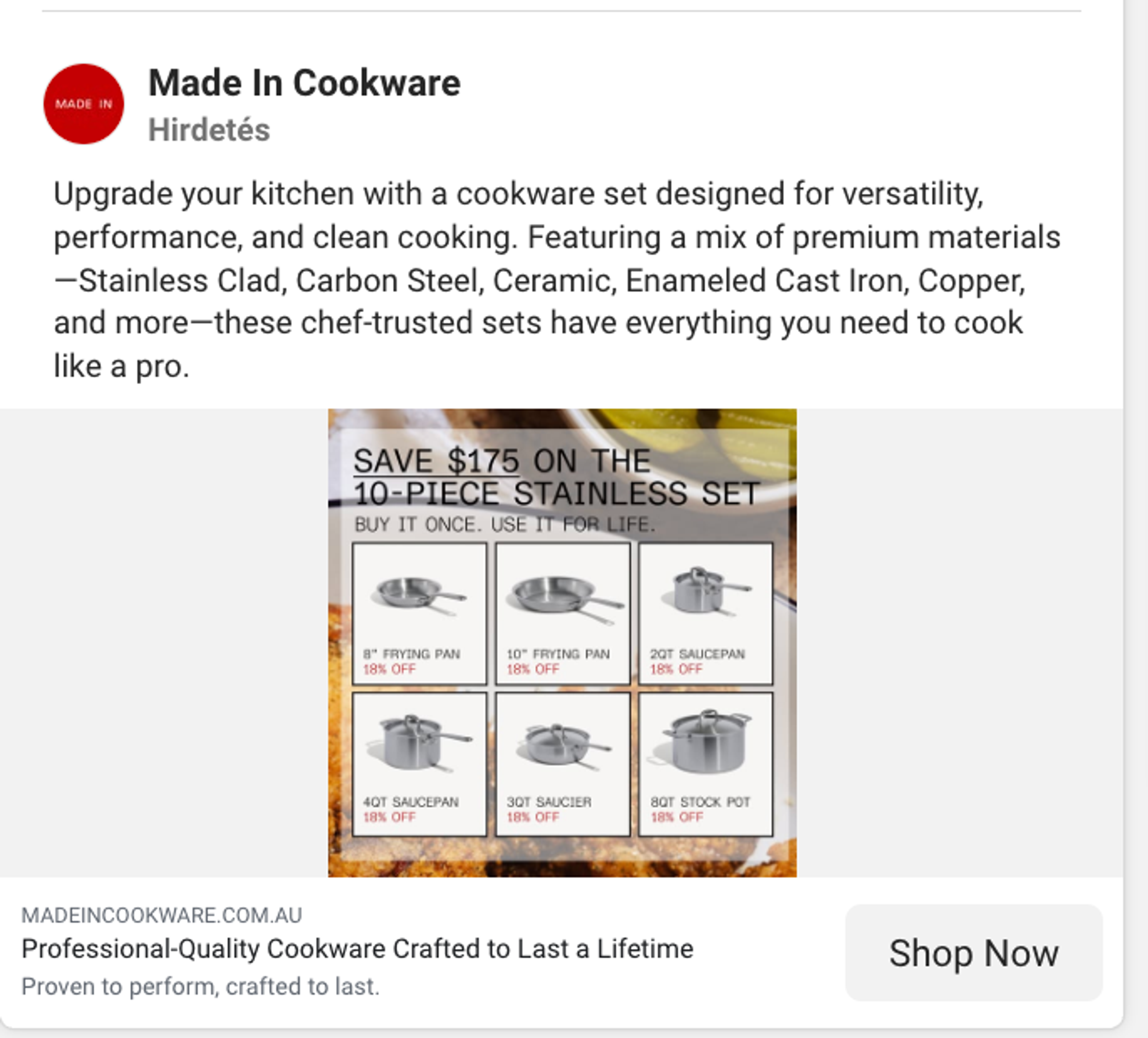
The second targets the growing segment of consumers concerned about PFAS and coatings, with messaging like "Upgrade Your Kitchen With Non Toxic Essentials", an angle tied directly to the CeramiClad line, launched in August 2024 and positioned explicitly as PFAS-free.
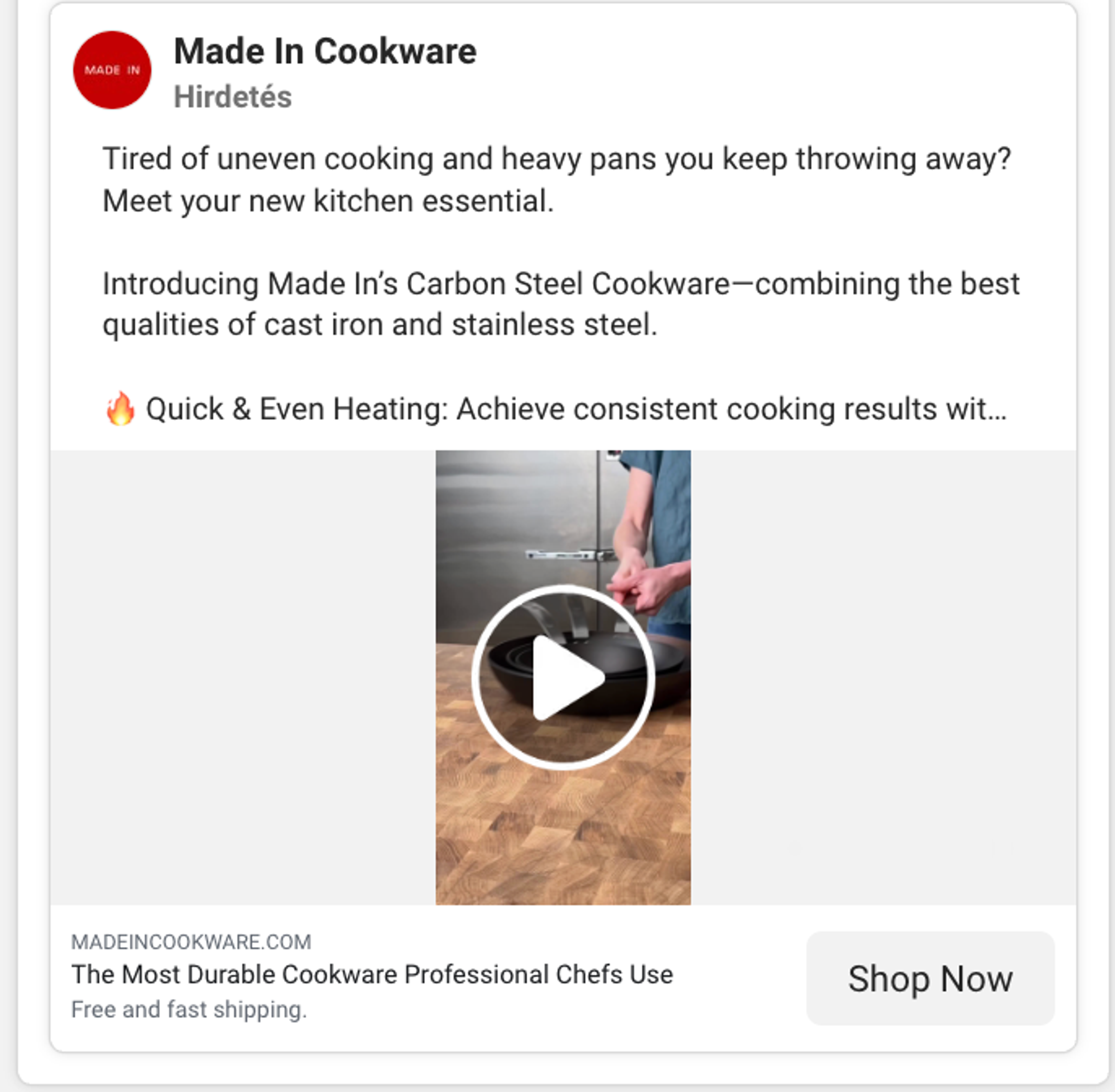
The third does straight product education: the Carbon Steel Griddle ads open with "Tired of uneven cooking and heavy pans you keep throwing away?" and explain the product from scratch, doing at the bottom of the funnel what organic video does at the top.
Cookware is a considered purchase. Buyers research, compare, and remember which brands tried to close them with a coupon.
By keeping paid creative consistent with organic content, Made In avoids the credibility gap that opens the moment a premium DTC brand's ads stop looking like the brand itself.
Before you've read a single line of copy on the Made In homepage, you've already received three conversion signals.
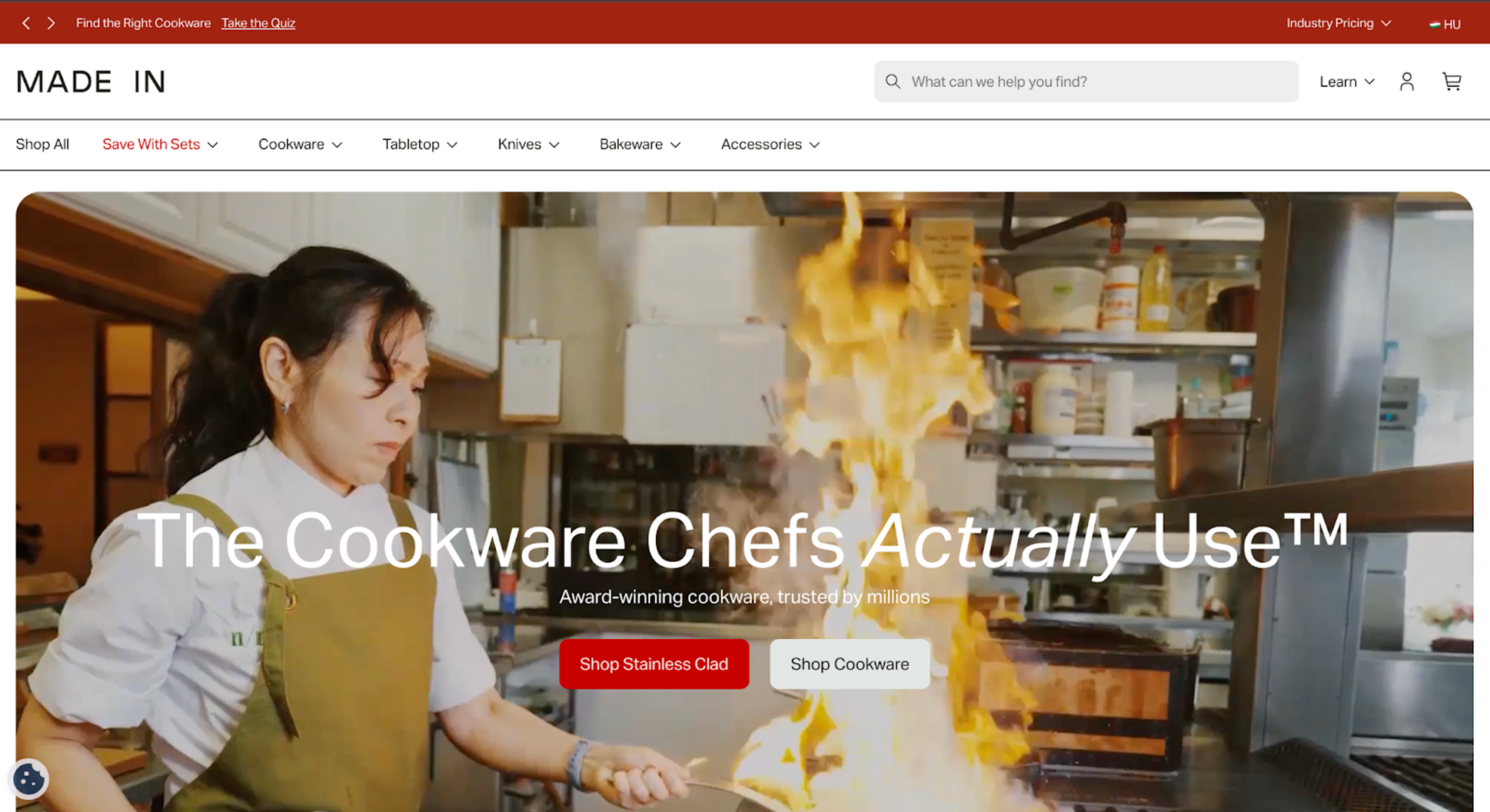
A rotating announcement bar cycles through a quiz funnel, a celebrity collab launch, and a new product drop. Three audiences, three different reasons to click, all before the hero image has loaded.
Then the popup appears. It doesn't lead with a discount. It leads with a secret: "Unlock a Secret Spring Offer."
Before you can see what the offer actually is, it asks why you're here, upgrading to professional quality, outfitting a new home, shopping for a gift, swapping for safety, cooking healthier.
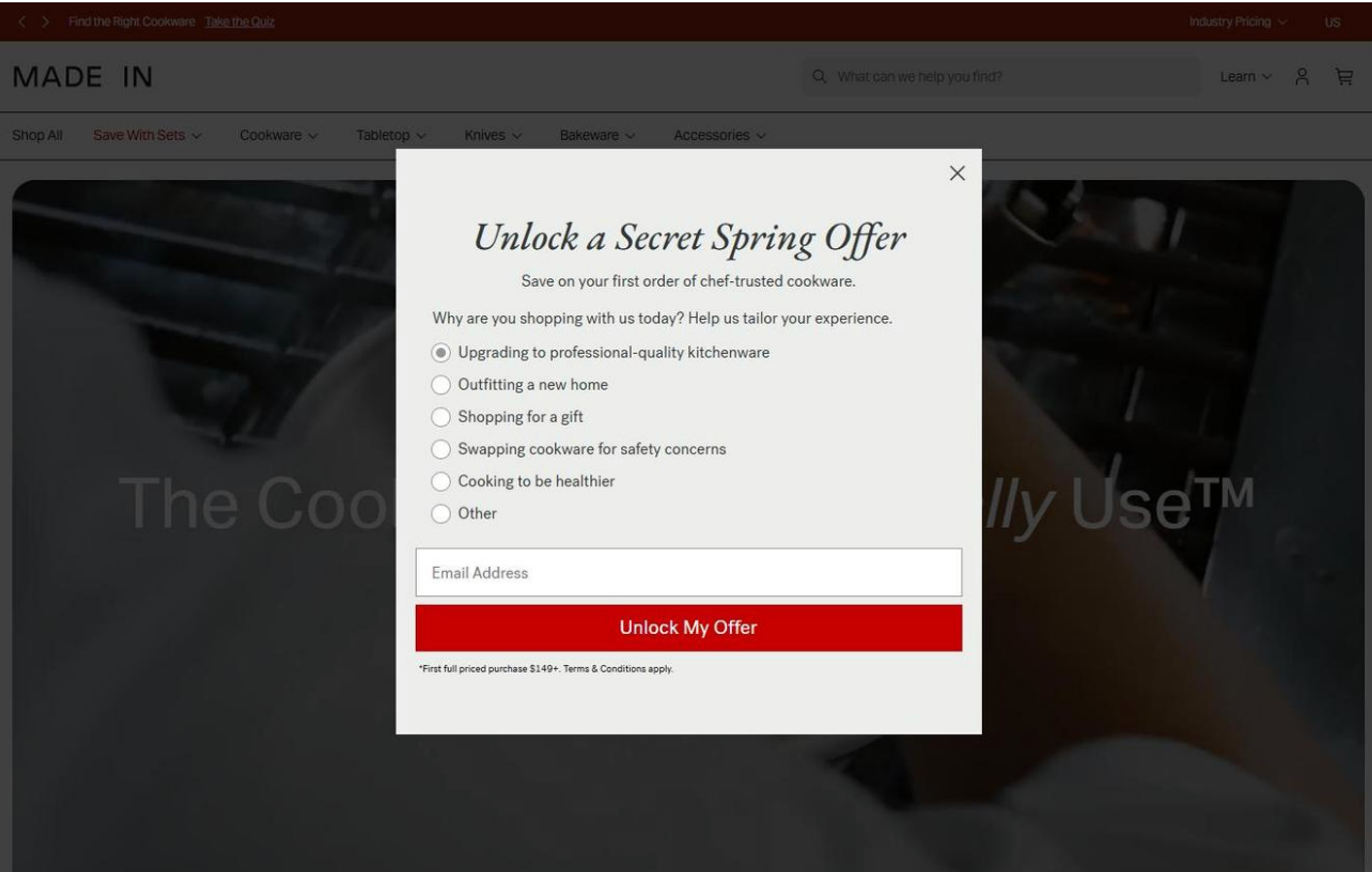
You answer before you've given your email address. The mystery drives completions. The question segments the list. The threshold mechanic nudges order value upward. It's doing three jobs inside a single popup.
Most ecommerce brands ask visitors one question: do you want this? Made In's DTC marketing strategy asks four, and by the time you've answered them all, you've already bought it.
The first is which configuration? A bundle option sits directly above the Add to Cart button, showing savings in both dollar and percentage terms.
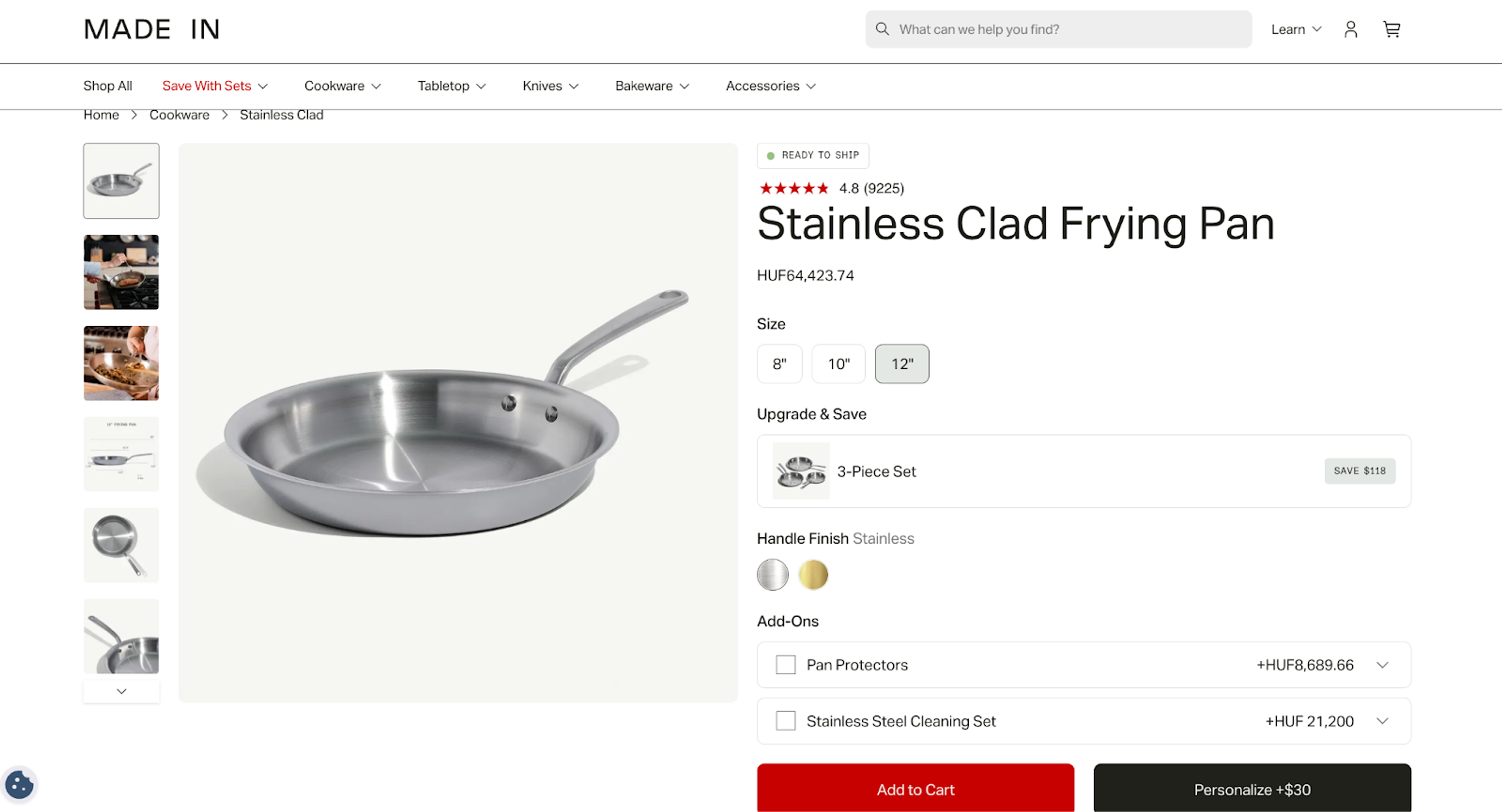
Every visitor processes it before committing to a single item, which reframes the decision from "do I want this pan?" to "which version do I want?" The purchase is assumed. The only question is how much.
The second is what else? Add-ons appear after the primary decision, not before. Shown before the cart, they create friction. Shown after, they feel like upgrades. The total price builds gradually, and each addition feels small because by that point, it is.
The third is how personal. Made In lets you customize handle finish, configuration, and engraving. The moment a visitor personalizes something, it mentally becomes theirs before they've paid for it.
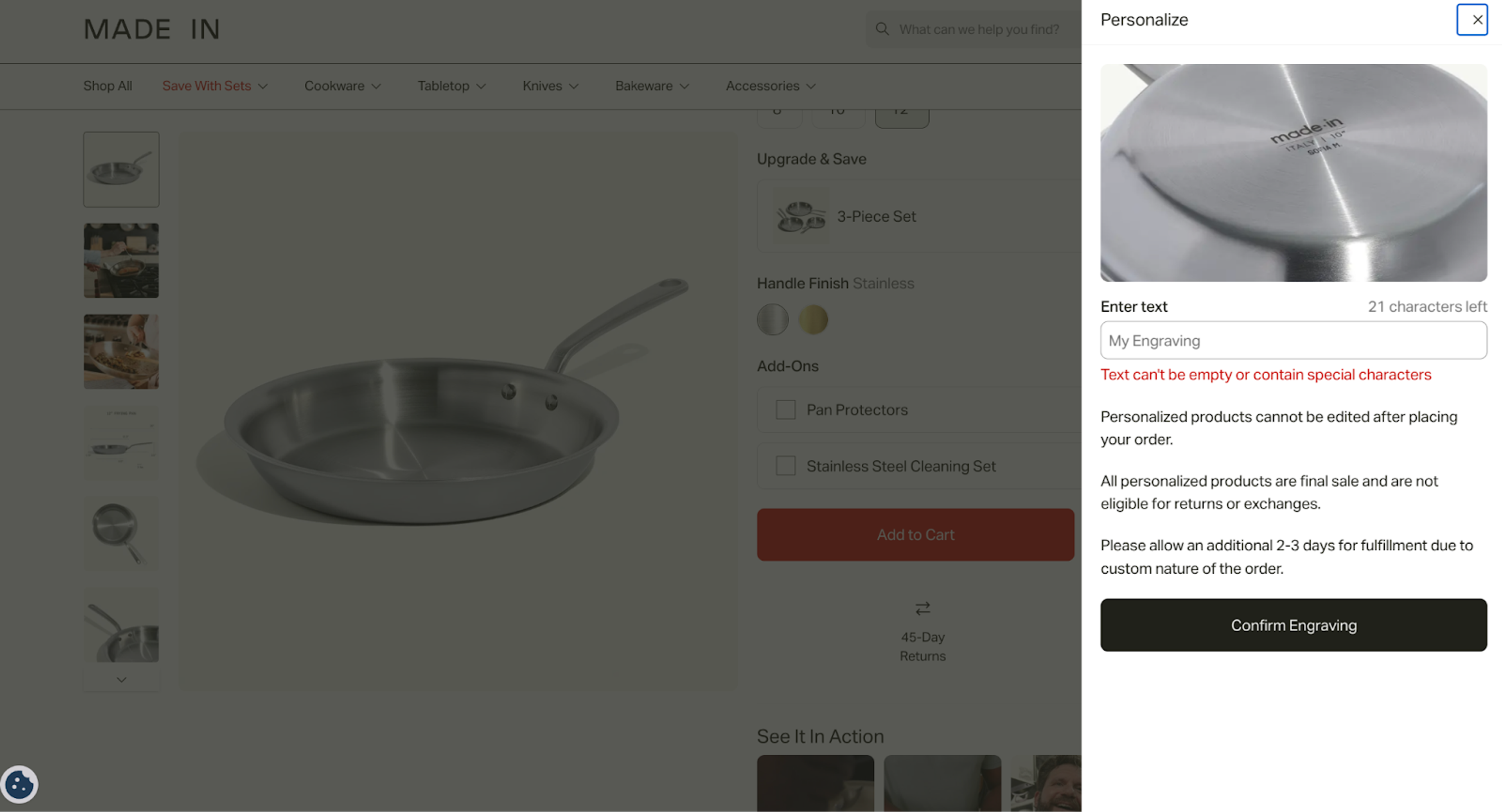
Cart abandonment goes down. Return rates go down. And a customizable pan becomes a gift option, opening a buyer motivation that a standard product page would never reach.
By question four — are you ready to commit? — most visitors already are. They haven't made one large purchase decision. They've made three small ones.
For anyone still on the fence, the page applies one final layer of ecommerce conversion optimization: 9000+ customer reviews at 4.8 stars, chef video testimonials that autoplay on scroll, and a product description detailed enough to answer questions the visitor didn't know they had.
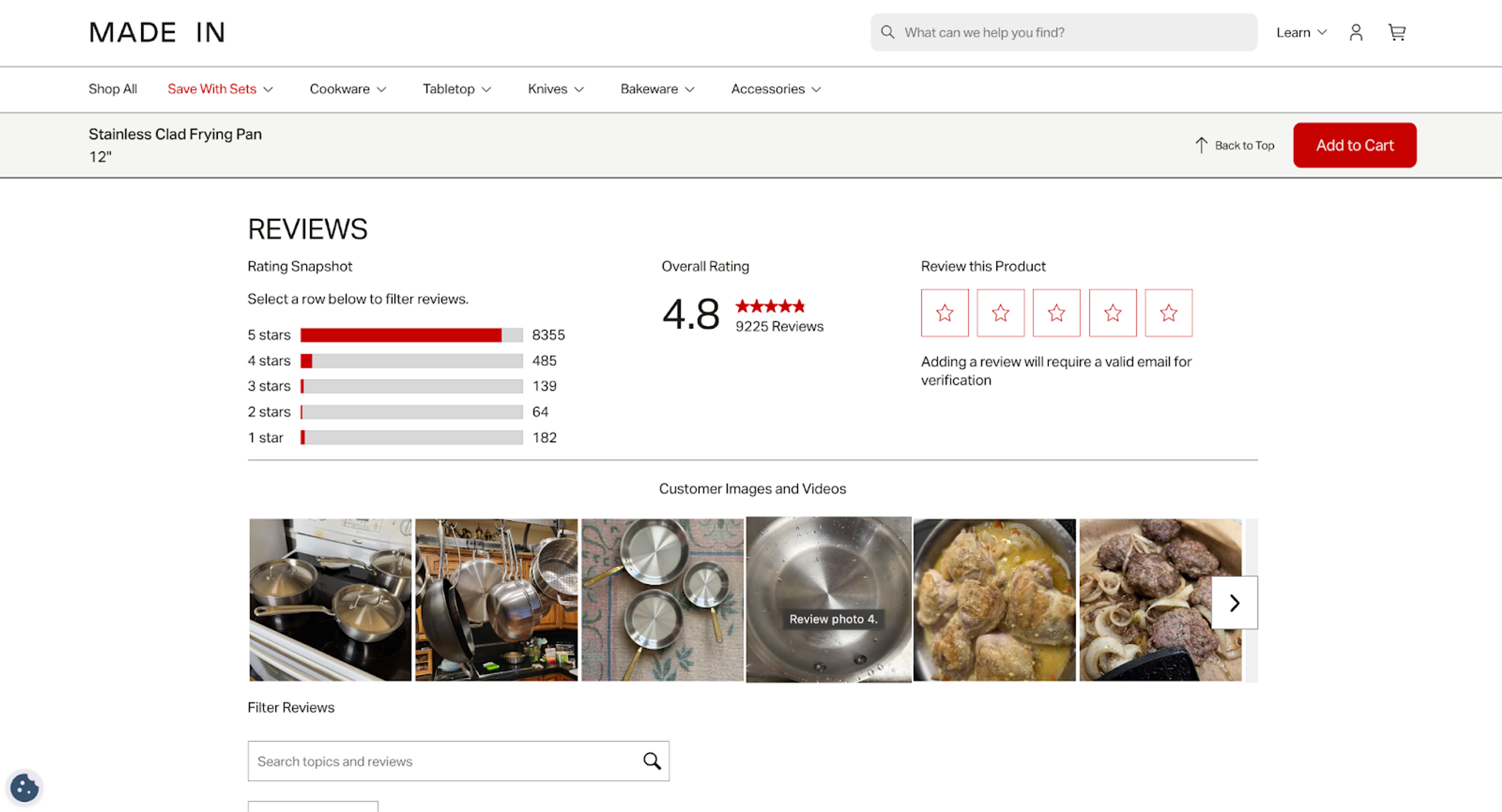
Not to introduce the brand, by this point the visitor already trusts it. Just to remove the last remaining reason not to buy. That's ecommerce conversion optimization at its most systematic and the whole architecture.
What makes a DTC marketing strategy successful? Made In's growth is built on a single counter-intuitive insight: in a category where consumers can't evaluate quality until after they've bought, the most powerful marketing asset isn't an ad, it's a network of people whose professional reputation depends on using the right tools.
By starting with professional chefs and letting that credibility flow outward to home cooks, Made In built something most DTC brands spend years chasing and never find: trust that arrives before the product does. The chef network validates the quality. The educational content teaches people how to use it. The DTC-first, then-retail expansion gives them somewhere to touch it. The website closes the sale.
The in-house content studio is what keeps the whole system running. By producing chef-led educational videos at scale, without agency costs, without losing the thread of the brand, Made In stays in the same lane across every channel. Authentic, skill-based, rooted in professional kitchen culture. The story doesn't change depending on where you encounter it.
What other premium DTC brands can take from this isn't the specific tactics. It's the underlying logic of a great DTC marketing strategy: find the credibility transfer that no amount of ad spend can replicate, then build everything else around letting that credibility do the selling.
For Made In, it was professional chefs. For every brand, there's an equivalent, the community of genuine experts whose endorsement, if earned rather than bought, changes how everyone else perceives the product.

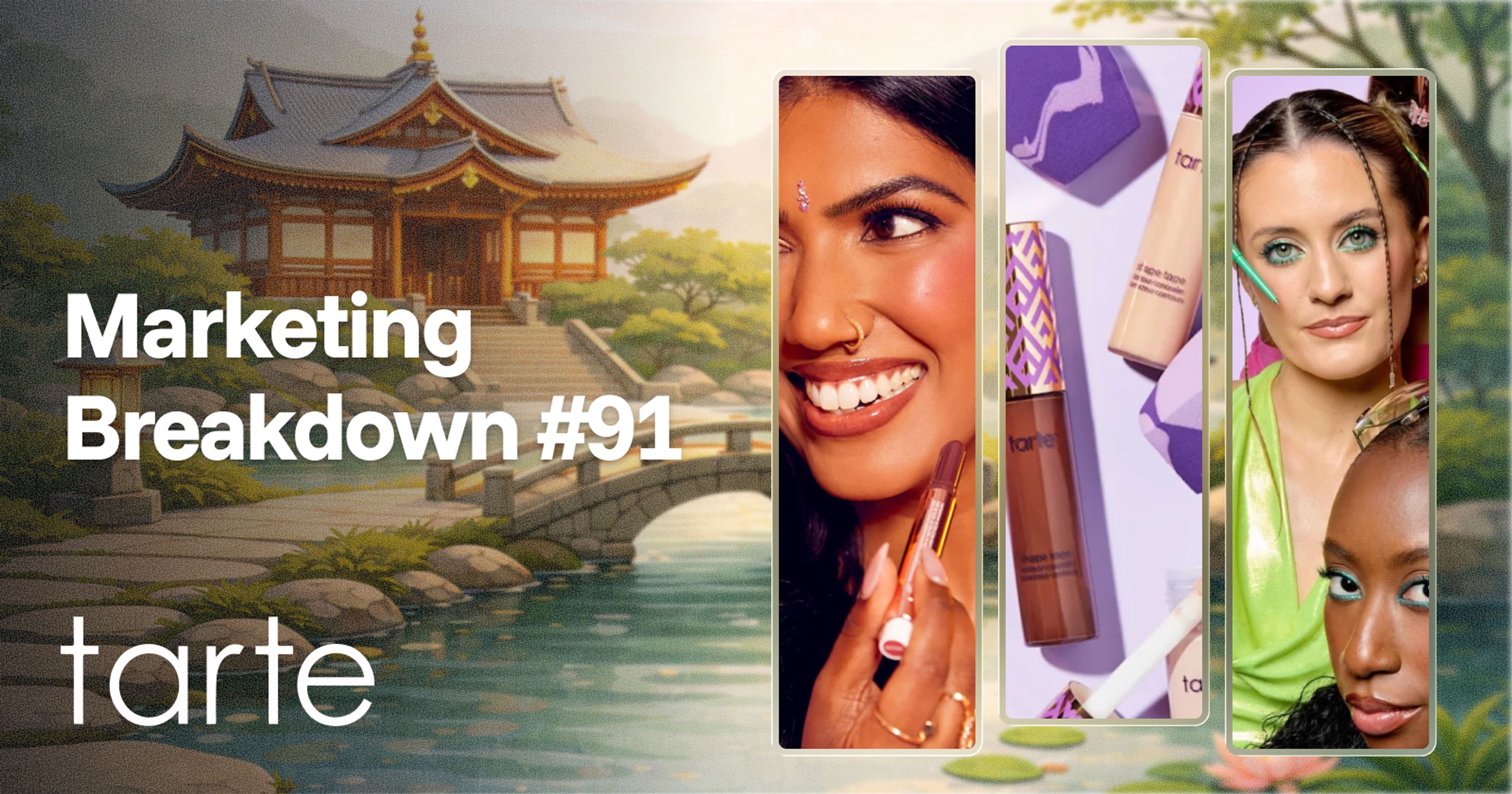
How Tarte turns founder storytelling, creator trips, TikTok virality, and smart on-site funnels into a repeatable beauty marketing growth engine.
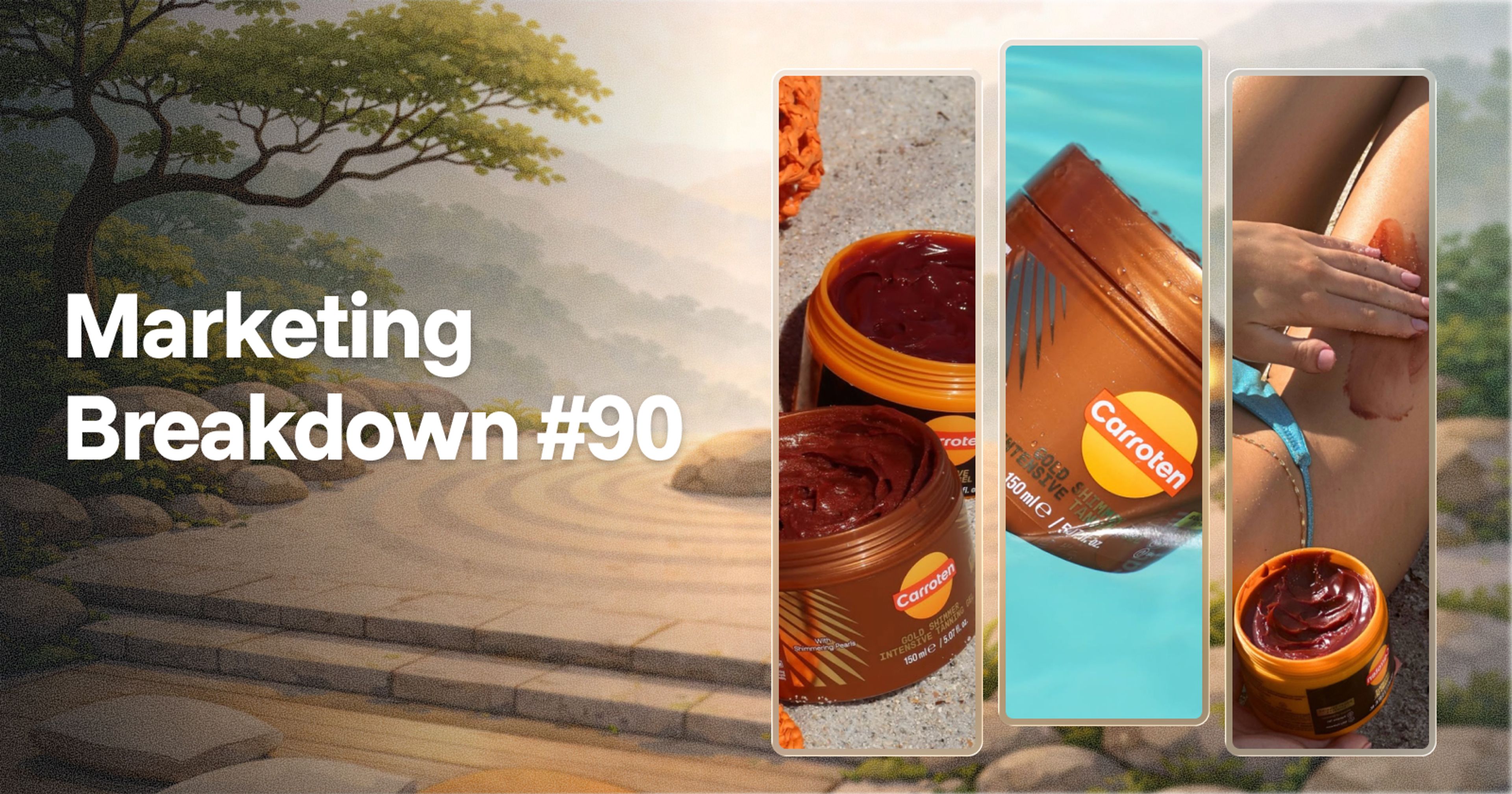
How Carroten went from unknown to every US Target shelf in under a year — using TikTok virality, creator-led commerce, and heritage brand positioning.
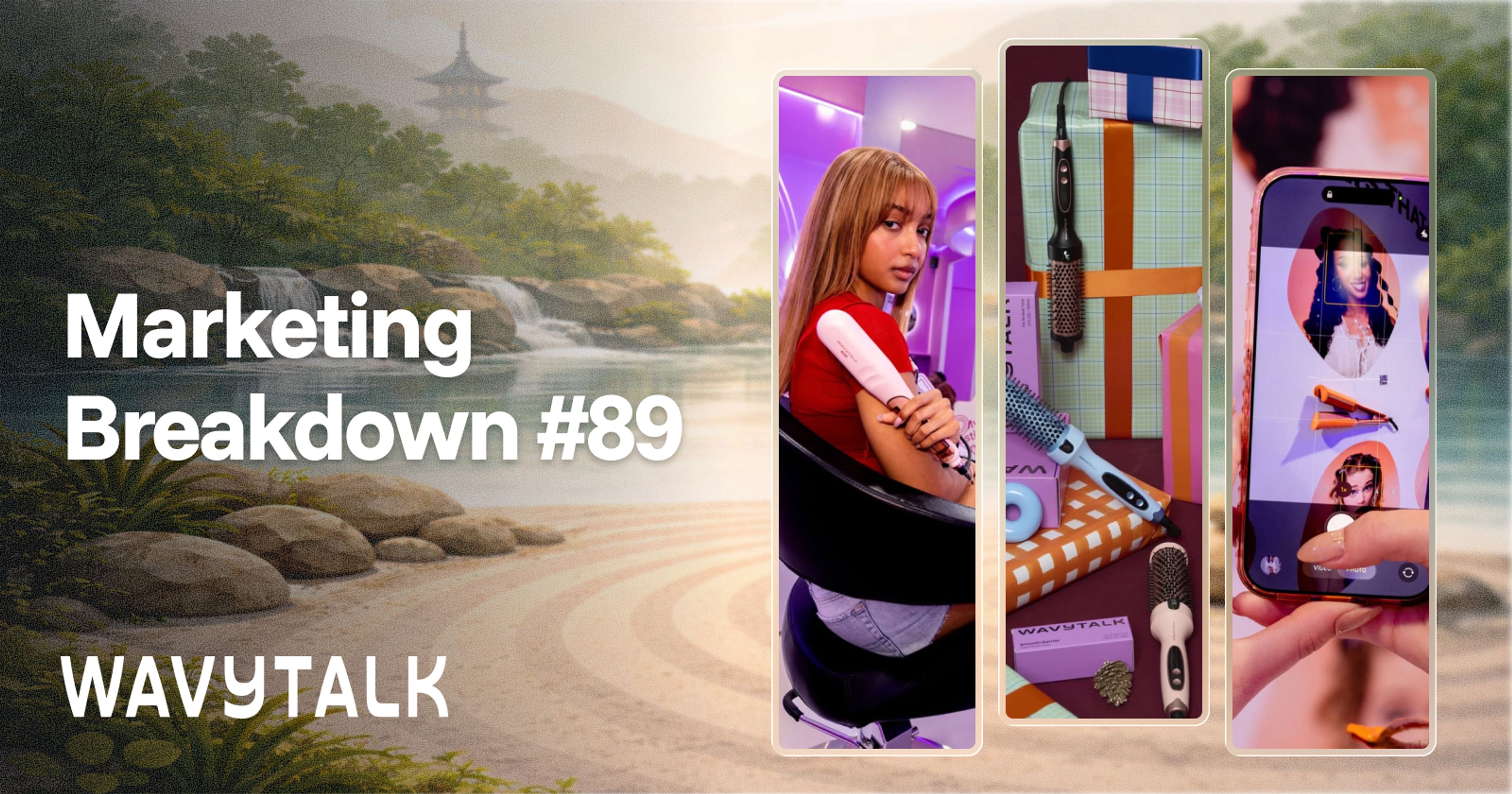
A deep dive into WavyTalk’s marketing strategy, from TikTok Shop and creator-led launches to UGC, cultural moments, and high-converting DTC tactics.