


Tarte Cosmetics Marketing Breakdown: How a 25-Year-Old Beauty Brand Keeps Making Products Feel Viral
How Tarte turns founder storytelling, creator trips, TikTok virality, and smart on-site funnels into a repeatable beauty marketing growth engine.
A deep dive into WavyTalk’s marketing strategy, from TikTok Shop and creator-led launches to UGC, cultural moments, and high-converting DTC tactics.
In short
WavyTalk didn’t grow by selling hair tool specs. It grew by turning a $52 thermal brush into a social commerce engine. The brand moved early on TikTok Shop, built products that naturally created before-and-after content, turned creators into collaborators, borrowed credibility from celebrity stylists, and connected cultural moments like Coachella to product launches. But the real growth engine was the full system behind it: UGC, creator trust, paid media, urgency, social proof, and a conversion-focused website working together to turn attention into revenue.
Most hair tool brands compete on specs. Barrel temperatures. Ionic technology. Ceramic coatings. WavyTalk's marketing strategy ignored all of that and built a community instead, then let the community drive the commerce.
Launched in 2021 as an Amazon-exclusive brand, WavyTalk spent its first two years quietly perfecting a single hero product: a $52 thermal brush that would eventually become one of the most talked-about hair tools on the internet.
When the brand joined TikTok Shop in August 2023 — among the first TikTok Shop beauty brands to do so — everything accelerated.
A million units sold on Amazon. TikTok Shop beauty sales growing 100% year over year from a single new channel. Five billion media impressions, built less on ad spend than on a content engine that turns every customer into a potential creator.
Let's break down the WavyTalk marketing strategy in full!
WavyTalk didn't blow up on magazine pages or through celebrity-fronted TV spots. It grew on TikTok, where a real person showing a real blowout in real time is worth more than any studio ad.
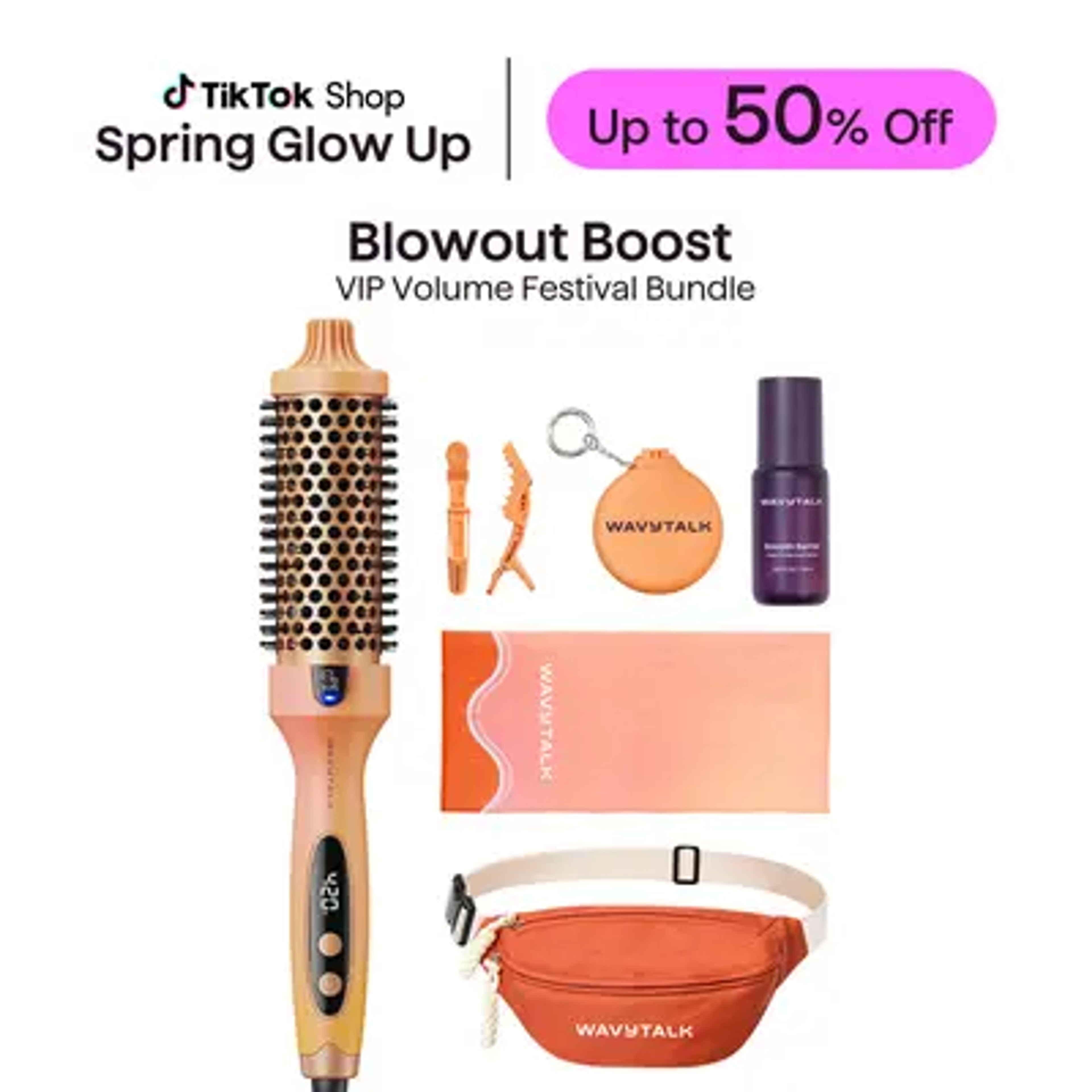
Joining TikTok Shop in August 2023 — before most beauty brands had even considered the platform a legitimate retail channel — gave WavyTalk's social commerce strategy a structural advantage that money couldn't have bought:
The timing paid off in ways that are hard to overstate. During a single Superbrand Day event in September 2024, WavyTalk generated $1.5 million in revenue across 48,000 orders in one week. A follow-up event in October 2025 hit $1.53 million, surpassed 135% of its target, and ranked third overall on TikTok Shop for the period.
Hair transformations are among the highest-performing content formats on TikTok. Every tutorial, every before-and-after, every "I tried this viral brush" video is simultaneously entertainment and shoppable content, the most powerful sales format in existence.
WavyTalk didn't manufacture that content. They built a product designed to produce visible, satisfying results in real time, which meant the content created itself.
In social commerce, being first doesn't just earn you sales. It earns you infrastructure.
Most brands treat beauty influencer marketing as distribution. You pay someone to show your product. You get reach. Transaction complete.
WavyTalk embraced creator co-creation instead. They made creators actual collaborators in the product-creation process.
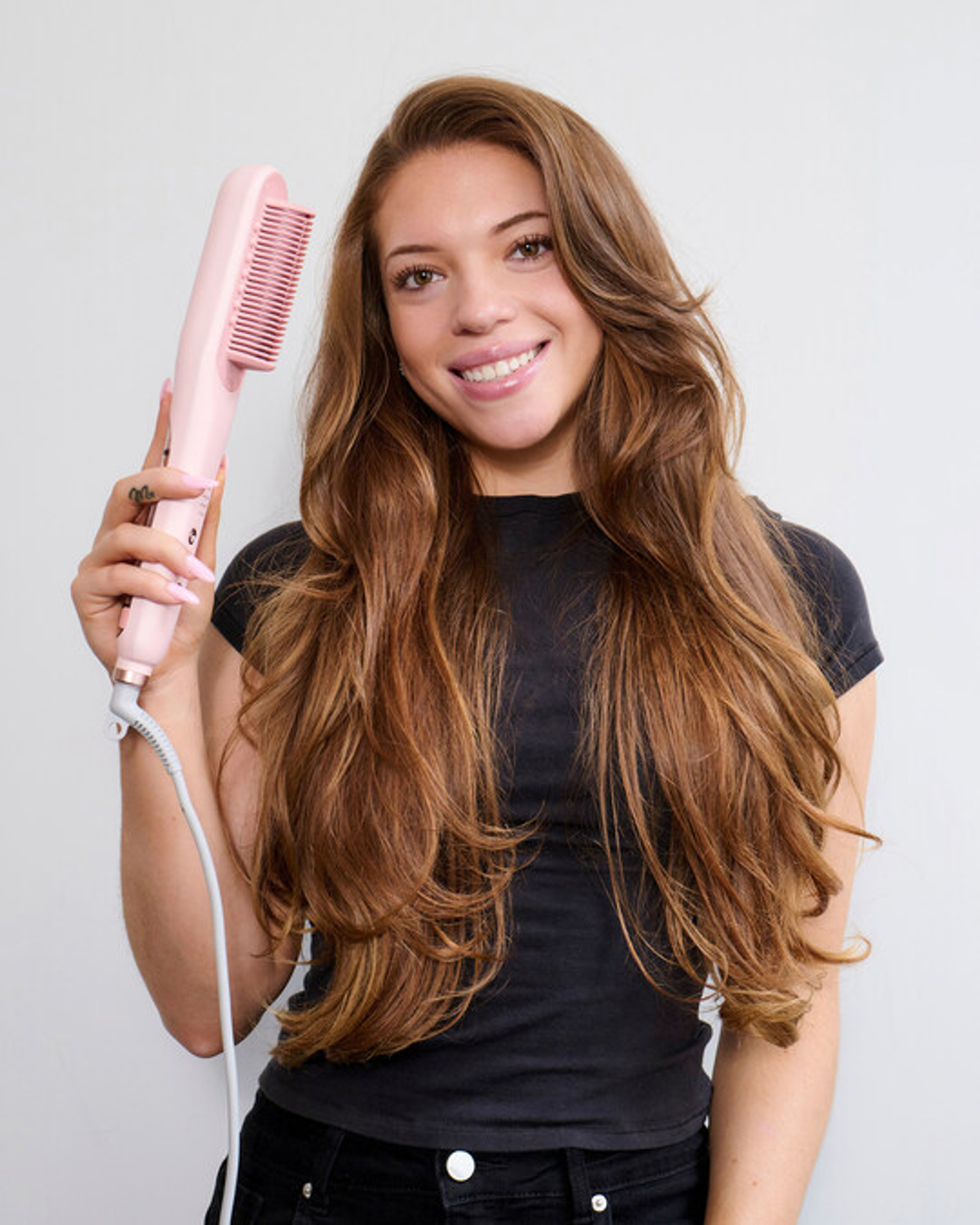
She was the first person to test early prototypes. She provided feedback that shaped the final product. She personally selected the launch colors, pink and white. She chose the accessories that shipped with it. Each box included a personal note from her.
Athena's audience didn't receive a sponsored post about a tool she was paid to hold. They received documentation of a product she'd spent months helping build. The difference in how that lands is not subtle.
When a creator co-designs a product, they can speak with authority about every design decision, every prototype they tested, every detail they personally advocated for. That specificity is what audiences trust and it's impossible to fake.
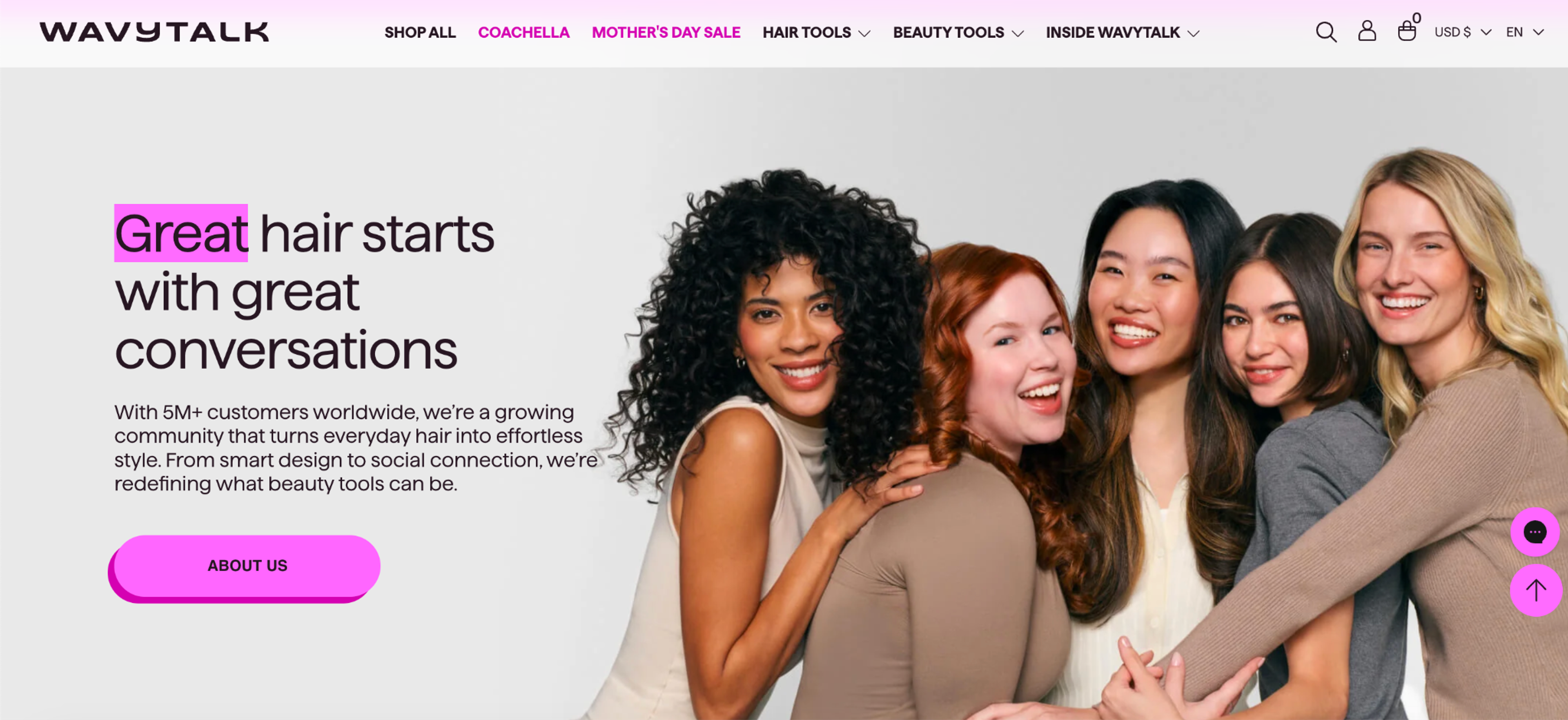
WavyTalk's tagline — "Great hair starts with great conversations" — isn't positioning copy. It's a strategic operating principle.
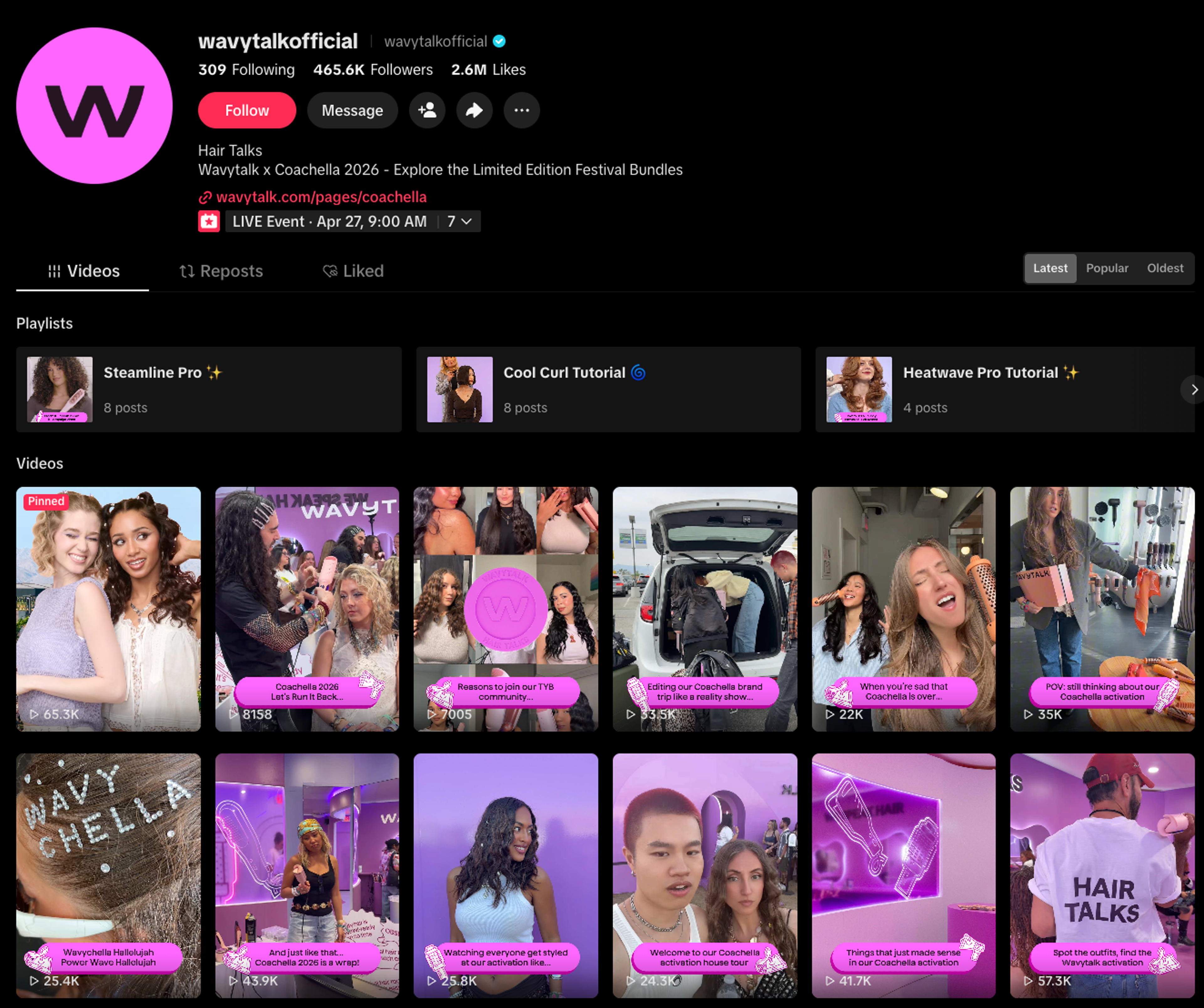
The thermal brush became one of the most organically documented hair tools in TikTok history. Not because the brand paid for that coverage, but because the results were visible, repeatable, and shareable.
Thousands of users posted their own transformations. The brand's profile sits at 465,000 followers with 2.6 million likes, but the real footprint lives in the user-generated content marketing that exists off-brand, keeps accumulating views independently, and costs WavyTalk nothing to maintain.
Hair tools are uniquely suited for this. A customer who achieves a great blowout in ten minutes has a natural incentive to share it, to seek validation and to help people with similar hair.
That organic motivation is worth more than any paid campaign because it carries something paid campaigns can't manufacture: the implicit credibility of a personal recommendation from someone with nothing to gain.
The brand's ambassador infrastructure reinforces the loop. By framing itself as "a community of people like you who love styling their hair," WavyTalk positions every customer as a potential contributor rather than a passive consumer.
That identity shift costs nothing to maintain and compounds over time.
Accessible brands face a ceiling. At some point, the consumer who wants professional-quality results starts wondering whether a $52 brush can really deliver them.
WavyTalk's answer was to recruit the professionals themselves and to do it in escalating stages.
First, celebrity stylist Andrew Fitzsimons was introduced as the brand's first-ever professional brand ambassador in July 2024 at a Brooklyn launch event. The event was attended by representatives from TODAY Show, Allure, Byrdie, InStyle, and E! Online.
Next, Scott King, Sabrina Carpenter's personal stylist, became the official hair tool partner for Carpenter's "Short N' Sweet Tour."
Finally, Marc Mena styled Madelyn Cline's Met Gala hairstyle in May 2024. This collaboration alone generated 25 creator offshoots, bringing in a total of 170,000 views.
When a celebrity's actual hairstylist — someone with access to every premium tool on the market — chooses WavyTalk on a red carpet, it communicates something no ad can: the product is genuinely competitive.
Each professional partnership also generates a wave of tutorial content, media placement, and UGC that operates independently of the brand's marketing budget long after the collaboration ends.
WavyTalk became the Official Hair Tools Partner of Coachella 2026. Not a sponsor in the traditional sense, a partner with products built specifically around it.
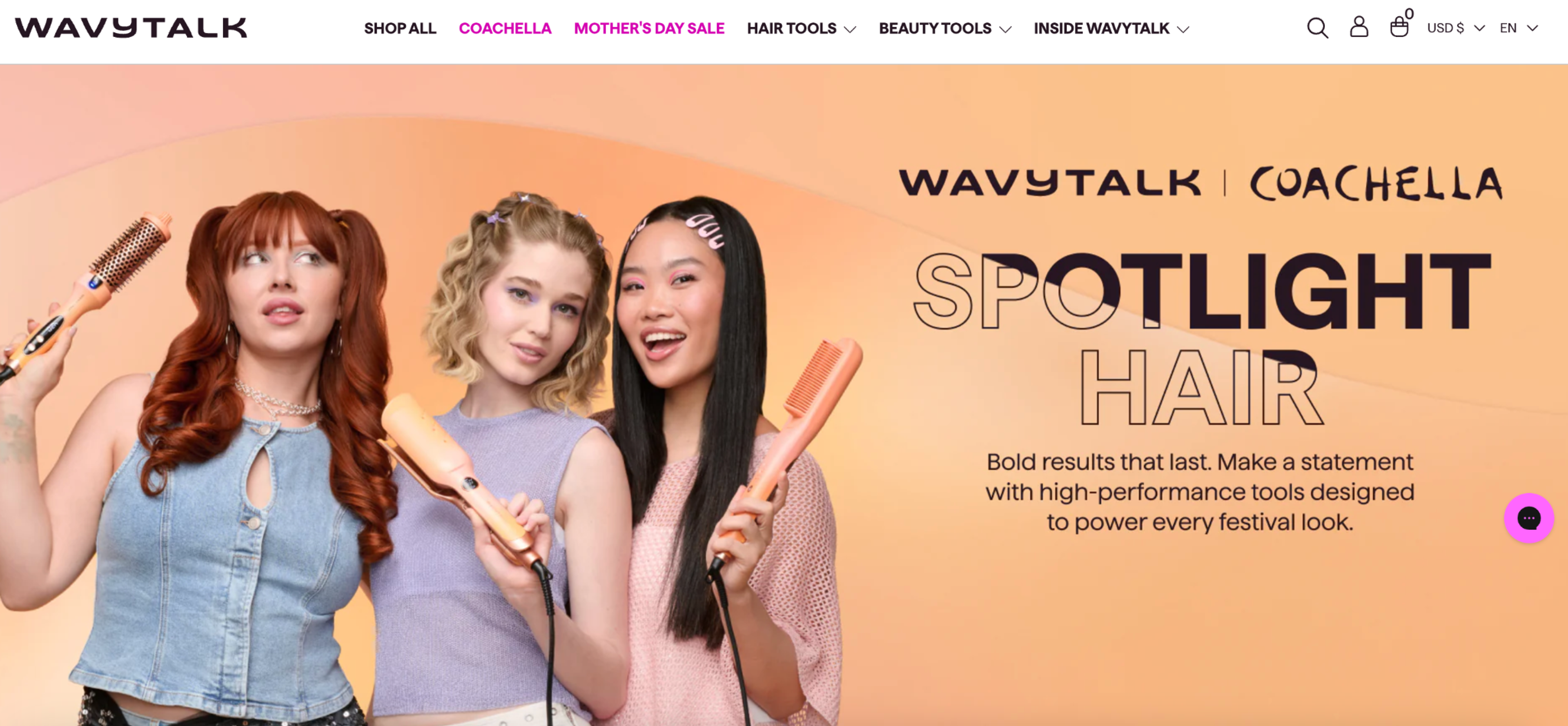
Three limited-edition festival bundles, designed around the looks that define the event:
PinkPantheress and Bretman Rock played a key role in increasing the visibility of the Coachella-themed products, each making high-profile appearances to promote the brand and its exclusive offerings for the festival.
In addition, exclusive masterclass sessions were held, offering fans an insider look at how to achieve festival-ready styles using WavyTalk tools. This content was shared across multiple platforms, feeding back into the brand’s content ecosystem, deepening engagement with potential customers.

To further excite their audience, WavyTalk launched a "Golden Ticket" promotion, where five limited-edition bundles contained a hidden $500 gift card, giving every purchase a chance to win the coveted prize.
Coachella is one of the most photographed and documented events in popular culture, with festival hairstyles being shared, saved, and searched millions of times each year.
By positioning WavyTalk tools as the key to recreating these iconic looks, the brand turned cultural interest into direct purchase intent. The limited-edition bundles made that intent feel urgent. These weren’t just effective tools; they became collectible expressions of a cultural moment.
WavyTalk's Meta ads follow a formula that's deceptively simple:
No overproduction. No clever brand storytelling. Just the fundamentals, executed consistently at scale.
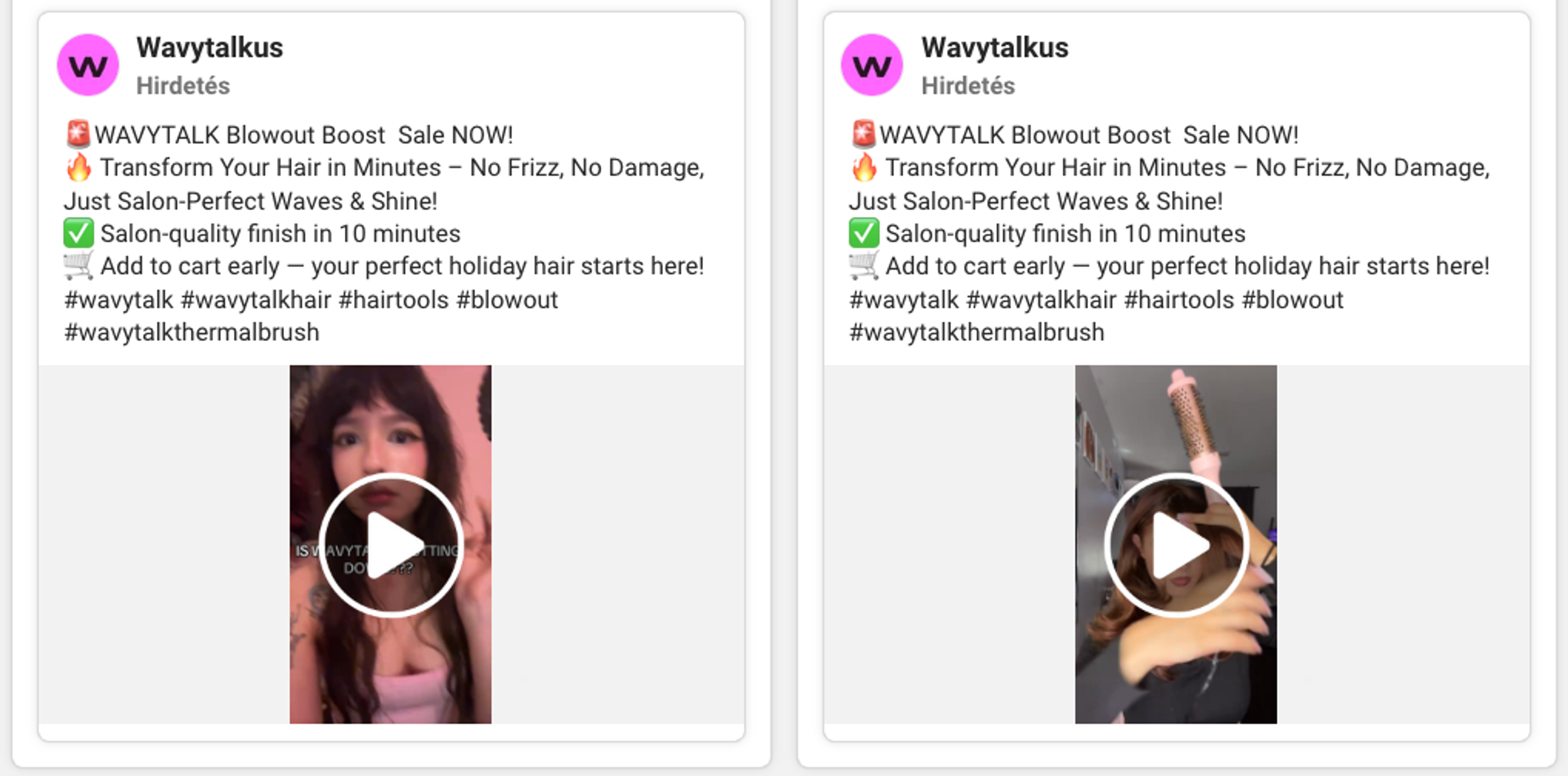
The hooks are problem-first — "Tired of spending hours styling your hair?" qualifies the audience in the first second. The copy sells outcomes rather than features:
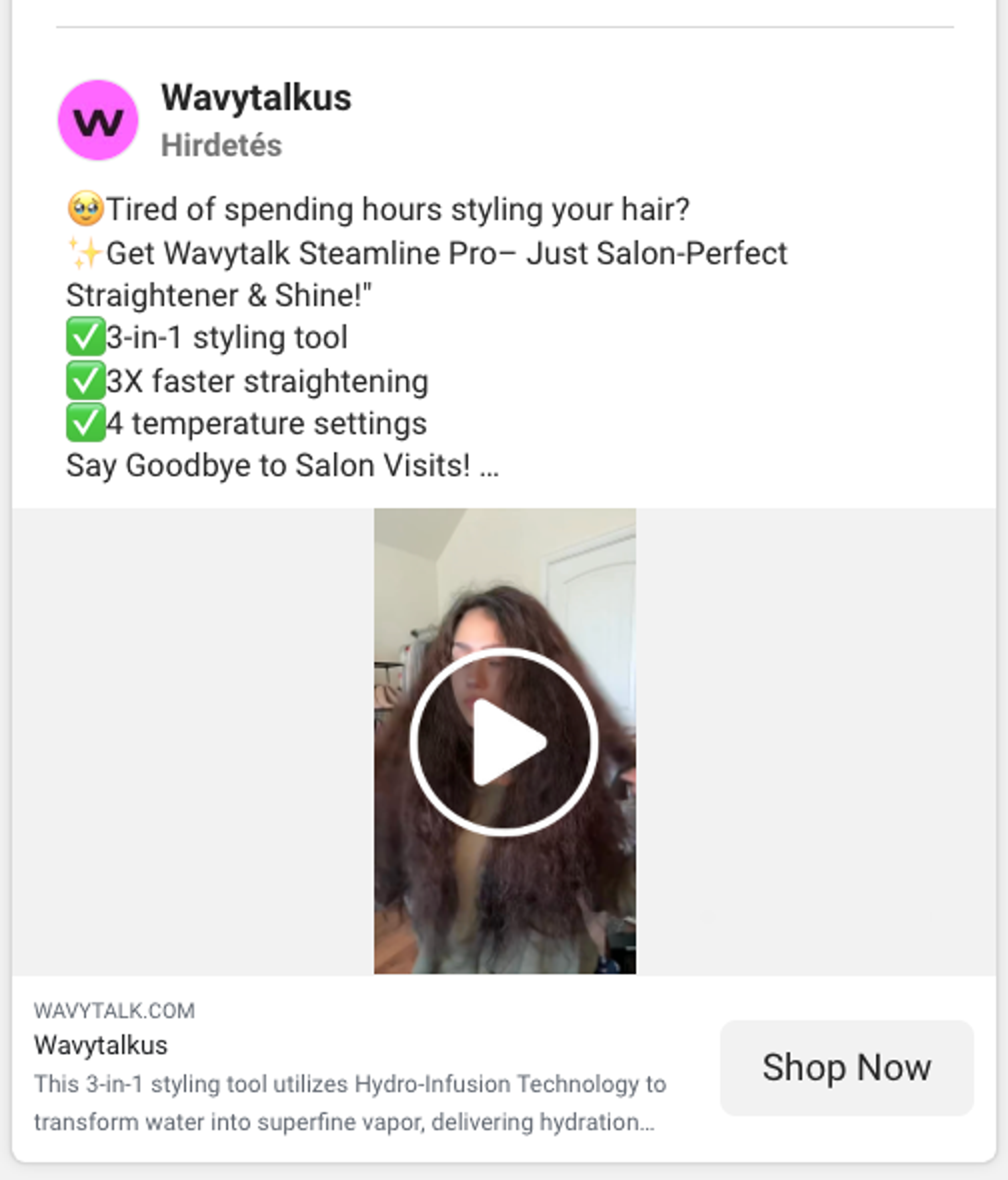
Speed appears in almost every creative because speed is the actual pain. The UGC format makes it feel native rather than sponsored, and winning angles get reused with small variations, letting the algorithm find the best-performing version rather than guessing upfront.
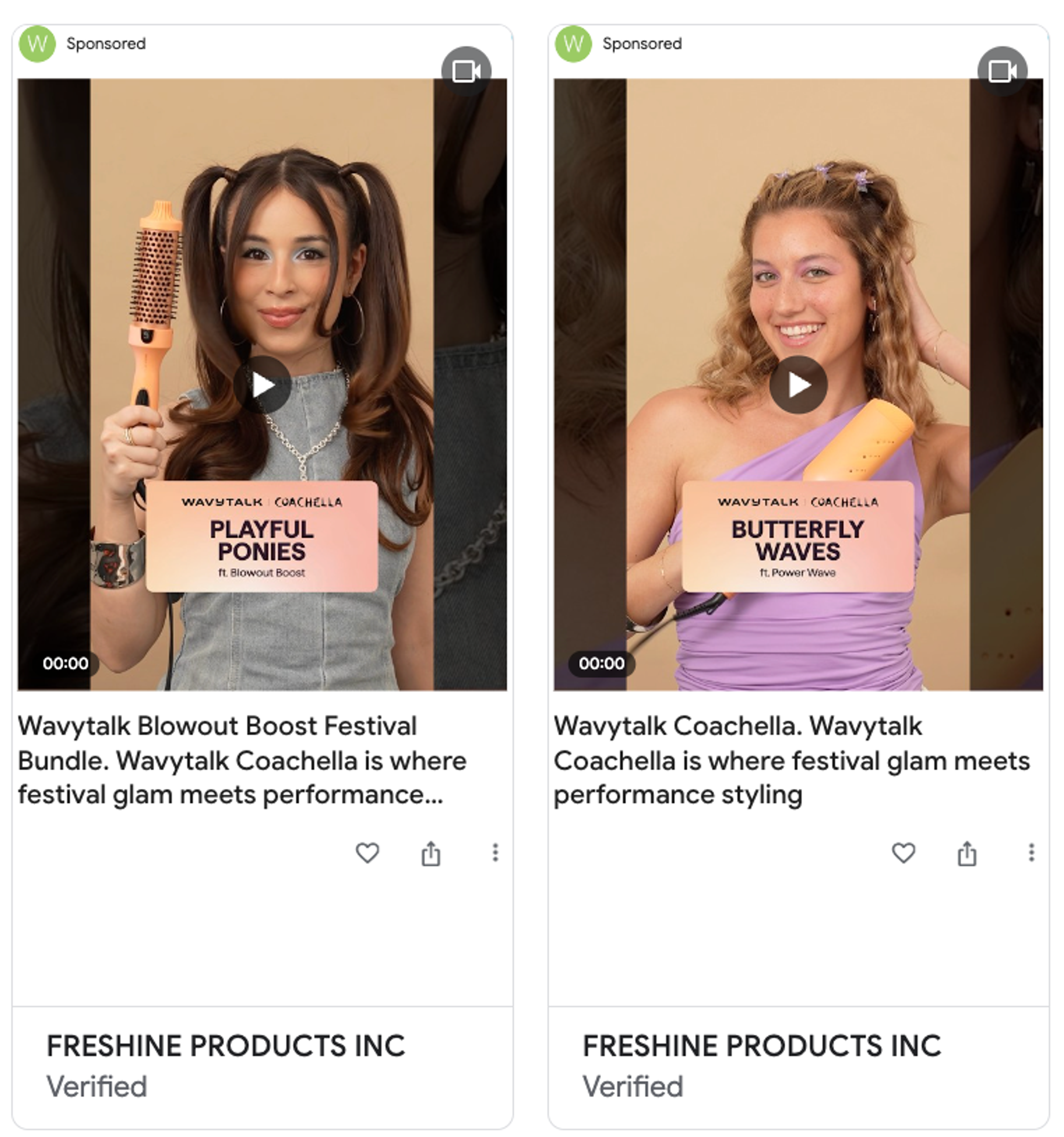
Google operates on a different logic entirely and WavyTalk treats it that way.
Video dominates. Short-form vertical ads target mobile users in YouTube feeds and Google Discover with headlines built for fast consumption: "Wavytalk Power Wave. Ionic technology reduces frizz for smooth, shiny, long-lasting waves."
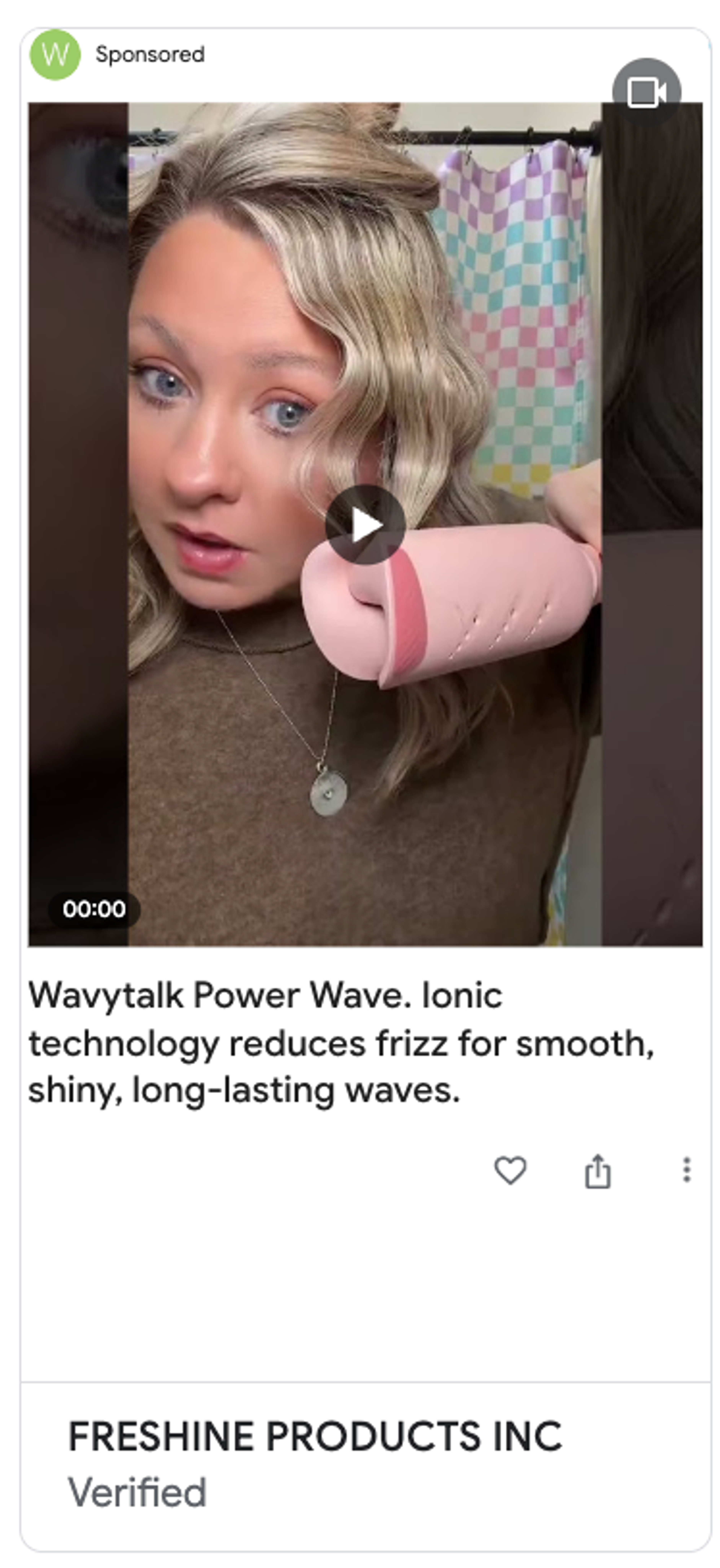
Simple enough to land in three seconds, specific enough to hold for thirty.
Display serves mid-funnel browsers who have already shown category interest:
No storytelling required. Search closes the loop with text ads targeting high-intent queries, leading with current promotions and sitelinks that cut the path to purchase as short as possible.
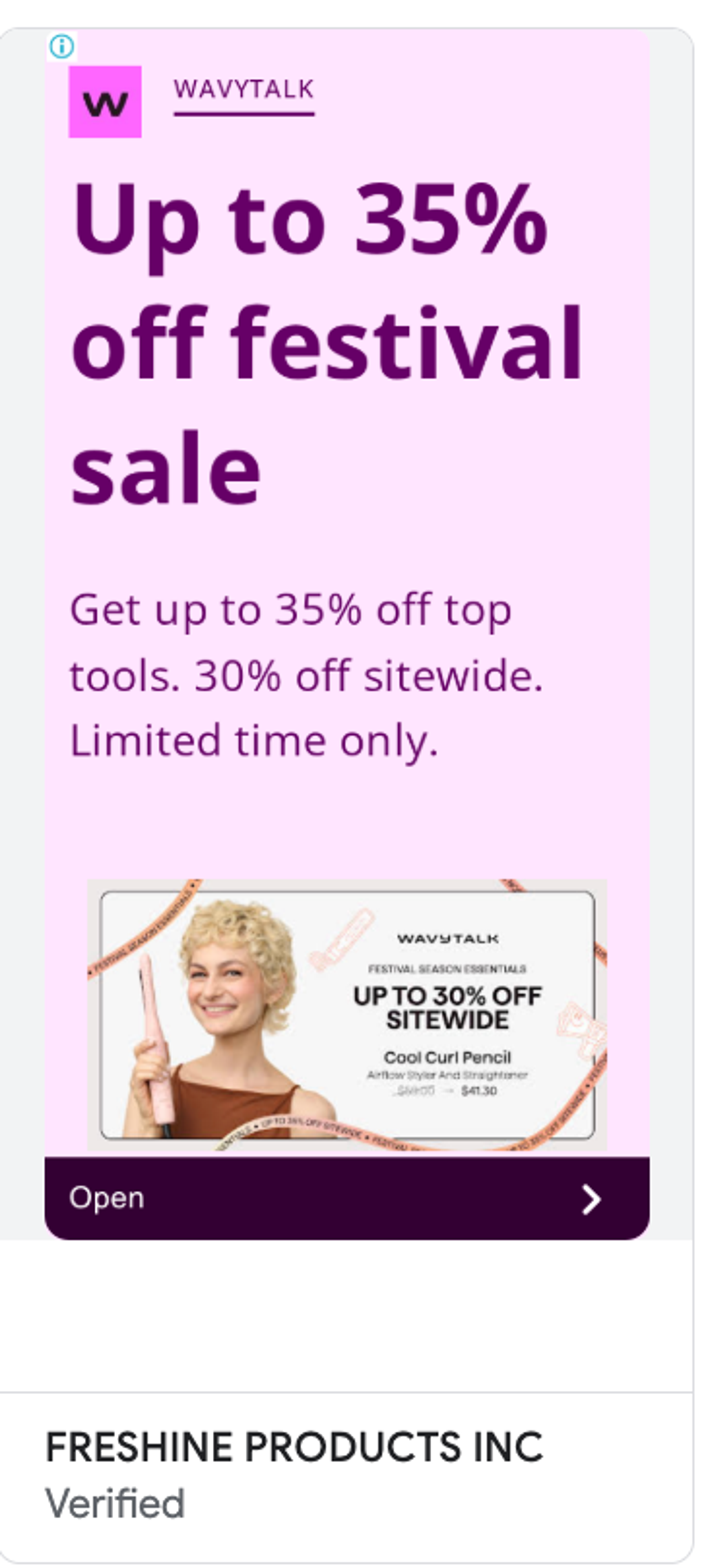
The through-line across all of it is creative-context fit. On Meta, the ads look like TikToks. On YouTube, like tutorials. On Display, like sale banners.
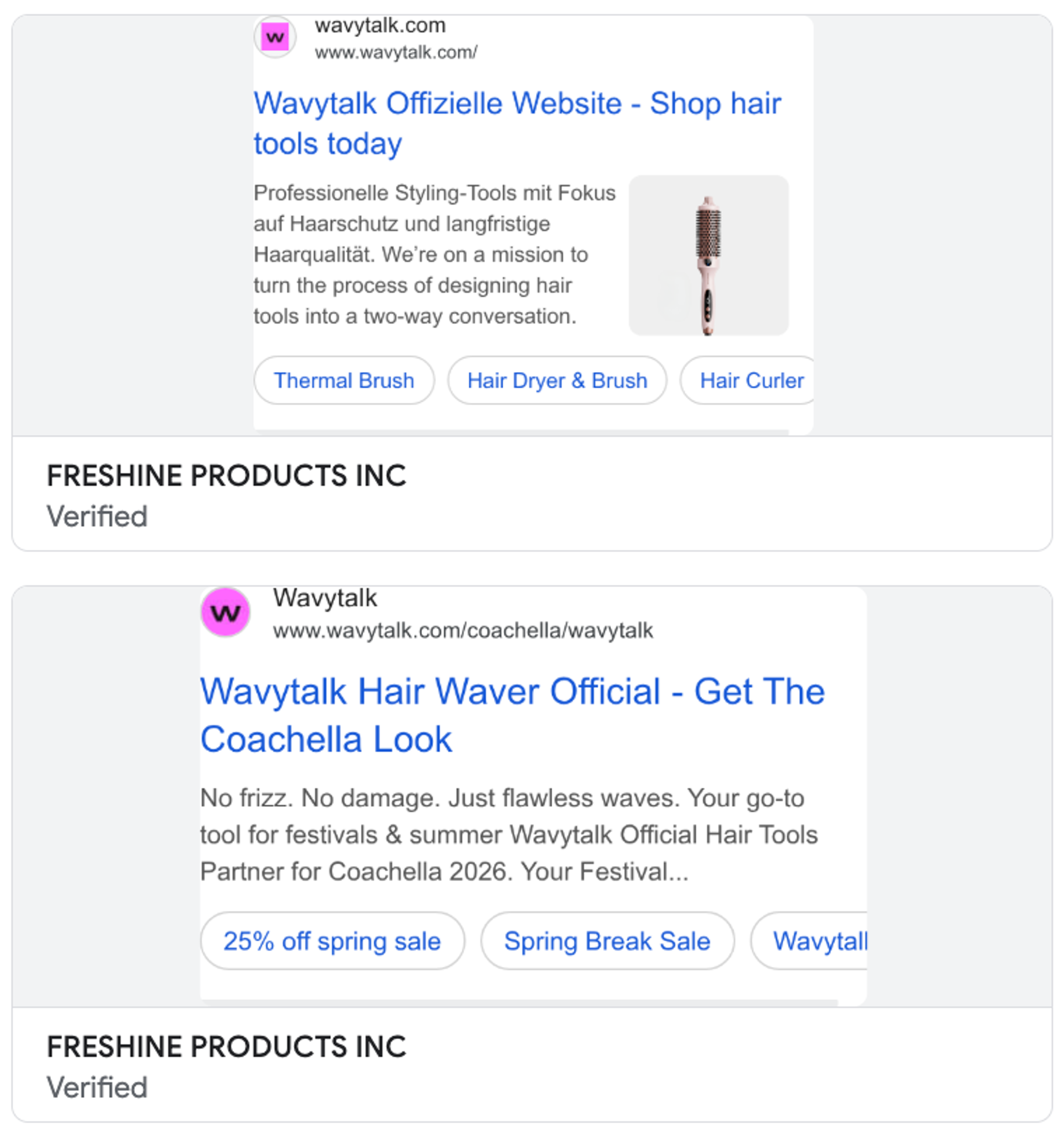
On Search, like exactly what someone with buying intent wants to click. Most brands produce one visual identity and blast it everywhere.
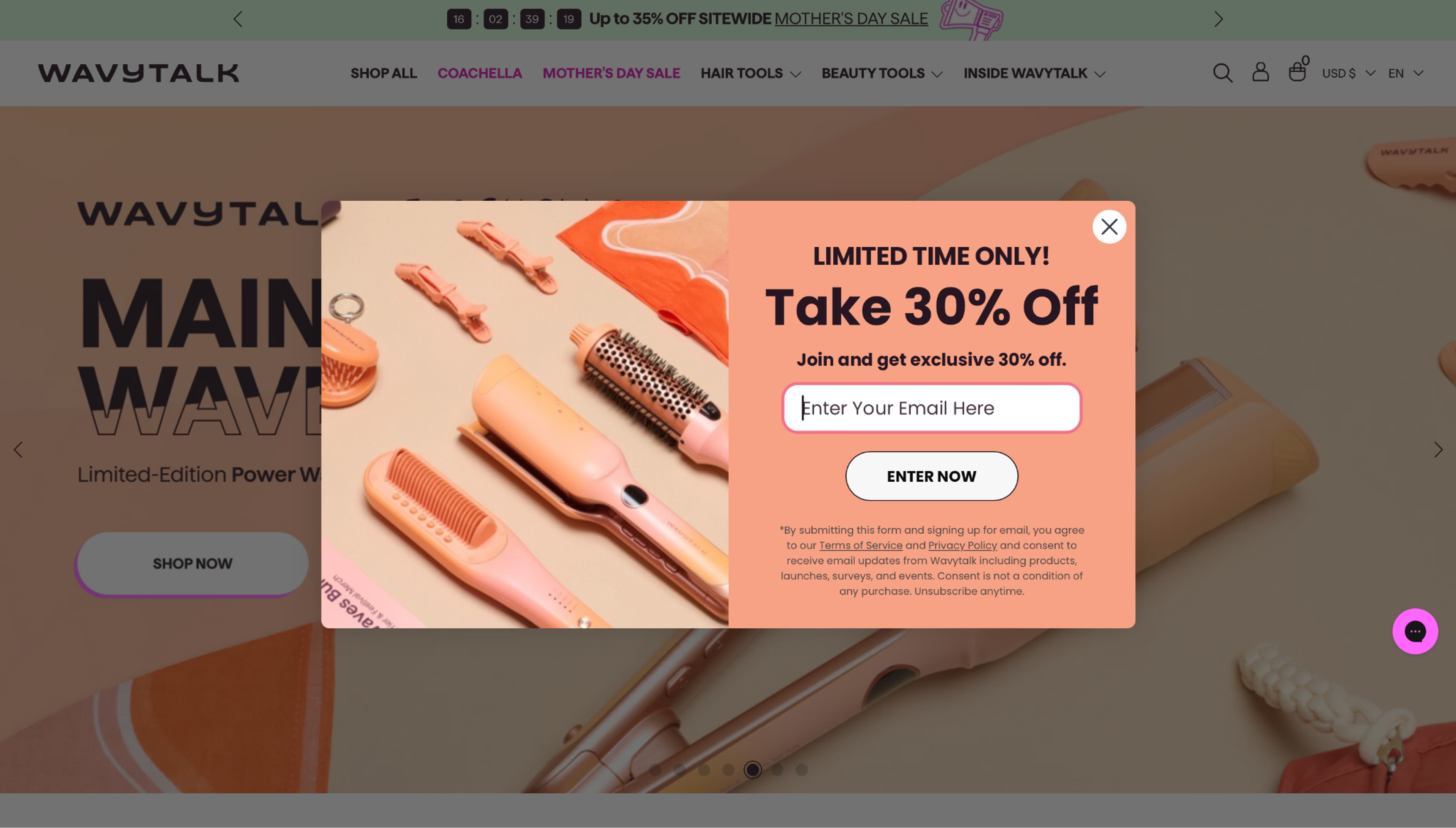
WavyTalk's DTC conversion website tactics don’t rely on a single conversion lever. The announcement bar, the popup, the product grid, the product page, and the cart drawer each play a distinct role and together they create a funnel where every visitor gets multiple, escalating reasons to buy before they ever reach checkout.
As soon as you visit the site, a popup appears offering a limited-time deal. The first step is to enter your email address.
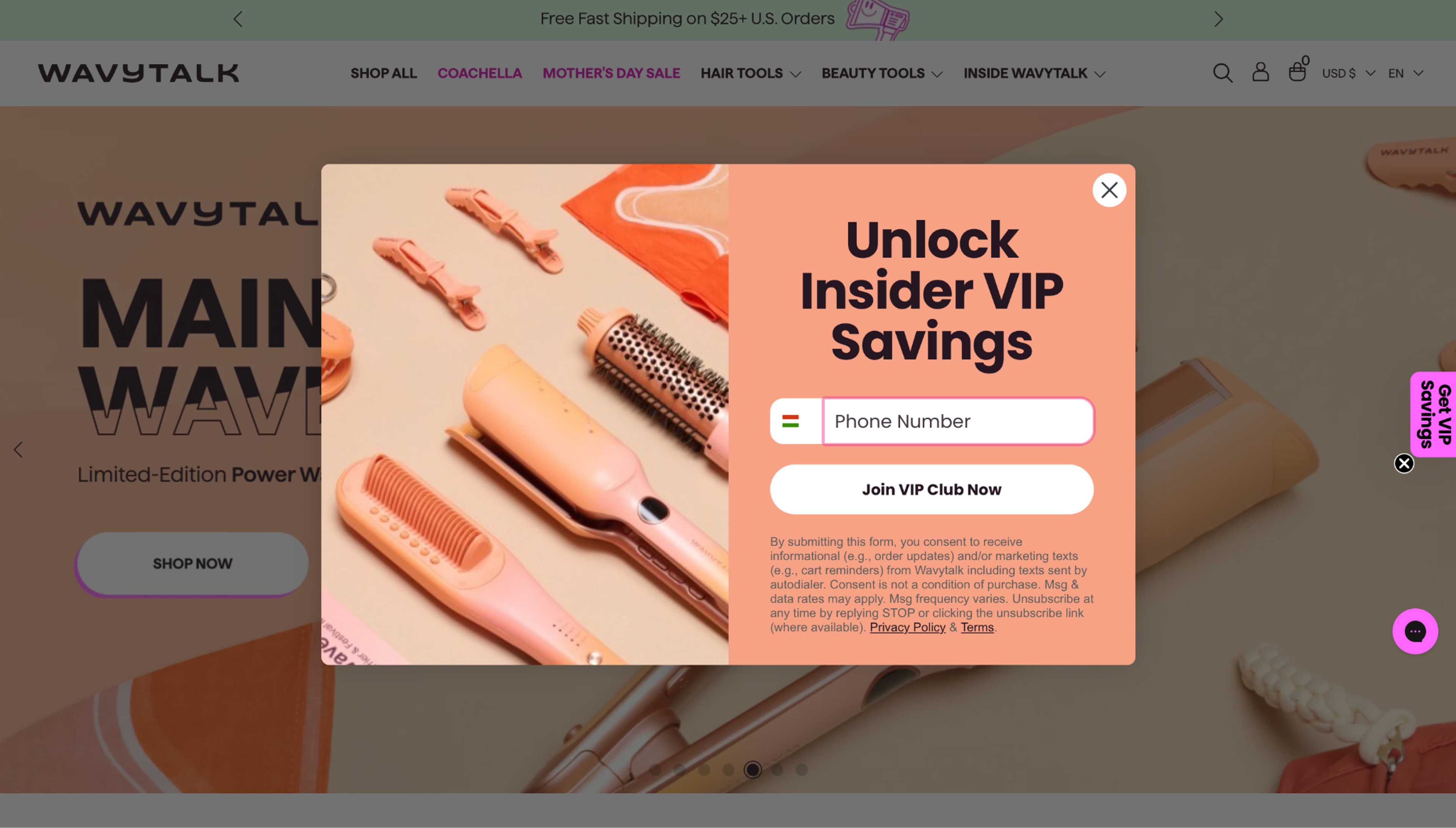
On the second page, it asks for your phone number, but not just any old way, it invites you to join the VIP membership.
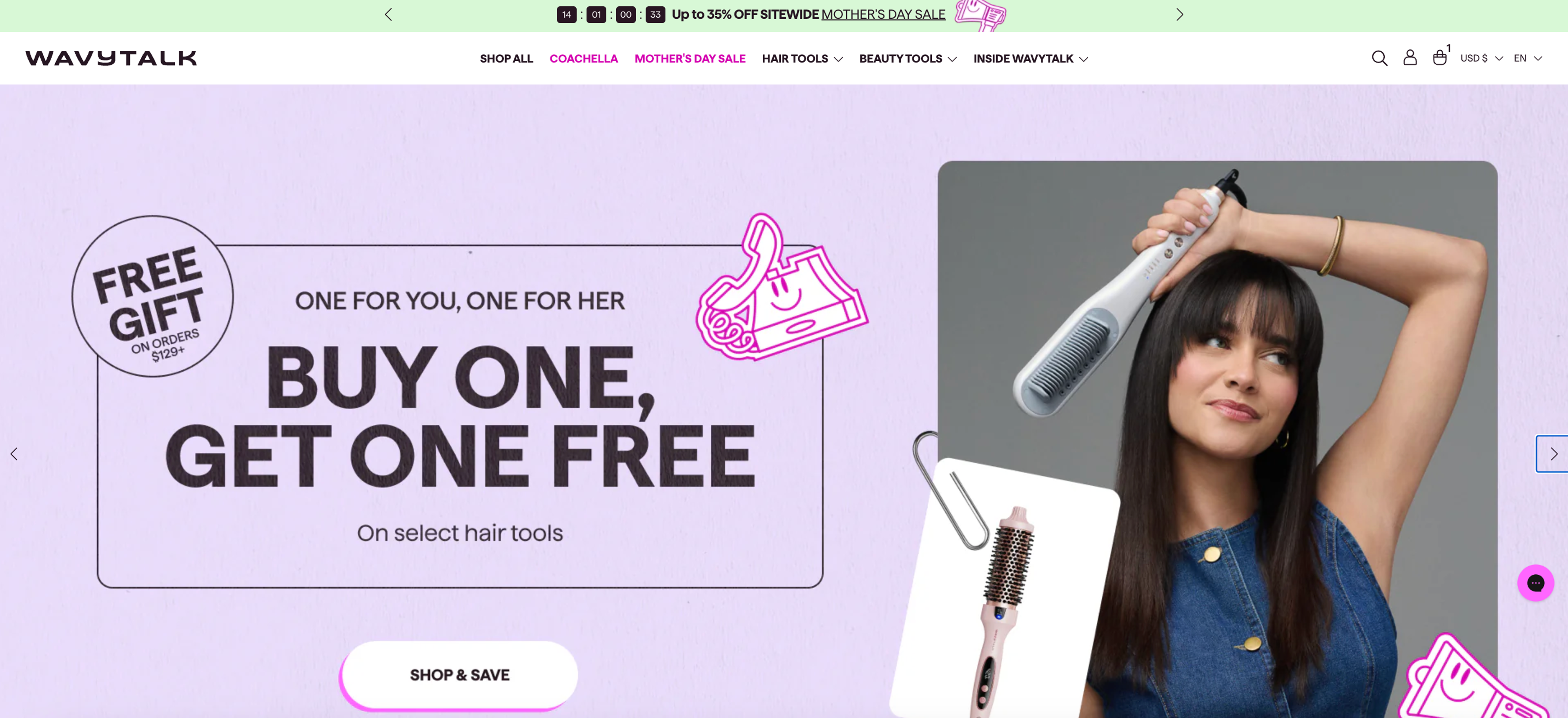
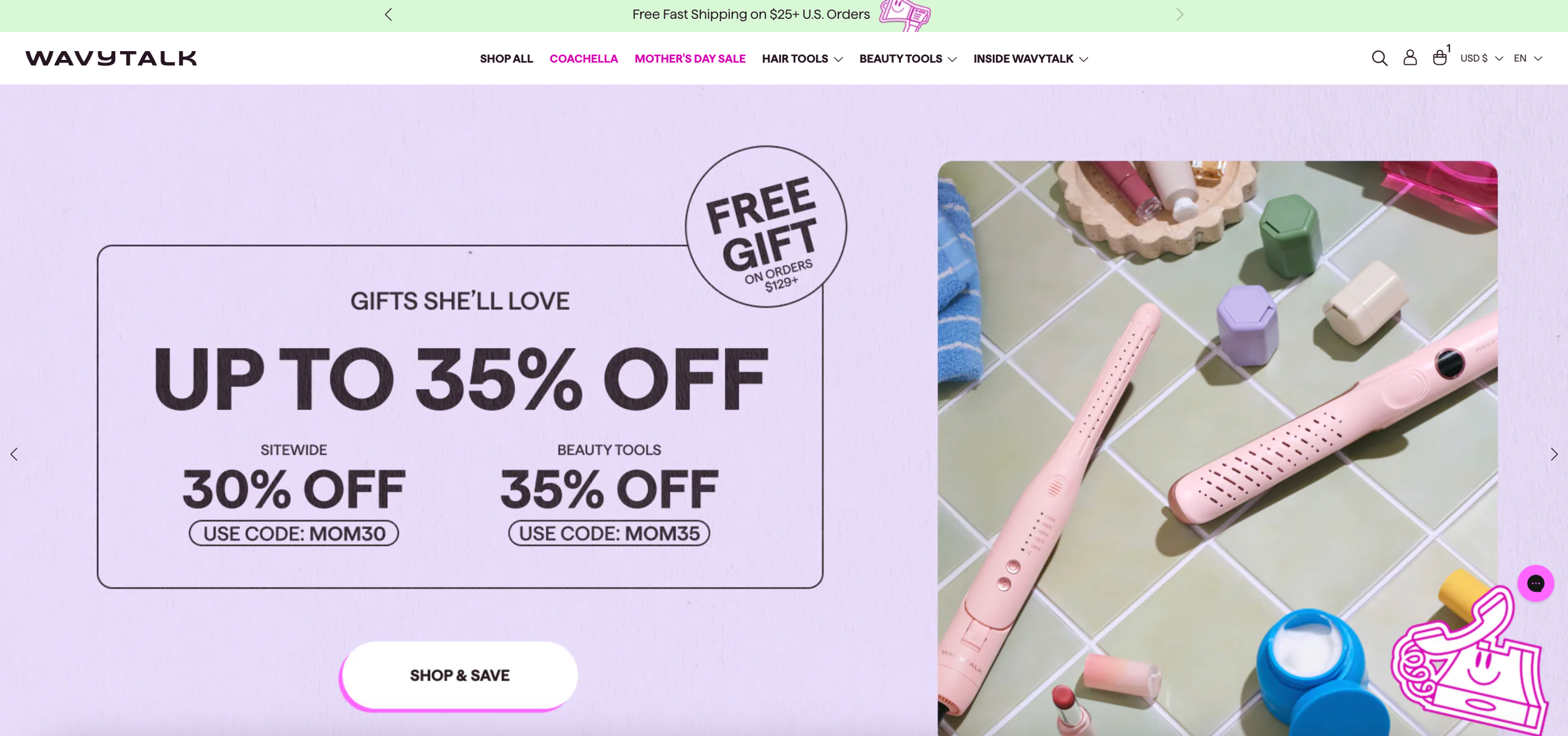
Dismiss the popup and the homepage layers on urgency without pause. A green announcement bar runs a live countdown timer above a hero carousel leading with a BOGO offer and a "FREE GIFT ON ORDERS $129+" badge.

A sticky "30% OFF" tab pins to the right edge of the screen and persists through the entire browsing session.

By the time a visitor has read the hero, they've received three separate discount signals without clicking anything.
The product grid reinforces the offer at the SKU level. Every card shows a strikethrough original price, a discounted price, a percentage-off badge, and a star rating, so a visitor can evaluate value and quality simultaneously without leaving the homepage.
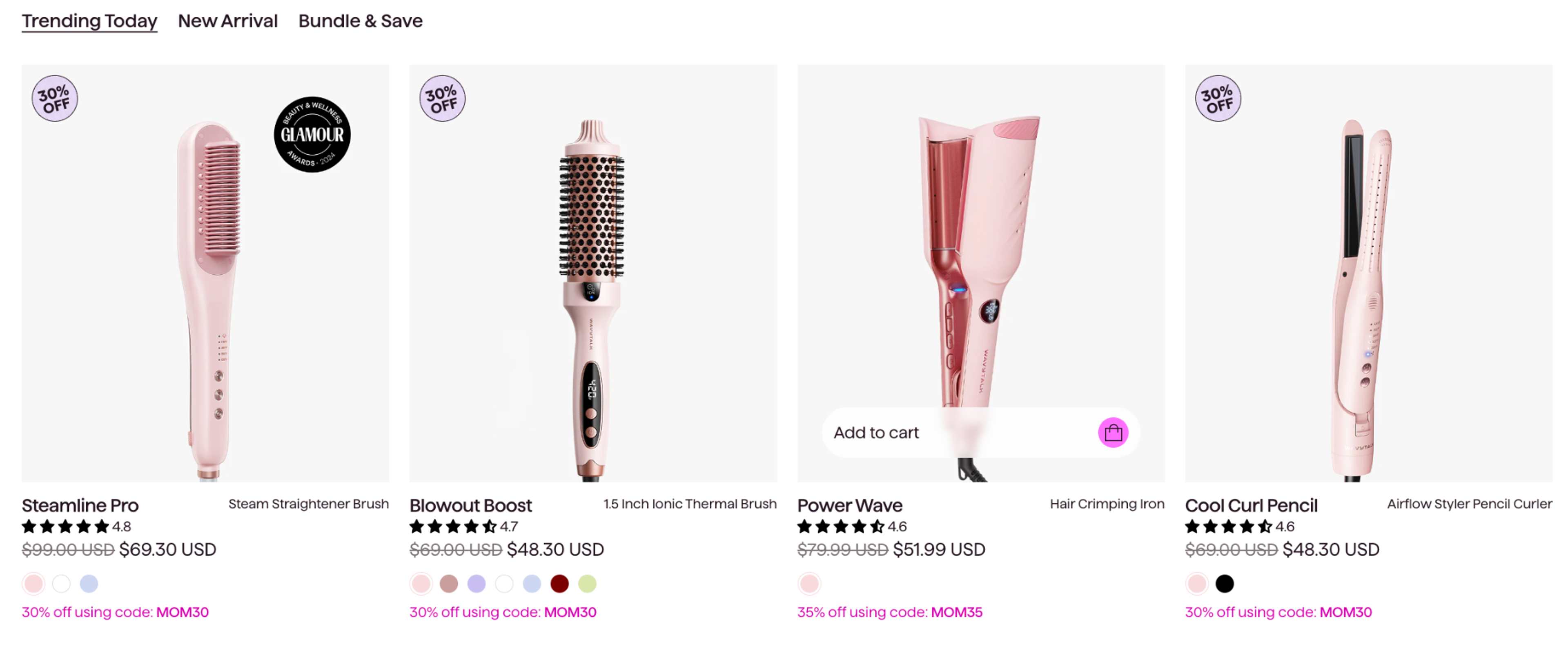
The Steamline Pro card adds a Glamour Awards 2025 badge, elevating one hero SKU above the rest with third-party editorial credibility.
On the product page, the Blowout Boost leads above the fold with its three strongest credentials: 4.7 stars, 1.5M sold, Best Seller badge.
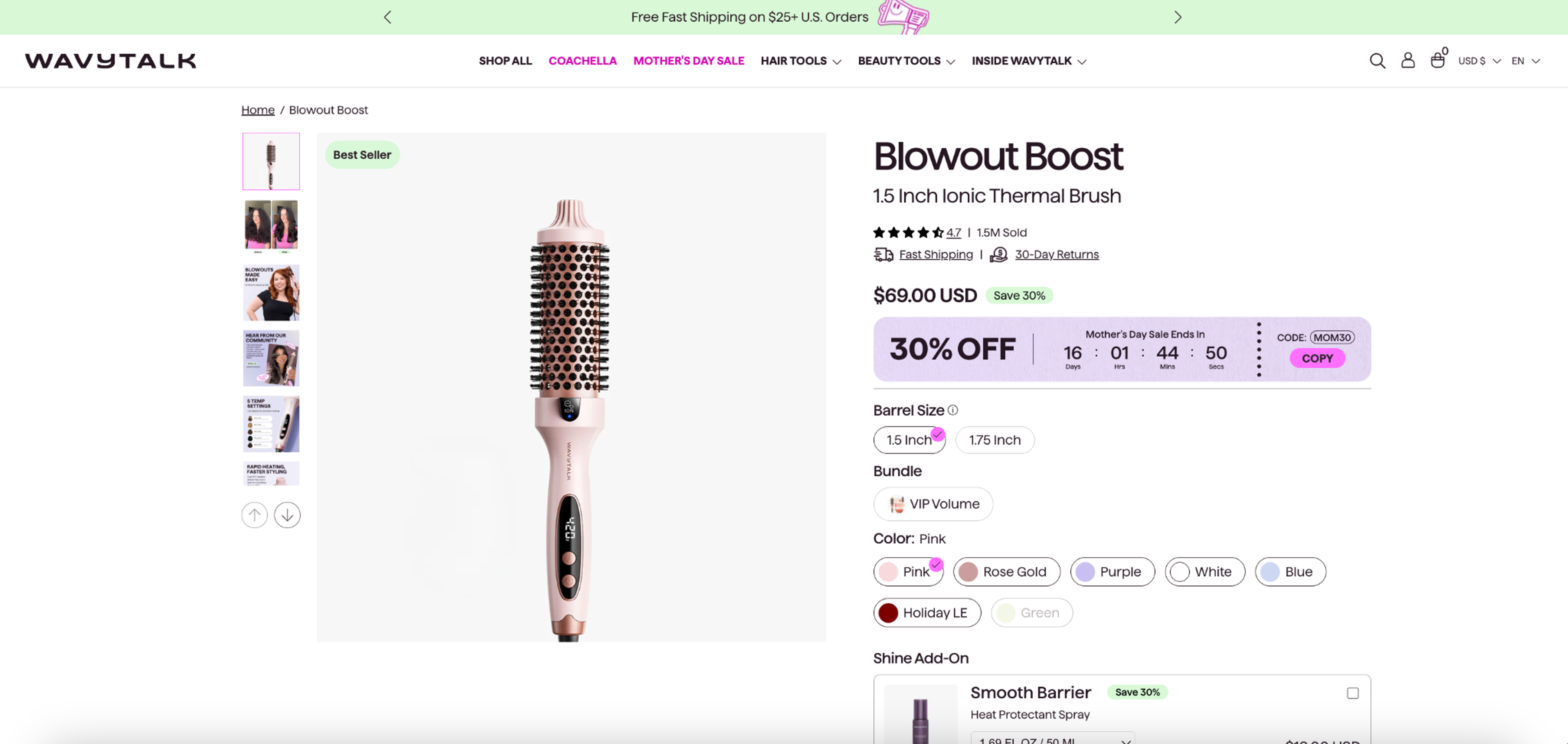
A promo code with a one-tap copy button, reduces the friction of applying a discount to near zero. Directly below the main CTA, an inline checkbox add-on offers a Heat Protectant Spray at 30% off.
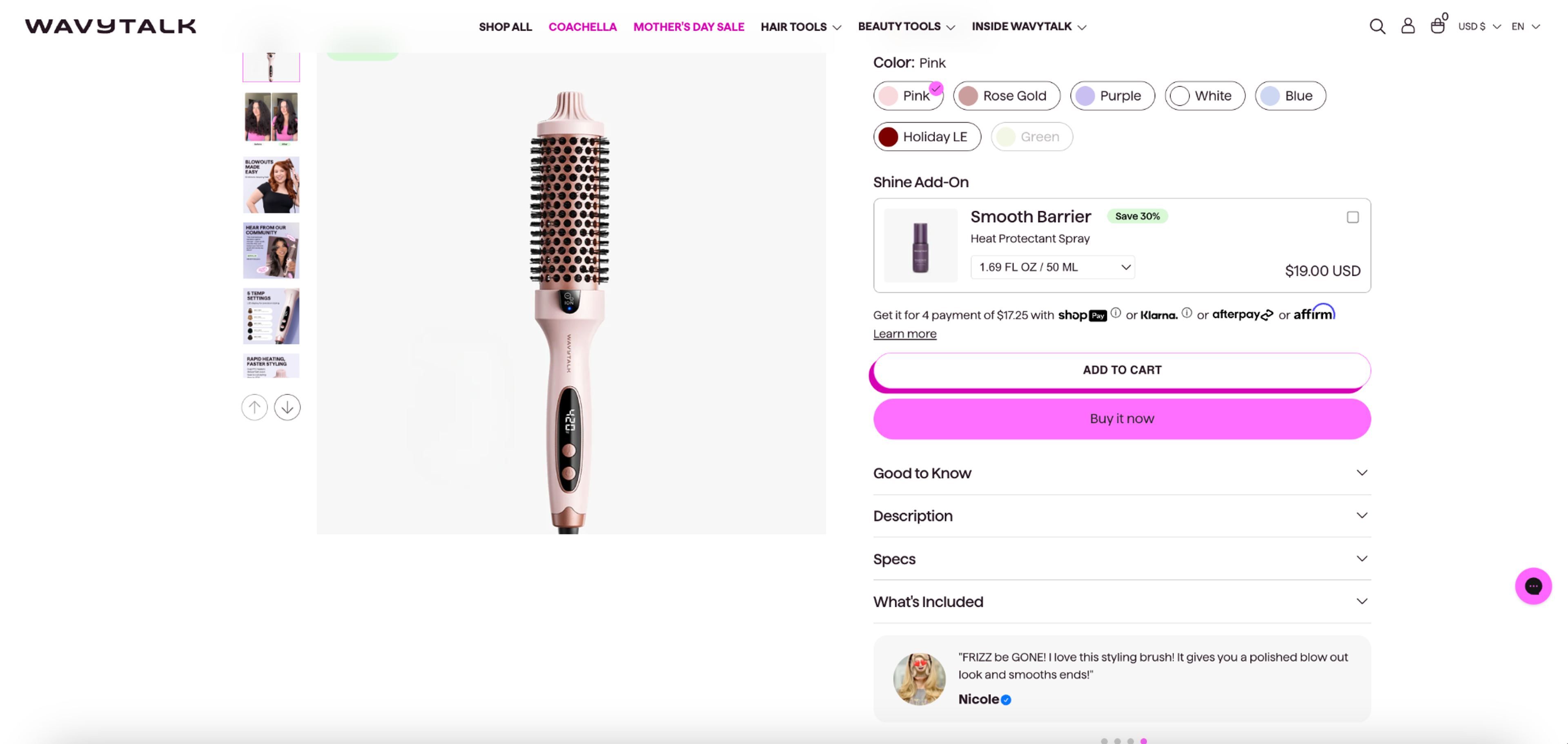
It's placed at the moment of maximum purchase intent and framed as a recommendation rather than a hard sell, which is exactly what makes it work.
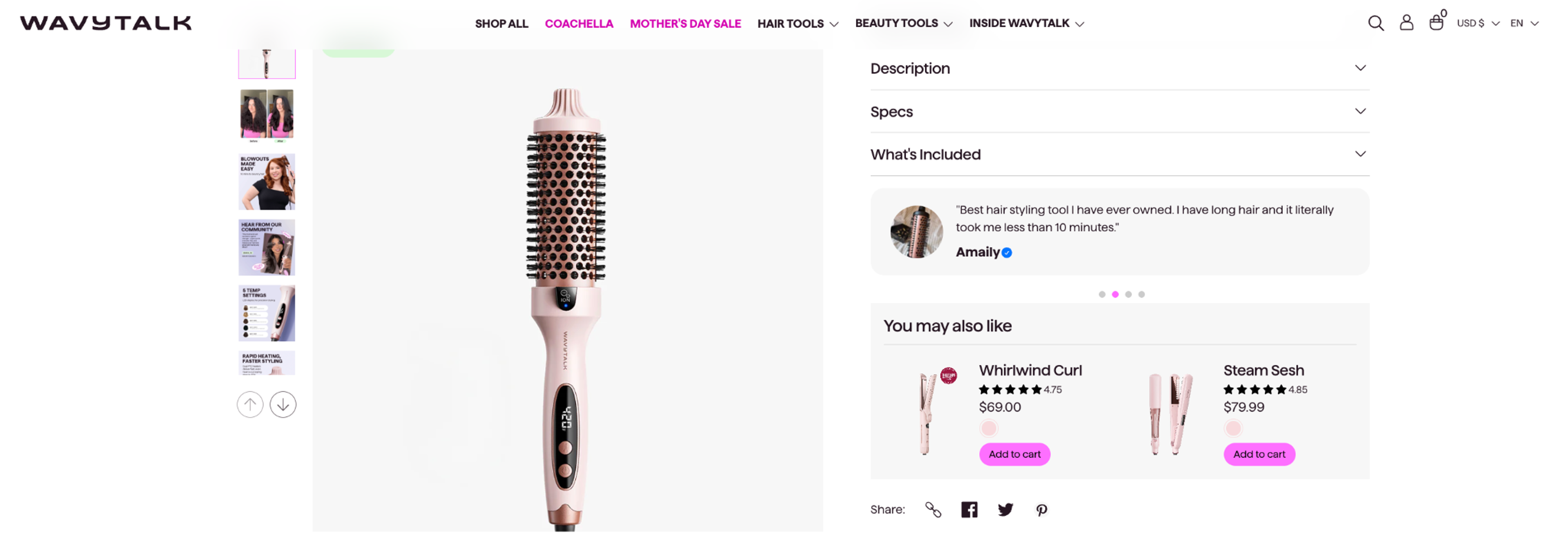
The upsell architecture continues below the fold. A barrel-size toggle creates a natural upgrade path. A "You may also like" widget shows complementary products with direct Add to Cart buttons, no click-through required.
The reviews section leads with UGC. The default sort is "Pictures First", meaning the first thing a visitor sees is a gallery of real customer photos and videos, not a wall of text.
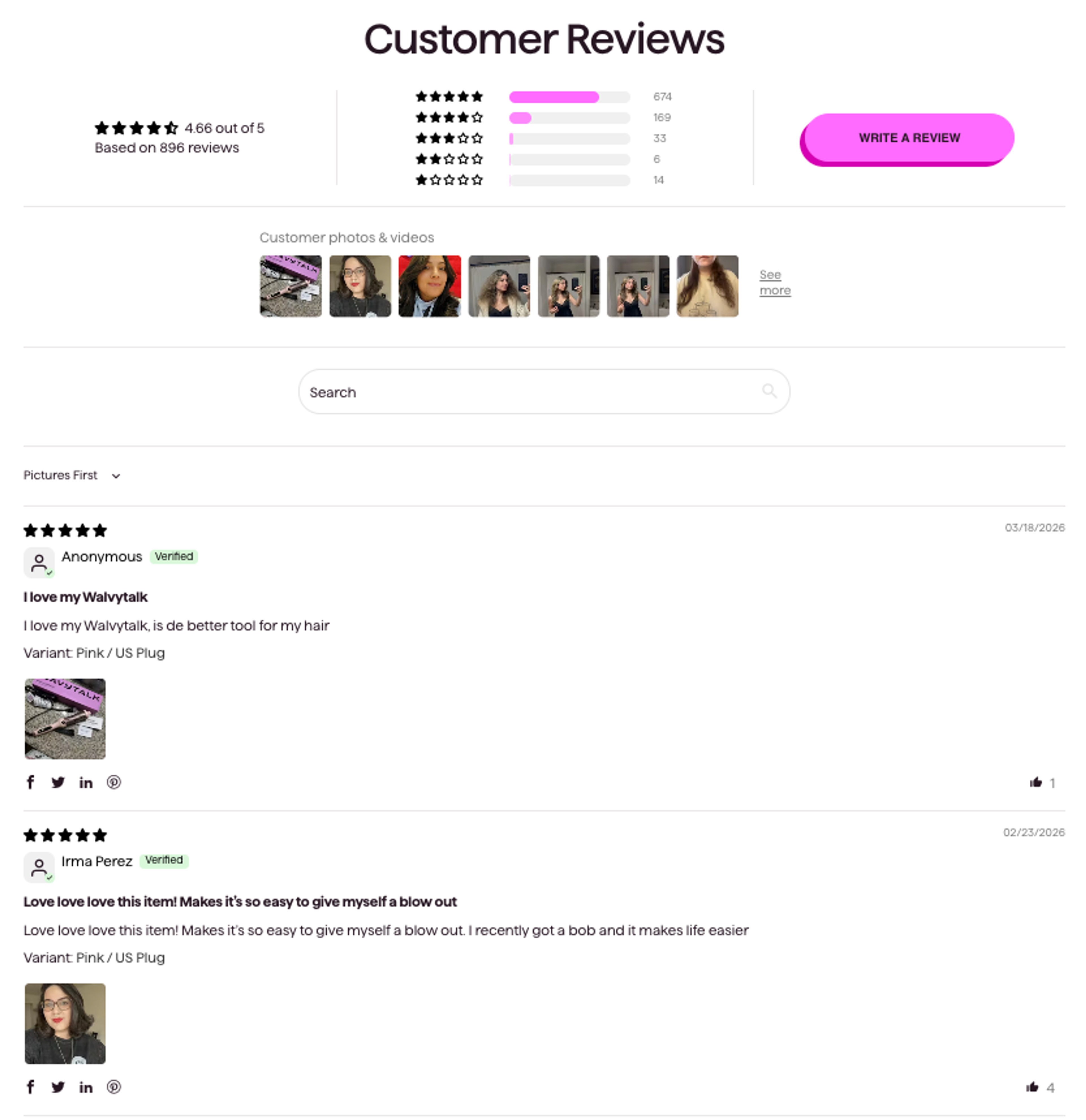
Behind those images are 896 verified ratings at 4.66 stars. This is social proof that does the work of a sales page.
The cart drawer closes with a spend-threshold mechanic: "Add $30.00 more for a free e-Gift Card." One element, zero additional creative required, meaningful lift in average order value.
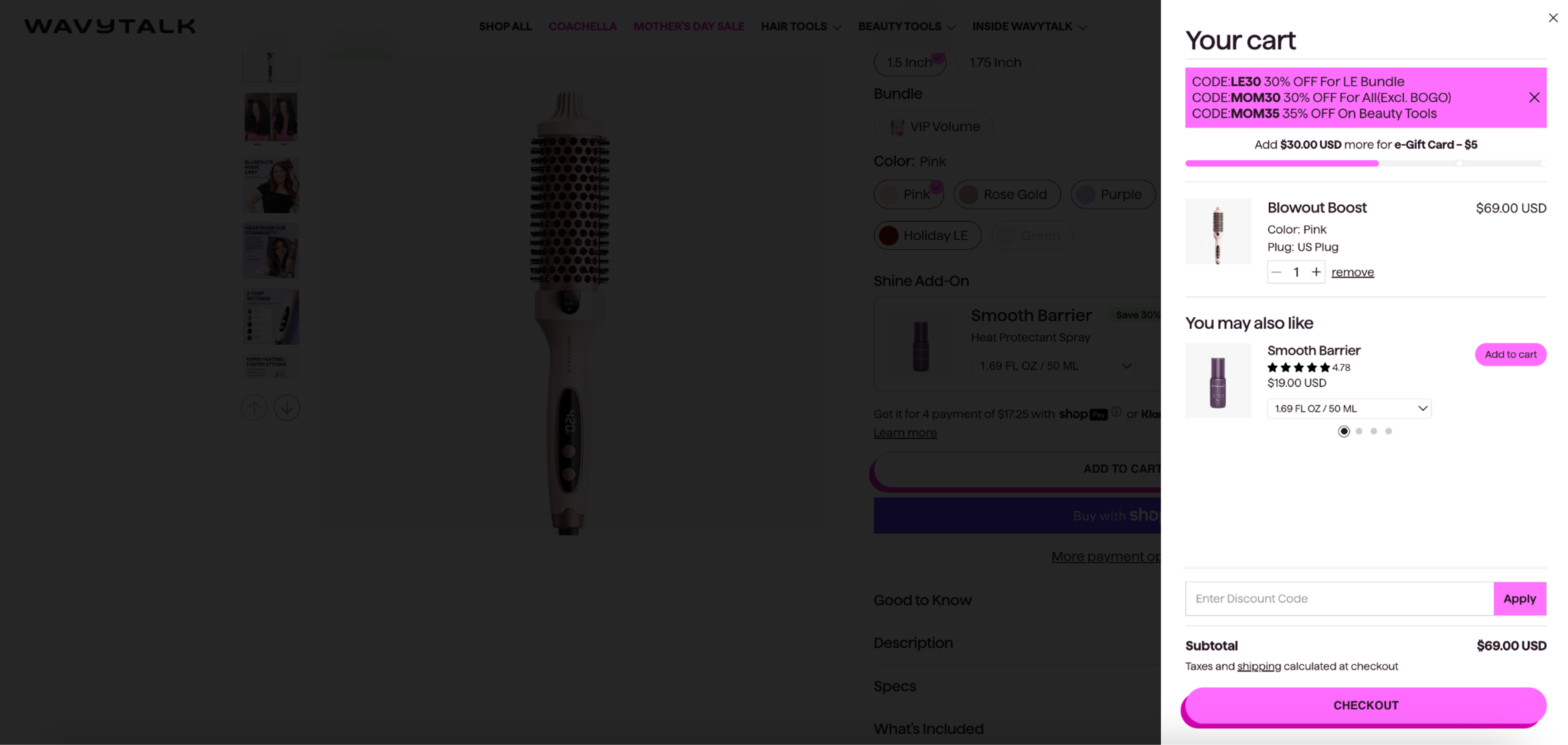
An inline "You may also like" widget in the drawer offers one last upsell at the moment of highest purchase intent, right before checkout.
What separates WavyTalk's approach from most DTC brand marketing is redundancy built into the conversion system. If the announcement bar doesn't create urgency, the countdown timer does.
If the popup doesn't capture the email, the footer signup does. If the product page doesn't close the sale, the cart drawer nudges the order higher anyway.
No single element carries the whole weight, each one is designed to catch the customers the previous layer missed. That's not a conversion strategy. That's a conversion architecture.
The WavyTalk marketing strategy is not a product story. It's a community story that happened to involve a very good product.
The thermal brush was the spark. The content ecosystem it ignited is what turned a $52 Amazon SKU into a 15-billion-impression brand. TikTok gave them the foundation. Creator co-ownership gave them authenticity at scale.
Professional partnerships gave them altitude. And a conversion architecture built around urgency, social proof, and layered discounts turned all of that awareness into revenue.
The real lesson isn't about hair tools. WavyTalk didn't try to out-spend its competitors. It out-communicated them.

How Tarte turns founder storytelling, creator trips, TikTok virality, and smart on-site funnels into a repeatable beauty marketing growth engine.
How Carroten went from unknown to every US Target shelf in under a year — using TikTok virality, creator-led commerce, and heritage brand positioning.
Knix didn’t just launch a product, it created a category. By turning taboo topics into honest conversations and backing it with real performance, it built trust and scaled to a $170M brand.