Tarte Cosmetics has built a powerful marketing engine by combining founder-led storytelling, hero products, influencer trips, controversy, TikTok virality, paid media, and a VIP-focused website funnel.
The beauty industry is full of brands that launch with a great product and plateau. Tarte Cosmetics is not one of them. Founded in 1999 by Maureen Kelly out of a New York City apartment with a single cheek stain and a lot of credit card debt, the brand has spent 25 years building something far harder to copy than a formula:
a marketing flywheel that turns controversy into content,
the creator economy into a distribution network,
and a concealer into a billion-dollar cultural artifact.
The brand was acquired by Japan’s Kosé Corporation in 2014, but founder Maureen Kelly remains CEO and the brand’s creative force. That continuity matters, Tarte Cosmetics' marketing personality is unmistakably hers:
bold, self-aware,
founder-led,
and permanently on the edge of going too far.
So what drives Tarte Cosmetics' marketing success? Let's break it down!
1. Turn your founder story into a product engine
Tarte Cosmetics' strongest marketing asset isn't a single campaign. It's Maureen Kelly, positioned on the brand site as founder, CEO, and visible content personality, the person behind every product decision rather than a name on a label.
That positioning does something specific: it makes product decisions feel personal rather than commercial.
Shape Tape isn't described only as a coverage product, it's framed as something born from Kelly's own experience with cystic acne, which ties the brand's bestselling concealer to a founder story rather than a marketing brief.
The product has a reason to exist that goes beyond performance claims.
That's the power of founder-led brand marketing: it makes product decisions feel personal rather than commercial. In 2022, Tarte brought back Cheek Stain — the brand's original first product — after followers repeatedly asked for it.
What could have been a straightforward nostalgia relaunch became something more useful:
proof that the brand listens,
and that the community has real influence over what gets made.
A discontinued product turned into a social feedback loop is a stronger brand signal than any new launch.
2. Build one product so good it becomes its own category
In 2015, Tarte invited a small group of beauty influencers, including Nicol Concilio, Desi Perkins, and Patrick Starrr among them, to Turks and Caicos.
The trip had one job: introduce Shape Tape Concealer to the people who mattered most to beauty consumers.
It worked. The concealer didn't just sell well. It redefined what a concealer was supposed to do.
Full coverage, non-creasing, 16-hour wear, a flat brush applicator that was itself an innovation, the product was demonstrably different, and the people demonstrating it were credible enough to make that difference legible to millions of viewers who had never heard of Tarte before.
The "house of tapes", Face Tape Foundation, Shape Tape Blur Concealer Stick, CC Undereye Corrector, and multiple format extensions, means every new launch borrows credibility from the original. Tarte doesn't have to rebuild trust from scratch each time. It extends it.
The "#1 Concealer Brand" designation appears everywhere:
in product imagery,
on the collections page,
in Meta ad.
It's not just a claim. It's the organizing principle of the entire brand identity.
Every product Tarte launches sits in the shadow of that one proof point, and that proof point was established in 2015 by sending the right people to the right place at the right time — a perfect example of how Tarte Cosmetics uses influencer marketing.
3. Invent a marketing format, then own it for a decade
Before beauty brand influencer trip marketing was a category, Tarte was running it.
The first #trippinwithtarte in 2015 was an instinct rather than a strategy. Maureen Kelly brought a group of influencers to Turks and Caicos, paid for everything, required nothing, and watched the content flow naturally.
It worked because the experience was genuinely remarkable and because the influencers trusted that Tarte wasn't trying to control their output. That combination of generosity and restraint is harder to manufacture than it sounds.
Over the following decade, the format scaled. Bora Bora. Costa Rica. Hawaii. Dubai.
Each trip was designed to be so visually compelling and logistically generous that not posting felt like leaving something on the table.
The format also gave Tarte something most legacy brands never figure out: a repeatable mechanism for onboarding new generations of creators:
Meredith Duxbury,
Alix Earle,
Monet McMichael.
Tarte Cosmetics' influencer marketing roster reads like a timeline of beauty's most influential creators at their peak. For a brand that was already 20 years old when Earle had her viral moment, that's a remarkable feat of staying culturally relevant without changing what you fundamentally are.
The rest of the industry eventually copied the format. Tarte just had a ten-year head start.
4. Use controversy as a brand-building tool
The Tarte Cosmetics Dubai trip controversy in January was the most scrutinized influencer event in beauty history. Tarte flew 50 creators to the Ritz-Carlton Ras Al Khaimah on business-class Emirates flights, private villas, and an ATV excursion in the Al Wadi desert.
The backlash was immediate:
"tone-deaf,"
"out of touch,"
"in this economy."
Tarte's response was a masterclass in brand self-awareness.
Rather than issuing a statement or going dark, the team posted a TikTok: a Shape Tape mascot costume wandering through an empty office, captioned "POV: When you show up for work but the marketing team spent all our money on a brand trip."
The video hit 2.7 million views. Top comment: "This ad makes me want to buy Tarte more than any influencer trip would."
Brands that can laugh at themselves — credibly, not desperately — earn a fundamentally different kind of trust than brands that maintain a carefully managed corporate voice. The Dubai trip cost Tarte a significant sum.
The mascot video cost almost nothing and reached 2.7 million people who might never have watched an influencer vlog. Controversy, handled correctly, generates more earned media than the original campaign.
5. Let virality happen, then pour fuel on it
The Sharpie concealer challenge started in Q1 2025 without any involvement from Tarte. A handful of creators began drawing under their eyes with a Sharpie marker, then covering it with the CC Under Eye Corrector to prove full coverage.
Extreme, memorable, immediately shareable, the kind of organic challenge beauty marketing teams dream about and almost never engineer.
Tarte's response to going viral on TikTok was to accelerate rather than interrupt. Rather than taking ownership with official creative — which would have killed the UGC authenticity the moment it landed — the brand opened its affiliate network.
Within days, a dozen creators became hundreds. Within weeks, hundreds became tens of thousands.
By mid-2025, Tarte had sold 600,000 units on TikTok Shop alone and sold out multiple times at Ulta and Sephora. International customers began requesting the product on Tarte's DTC site in markets where TikTok Shop doesn't operate.
Tarte didn't create the moment. It just made sure everyone who wanted to participate had a financial reason to keep going and made sure the product was everywhere when the demand arrived.
6. Run paid media as a precision conversion tool
Tarte Cosmetics' paid marketing strategy is surgical rather than saturating. Each ad has a clearly defined conversion objective and none of them are trying to explain the brand. That job is done by TikTok. The paid media just closes what organic already opened.
The "#1 concealer brand — 1 sold every 4 seconds" line appears directly in ad copy, compressing social proof into the hook.
A concealer quiz ad promises "find your match in 15 secs (plus save 15%)" — a lead-gen mechanism disguised as a helpful tool.
Teacher and healthcare worker discount ads — 40% off, all year — target specific identity groups with an offer that has nothing to do with product performance and everything to do with feeling seen.
The VIP waitlist ad — "The wait is almost over… Join the VIP text list" — converts ad exposure into SMS subscribers before a product even launches.
By the time the product drops, the audience is already built, already opted in, and already primed to buy. Zero incremental media spend required at launch.
7. Build a site that treats every visitor like a potential VIP
For a DTC beauty brand, Tarte's website has one organizing principle: every visitor is one step away from becoming a member, and membership changes the economics of every subsequent purchase.
The entire on-site architecture — popup, announcement bar, product grid, product page, footer — is a sequential funnel built around that belief.
Within a few seconds of visiting the website, a 15% signup popup appears asking for your email address.
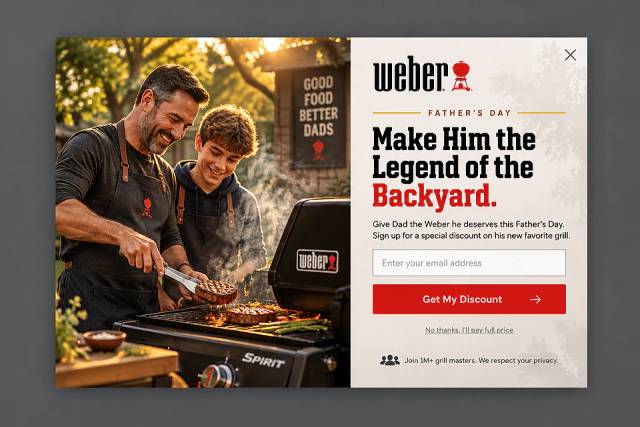
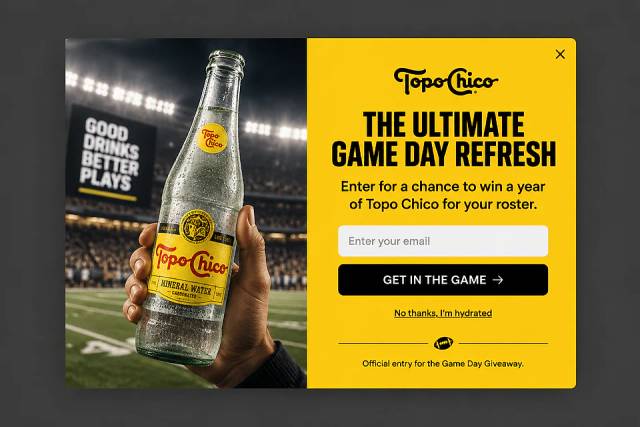
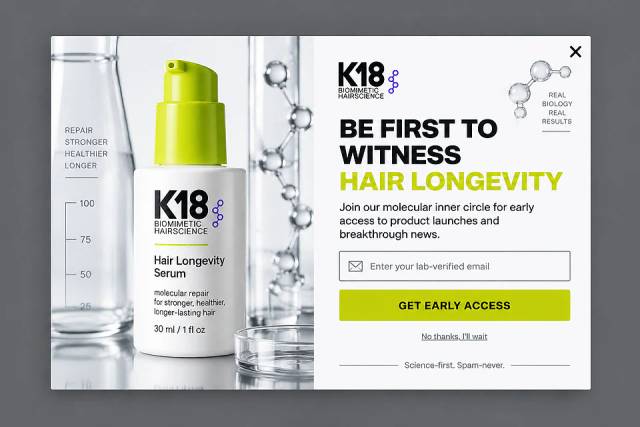
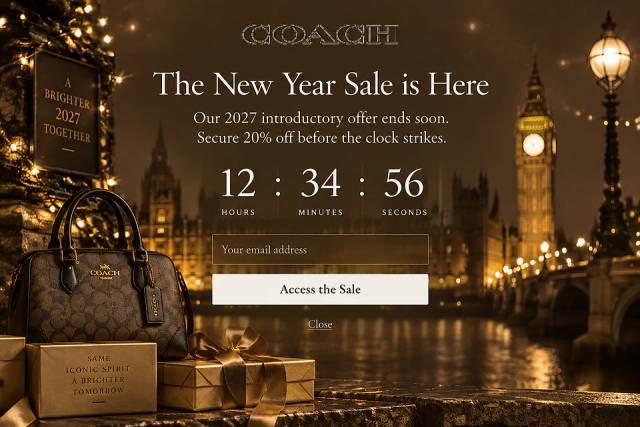
Would you like to add a similar popup to your site? Try these popup ideas!
The announcement bar reinforces the VIP narrative from both directions simultaneously: "FREE mini mascara with 2+ items — VIPs ONLY" for retention, and "New VIP? 15% off with VIP15 — JOIN NOW" for acquisition.
Two messages, one element, no additional visual weight.
The hero leads with "VIRAL macaron blush & bronzer duos — BACK IN STOCK":
"Viral" is social proof compressed into a single adjective,
"Back in stock" is urgency without manufactured scarcity,
The CTA reads "SUMMER CHEEKS MADE EASY", outcome-first copy that sells the result rather than the action.
The shoppable video carousel above functions as mini-TikToks within the homepage, matching the medium to where discovery happened.
Four trust panels address the four most common conversion blockers for a prestige beauty brand without burying them in an FAQ.
"What we're made of" handles ingredient skepticism.
"Try it on" handles shade-matching anxiety, the leading reason beauty consumers abandon a purchase.
"Get 15% off" handles price sensitivity.
"Shop for good" handles ethical hesitation.
Four objections answered in one scroll, proactively, in the main browse flow.
The product page loads social proof before price, 25,980 reviews at 4.8 stars above the product name. The shade filter system with a "FIND MY SHADE" CTA solves wrong-shade anxiety before it becomes a drop-off.
The AI-generated review summary collapses 26,000 opinions into four sentences in consumer-readable language. For a first-time visitor, it does in five seconds what reading 50 reviews would take five minutes to do.
The sticky “Add to Bag" bar remembers the visitor's selected shade and includes a "change" link inline, so a visitor who has already chosen doesn't have to scroll back up to modify it.
The footer concludes with a message encouraging recipients to provide an email address that clearly reflects the brand’s tone: “Your texts are so good, even your ex would be jealous.”
The cart experience is where Tarte does its quietest and most effective conversion work. The moment a product is added, the cart bar shows exactly how much more is needed to qualify for free shipping.
The product recommendation inside the cart catches the visitor at the highest-intent moment in the entire session. The purchase decision has already been made.
The psychological cost of adding one more item is small compared to the commitment already in place, which is exactly why cart-stage recommendations convert at a meaningfully higher rate than the same recommendations shown earlier in the browse journey.
The free sample option adds a third layer. Adding a sample gives the visitor a secondary reason to complete the purchase, they're no longer just buying a concealer, they're also getting something free.
And a customer who discovers a new product through a sample has a built-in reason to return. One cart interaction, one transaction converted into the beginning of a relationship.
Above the checkout button, "don't wait, sellout risk" applies the final pressure at the last possible exit point. Most cart abandonment happens here, not earlier. A scarcity signal placed exactly at the moment a visitor is looking for a reason to pause removes that pause without adding any friction to the experience.
By the time a visitor reaches the checkout button, the site has already answered the free shipping question, offered a recommendation, given away a sample, and reminded them the product might not be there tomorrow. There is very little persuasion left to do.
Takeaway
Tarte's 25-year run as a cult beauty brand comes down to one insight most beauty companies never act on: marketing isn't a cost center. It's the product.
Shape Tape Concealer marketing gave the brand a franchise — one product strong enough to carry a billion dollars in sales and lend credibility to every launch that followed. Its beauty brand TikTok Shop strategy gave it a social commerce innovation: $105 million in revenue with no platform investment, funded entirely by a 22,300-creator affiliate network. The controversy playbook gave it a moat — the rare ability to turn backlash into earned media that outperforms the original campaign.
The website closes the loop. Every visitor lands in a conversion architecture designed to turn them into a VIP member first and a customer second. A member who buys once is worth far more than a buyer who never joins, and Tarte's entire on-site experience is built around that single sequencing decision.