


Top Sleeknote Alternatives to Get More Leads in 2026
In this article, we'll share the best alternatives to Sleeknote that help you to get more leads in 2026.
In this article, we’ll show you why you should implement Bayesian testing in your marketing strategy, and how to harness its full potential.
In short
Discover the power of Bayesian A/B testing in enhancing your marketing strategy. This guide explains how Bayesian methods differ from traditional Frequentist approaches, offering faster decision-making, intuitive results, and reduced error rates. Learn how to implement Bayesian analysis effectively to optimize conversion rates and user experience, making it a vital tool for data-driven businesses.
Looking for new ways to level up your A/B testing game? Well, you might have found the answer: it's the Bayesian approach.
If you’re familiar with the Frequentist methods, then the Bayesian methodology will streamline your decision–making.
In this article, we’ll show you how Bayesian testing is different from Frequentist A/B testing, why you should implement it in your marketing strategy, and how to harness its full potential.
Let's see!
Let's take a look at Bayesian versus Frequentist A/B testing methods.
Imagine you're a data scientist working on improving a website. You have two main approaches to statistical analysis: Frequentist and Bayesian methods.
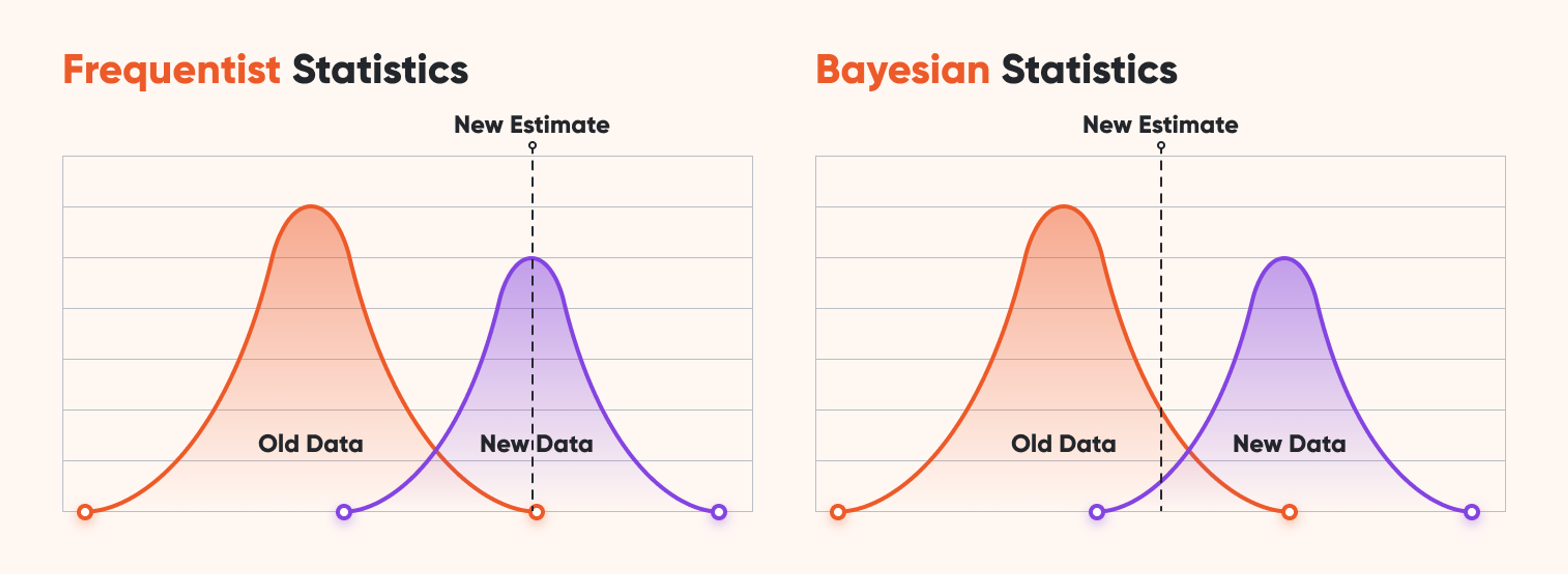
The Frequentist method is the traditional choice. It relies on things like p-values to make decisions.
But Bayesian methods are gaining popularity, and for good reason. They blend what you believe with the data you collect to make better decisions.
Choosing the Bayesian approach can help you make changes to your website faster, understand the results more easily, and reduce the chances of making mistakes.
It’s like being able to adjust your website in real time based on what’s happening, giving your users a more customized experience.
Traditional Frequentist A/B testing revolves around the concept of the null hypothesis, which assumes there's no difference between the control group (A) and the treatment group (B).
In simpler terms, Frequentist methods try to assess the null hypothesis by calculating something called a p-value.
This p-value is like a measure of the probability that you’d get the data you observed if the null hypothesis were correct.
By looking at the p-value, you can figure out if there are significant differences between the control and treatment groups.
Frequentist A/B testing is commonly employed in digital marketing to compare different versions of website landing pages, email campaigns, and ad creatives.
While it has benefits, this method may not provide the most efficient or intuitive interpretation of test results, particularly with small data sets or noisy data.
Now, let’s explore the Bayesian approach.
In Bayesian hypothesis testing, each variant’s performance metric is treated as a random variable with a specific probability distribution. This allows you to continuously update your beliefs as you gather more data.
The Bayesian method begins with something called a prior distribution, which represents your initial beliefs about the possible outcomes of the test.
As you collect more data, this prior distribution is updated to create what’s known as the posterior distribution. The posterior distribution reflects your revised beliefs about the most likely values for each variant.
The Bayesian approach offers some distinct advantages, such as its ability to handle skewed population distributions effectively, making it robust in real-world situations.
It also provides a simpler, less restrictive, and more dependable framework for analysis. This simplicity and flexibility make it easier to interpret your results. That’s why Bayesian A/B testing is gaining popularity for its intuitive and user-friendly approach to A/B testing.
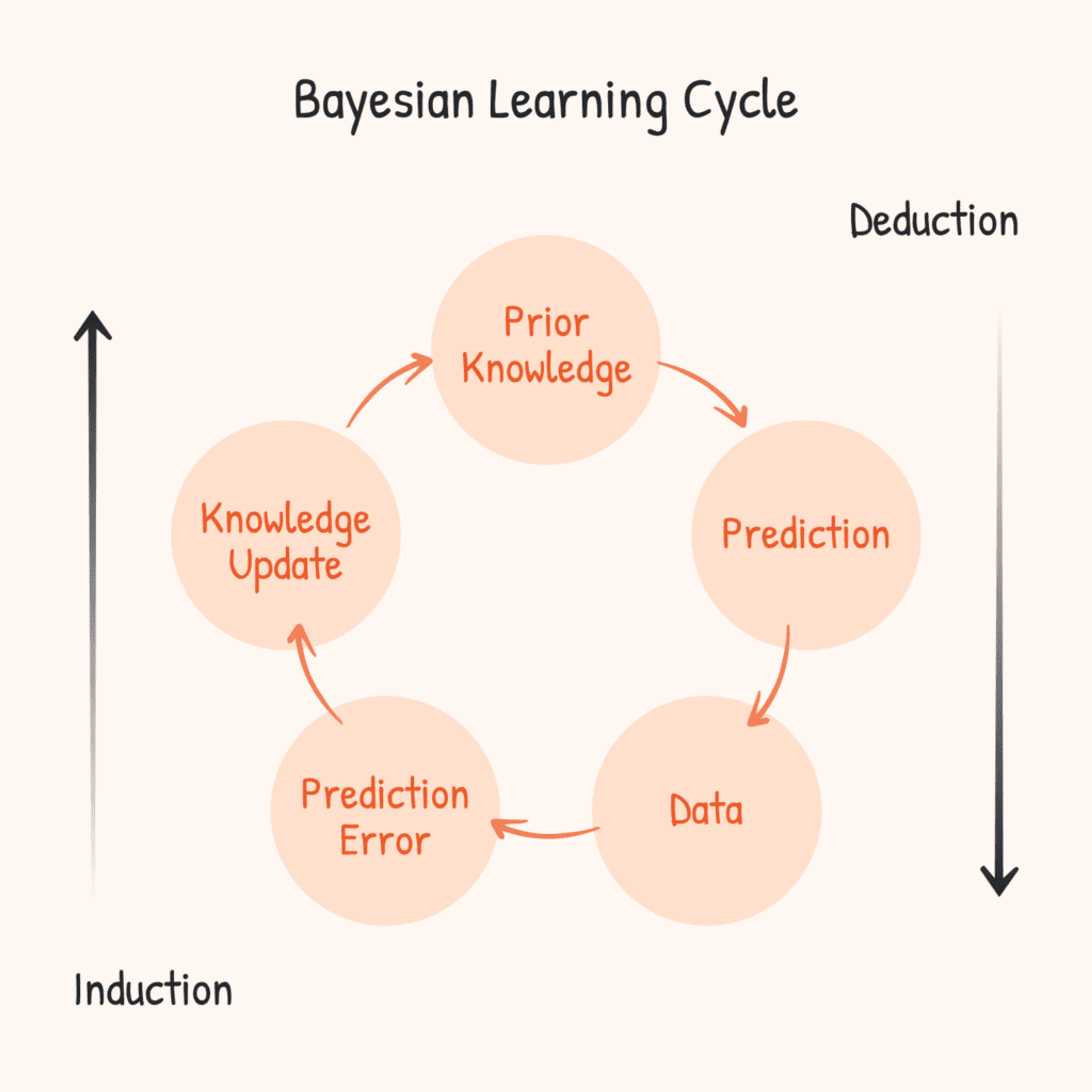
Bayesian statistics have several advantages in A/B testing. They can help you make decisions quickly and with flexibility, give you clear and intuitive results, and reduce the chances of making mistakes.
These benefits make Bayesian hypothesis testing a strong tool for businesses looking to improve their websites and expand their digital marketing strategy.
Now, let’s explore these advantages one by one.
One of the most significant benefits of Bayesian A/B testing is its ability to help you make decisions more quickly and adapt experiments more easily.
It does this by continually updating the important factors based on new data. This means you can optimize experiments for things like website conversions, even when you have small amounts of data or data that's a bit messy.
Additionally, the Bayesian approach lets you use the results from one experiment as the starting point for another one, which helps keep things consistent and efficient. The result is a smoother and more effective A/B testing process.
Bayesian testing doesn't rely on tricky statistical concepts like p-values or null hypotheses. Instead, it gives you results that are simple to understand.
You get a clear, quantifiable measure of how likely one variant is better performing than the other, so it's a lot easier to make informed choices.
The Bayesian framework also includes prior beliefs and updates them with new data, which gives you a more complete understanding of the probabilities involved.
This ease of interpretation is especially helpful in a business setting where not everyone might have a background in statistics. With Bayesian testing, the results are more straightforward, which leads to smarter decisions and can save time and resources.
Mistakes in A/B testing, like wrongly thinking a change is an improvement when it’s not, can be a big problem.
Bayesian testing helps with this by giving a confidence interval. This interval shows that it’s less likely to suggest an improvement when there isn’t really one, helping to reduce those mistakes.
Moreover, Bayesian testing limits mistakes by including prior information that tends to reject the null hypothesis. This more careful approach ensures that businesses make decisions based on accurate results, leading to better choices and more effective A/B testing outcomes.
Now that we’ve explored the benefits of the Bayesian method, let’s take a look at how you can put it into practice.
When you’re doing Bayesian analysis, the initial choice of prior distributions is crucial.
The prior represents your first beliefs about what might happen in the test.
To make the right choice, you need to consider what you already know or believe about the things you’re testing.
One common option is to go with a non-informative prior, like a uniform or Jeffreys prior. These priors give equal chances to all possible outcomes. Another choice is to use informative priors based on past data or expert knowledge.
When selecting priors, it’s often a good idea to go for weaker priors than what historical data suggests. A strong prior can help guard against false discoveries, but it might require more data to spot winning variations when they’re there.
A weak prior means the data you’ve collected is given more weight. However, this can sometimes lead to false discoveries if you stop the test early.
Efficient Bayesian A/B experiments involve the following steps:
For really accurate results, consider things like the expected effect size, significance level, power, and the conversion rate you typically have when deciding how big your Bayesian A/B test should be.
With careful planning and by following these best practices, you can get the most out of your Bayesian A/B testing and achieve the best results.
Understanding the results of a Bayesian A/B test involves looking at the probability distributions of the conversion rates for each group in the experiment.
Unlike other methods, Bayesian testing provides a range of possible values for the conversion rate, making for a more detailed understanding. By comparing these probability distributions for different groups, you can figure out how likely one variation is to do better than the other.
Moreover, Bayesian A/B testing enables the incorporation of prior knowledge or beliefs into the analysis, providing a more comprehensive understanding of the results.
This information, combined with the posterior probabilities of each variant’s performance, can help you make informed decisions and optimize your website or digital assets based on data-driven insights.
From big online stores to tech startups, companies from all sorts of fields are seeing the benefits of Bayesian A/B testing.
Let's explore some real-world examples of how this powerful statistical method has made a big difference and how it's helping businesses make smart choices based on data.
Bayesian A/B testing plays a crucial role in maximizing conversion rates. By using Bayesian methods, businesses can quickly fine-tune their experiments for better conversion rates, even with limited or imperfect data.
For example, you can use Bayesian A/B testing tools toincrease conversions or do tests for high-speed companies with Bayesian stats.
By picking the variation that has the best chance of success, Bayesian A/B testing helps businesses make their websites better, leading to more conversions and a better return on their investment.
This data-driven approach to decision-making is super important for businesses trying to keep up in the digital world.
Bayesian A/B testing isn't just about numbers. It's also about making users happier. Understanding how users feel and what they like is a big deal, and those kinds of insights can help you keep customers happy and loyal.
By using Bayesian A/B tests, companies can learn what users prefer and how they behave. They use this information to make design choices, improve how their websites work, and make things more personal for users.
Here are a few of the ways businesses use the results of Bayesian A/B testing:
The result is a better user experience. By leveraging Bayesian A/B testing, even DTC businesses can create a more enjoyable and intuitive user experience, leading to increased customer engagement and retention.
While Bayesian A/B testing offers numerous advantages, it’s not without its challenges.
In this section, we’ll tackle these challenges and provide solutions so you can maximize the effectiveness of your Bayesian A/B testing efforts.
Data peeking, or the practice of looking at test results before the test has concluded, can lead to biased results and false positives in A/B testing.
Since Bayesian A/B testing enables continuous monitoring and updating of the test results as new data is collected, you’ll need to avoid looking at the results too early to reduce the chances of drawing false conclusions from prematurely ending the test.
To avoid data peeking issues in Bayesian A/B testing, follow these steps:
This approach secures accurate and reliable Bayesian A/B test results, reducing the likelihood of false positives.
Prior sensitivity refers to the effect of different prior assumptions on the test results in Bayesian A/B testing.
Performing a sensitivity analysis by modifying the prior and observing result changes can mitigate the influence of a particular prior assumption on the test’s conclusions.
This method helps evaluate the conclusion’s robustness and the impact of the prior on the A/B test’s final outcomes.
When selecting priors for Bayesian A/B testing, it’s important to take into account prior beliefs or knowledge about the parameters of interest. A non-informative prior, such as a uniform or Jeffreys prior, which assigns equal probability to all possible values, is a popular option.
Alternatively, you can use informative priors based on prior data or expert knowledge to ensure the most accurate and reliable results.
Non-Gaussian distributions, or probability distributions that are not Gaussian or normally distributed, present a challenge in Bayesian A/B testing due to the traditional Gaussian assumption often used in Bayesian inference.
Selecting an appropriate distribution to support accurate inference is difficult when the data does not follow a Gaussian distribution, which can lead to unreliable and invalid results from Bayesian A/B testing.
A common approach to address issues stemming from non-Gaussian distributions in Bayesian A/B testing is to transform the data to a Gaussian distribution, such as taking the logarithm of the data samples or through other suitable transformations.
By doing so, traditional Gaussian-based Bayesian methods can be applied for analysis, ensuring accurate and reliable results in Bayesian A/B testing with non-Gaussian data.
Conducting Bayesian A/B testing involves a few key steps: selecting a prior distribution, running the experiment, and then calculating important metrics using Bayesian methods.
The sample size for Bayesian A/B testing is determined based on factors like the desired level of statistical power, significance level, expected effect size, and others. It’s important to calculate the sample size needed to detect meaningful results, as required sample sizes can vary widely depending on the context of the test and the goals of the analysis.
The main difference between the Bayesian and Frequentist approaches lies in their methodologies. Bayesian A/B testing relies on prior beliefs to make informed decisions, while Frequentist A/B testing employs p-values and null hypothesis testing for its results.
Bayesian A/B testing minimizes the chances of false positives by using a credibility interval, which provides a more informative representation of uncertainty in the results. This reduces the possibility of misinterpretation.
Bayesian A/B testing is a flexible and potent tool for enhancing the performance of websites and digital assets.
Its ability to speed up decision-making, offer clear results, and reduce the chance of errors makes it an essential resource for businesses looking to make data-driven choices.
By understanding the basics, capitalizing on its advantages, and addressing potential challenges, you can unlock the full potential of Bayesian A/B testing to achieve superior results for your business. Don't hesitate to explore this statistical approach and enhance your digital endeavors.
Looking for an A/B testing tool to explore your website's full potential? Try OptiMonk!


In this article, we'll share the best alternatives to Sleeknote that help you to get more leads in 2026.

Wisepops' 2026 pricing changes explained, plus six alternatives matched to the exact problem each one solves: pricing, free plans, platform access, and AI.

Discover the top 5 AI popup tools for 2026 that boost website conversions. Learn how AI-driven popups personalize offers, optimize timing, and increase engagement.