




Tarte Cosmetics Marketing Breakdown: How a 25-Year-Old Beauty Brand Keeps Making Products Feel Viral
How Tarte turns founder storytelling, creator trips, TikTok virality, and smart on-site funnels into a repeatable beauty marketing growth engine.
A deep dive into Graza’s marketing strategy: how product clarity, organic social, CRO, and smart bundling turned olive oil into a high-growth DTC brand.
In short
Graza, a DTC olive oil brand, achieved rapid growth by simplifying product use with two distinct SKUs: Sizzle for cooking and Drizzle for finishing. Their marketing strategy focused on product clarity, casual branding, and leveraging social media for organic growth. By prioritizing visibility, user-generated content, and a seamless online shopping experience, Graza expanded its market presence and drove significant sales
Most people don’t know which olive oil to buy, how to use it, or why it costs $25. Graza solved that in one smart move: split it into two bottles—Sizzle for cooking, Drizzle for finishing—and make them easy to use.
That clarity turned a pantry staple into a repeat habit. In less than three years, they sold out DTC, entered over 11,000 stores, and became one of the fastest-growing brands in the category—driving a whopping 25% of total U.S. olive oil market growth.
Let’s break down how they did it and examine the core elements of Graza’s marketing strategy, from product positioning to performance and retention.
The olive oil category is packed with “premium” brands that all say the same thing: cold-pressed, early harvest, single origin.
Graza didn’t try to outdo them on those claims. Instead, they made the product easier to understand and easier to use.
They introduced two SKUs:
That simple split reframed how people think about olive oil. Graza’s marketing strategy and messaging removed decision friction, aligned with real cooking behavior, and positioned each product around a specific moment in the kitchen.
The packaging reinforced it: good-looking squeeze bottles (hello, precise pouring!) that stay visible, accessible, and easy to integrate for daily use.
By leading with clarity and utility, not education or storytelling, Graza made olive oil feel like something you use every day, not something you save for special occasions. That shift drove trial, habit, and ultimately, growth. This was not accidental. It reflects a deliberate DTC marketing strategy.

Graza entered the premium tier without relying on the usual cues like heritage, minimalism, or prestige language. Instead of elevating the brand with formality, they built familiarity.
The product is objectively high quality: early harvest, single-origin Picual olives from Spain. But the branding avoids traditional “gourmet” signals.
The tone is casual. The design is bold and playful. The copy sounds like a friend, not a food critic.

That’s intentional. Graza de-risked the purchase by removing intimidation. The message isn’t “this is a luxury product.” It’s “this is the olive oil you’ll actually use.”

This creates two key advantages:
The result is a rare positioning outcome: a high-margin product with high repeat behavior. That’s not easy to pull off in a pantry, but Graza did it by making a premium product feel practical. At a deeper level, this move defines Graza’s brand strategy: premium quality without premium pressure.
Graza understood where brand discovery actually happens: in feeds, not aisles.
Their packaging wasn’t designed for elegance. It was designed for visibility. The squeeze bottle format, bold color palette, oversized type—it all reads instantly in a TikTok pantry tour or an Instagram Story. It looks great on a shelf, but it really performs online. This is where Graza’s social media strategy becomes visible.
Most legacy brands optimize for retail first, then try to retrofit the brand for content. Graza flipped that.
The visual system is built to be native to social: loud enough to grab attention, consistent enough to build memory, flexible enough to show up across UGC, ads, and creator posts without compromising their identity.
This shows how Graza’s olive oil marketing strategy extends beyond packaging and into long-term content ownership. The product itself becomes a recurring media asset, not just a SKU on a shelf.
Before launch, they skipped the influencer deals, the creative briefs, and the polished brand assets.
Instead, they DM’d food creators, sent them the product, and let the bottle do the work.
No scripting. No contracts. Just: “here’s something useful, show us how you actually use it”.
It worked. The product landed in kitchens that already had an audience and because it looked different, it stood out.
Graza ran with it. Their Instagram and TikTok feeds became pure UGC:
No studio lighting, no polished food shots. Just real content, edited like the platform expects.
Behind the scenes, this was a system:
That’s how they hit a 7.9% site conversion from Instagram in week one. Not because they went viral, but because they built a content engine that looked nothing like traditional marketing.
This illustrates how Graza used influencer marketing to grow: not through celebrity deals, but through creator-native seeding and consistent reposting. Over time, this evolved into a repeatable Graza community building strategy.
Graza’s growth strategy was fully organic early on, generating $500K in revenue with zero ad spend. But as they scaled, they didn’t flip into performance mode. They kept paid lean and used it to reinforce what was already working.
Most of Graza’s Facebook ads are repurposed TikTok clips: creator-shot, unpolished, and product-first. No scripts, no voiceovers, just real use cases: cooking with Sizzle, finishing with Drizzle.
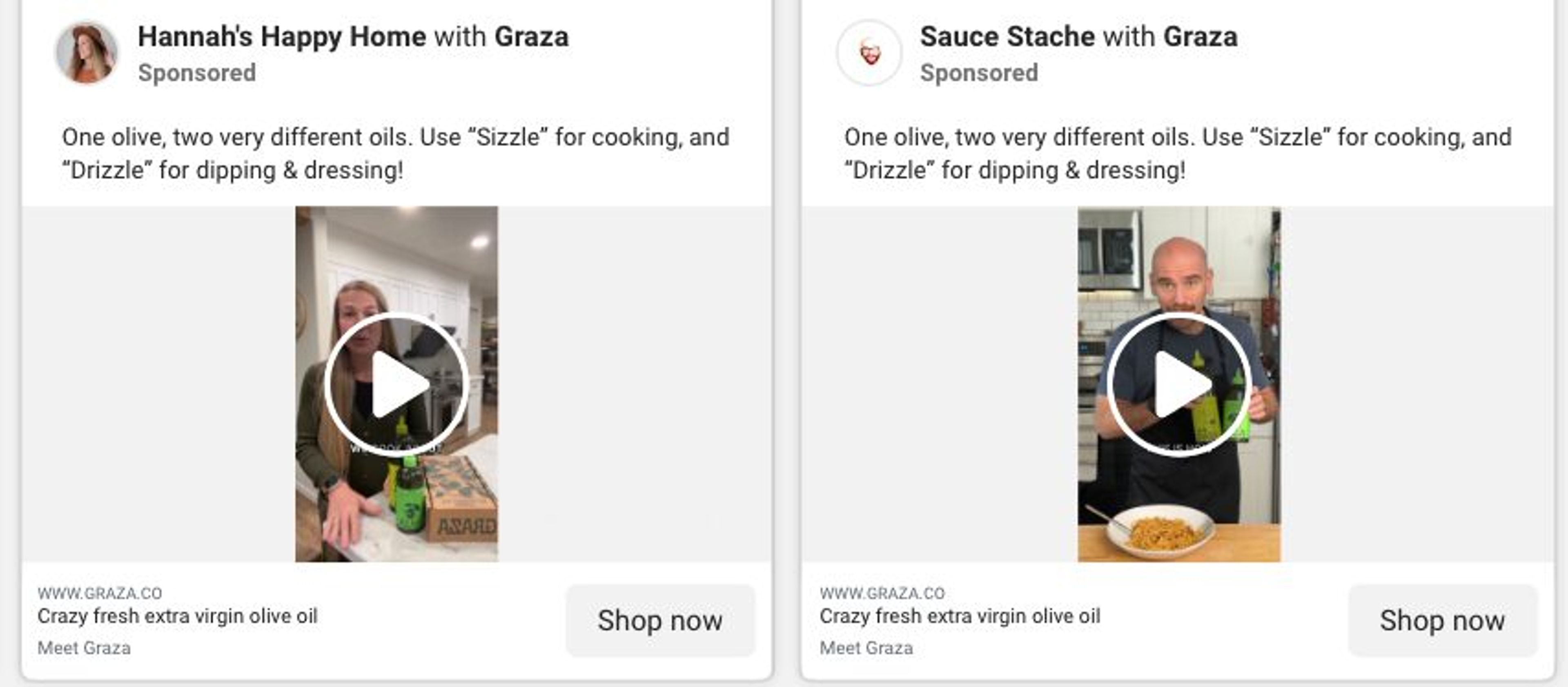
They don’t look like ads, and that’s the point. They stop the scroll, show the product in action, and convert without needing to sell.
The same goes for Google. Branded search is covered, product listings are simple, and video content shows the product being used. No extra messaging. Just showing up where it matters and keeping it consistent. It’s a textbook case of modern performance marketing for DTC brands, where paid channels amplify organic proof instead of replacing it.

This is what smart paid looks like at scale:
As soon as you land on the Graza website, you’re immediately greeted with a clean, welcoming homepage that reflects the brand’s playful yet practical identity.
The design is minimal but engaging, with bold colors, clear messaging, and a focus on usability.

Before you even explore further, a full-screen popup appears, staying true to Graza’s straightforward approach. It offers a special discount, but it doesn’t start by asking for any data. Instead, the first step is a simple question: What do you use olive oil for?
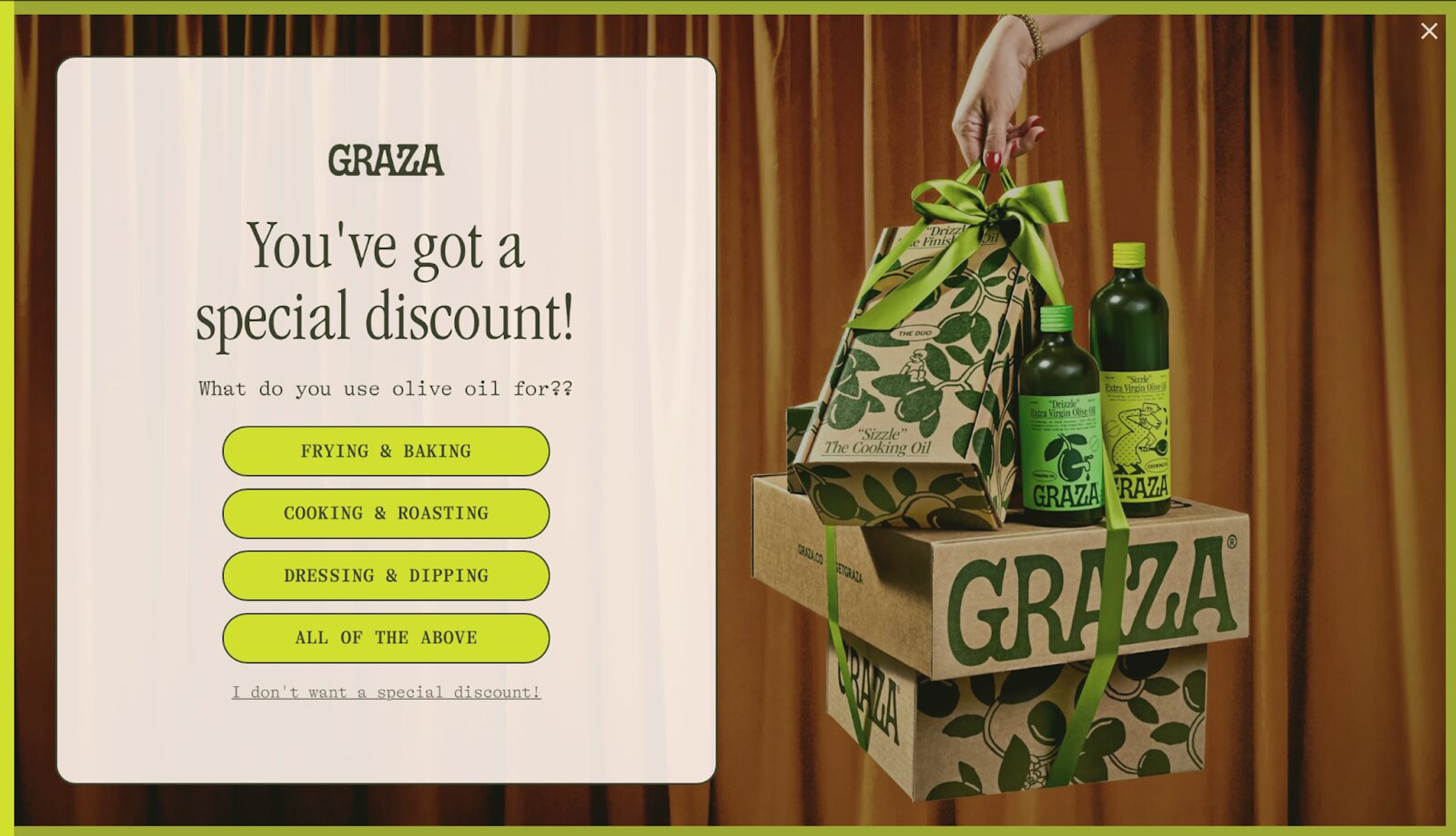
This does two things: first, it reduces friction—clicking an answer is easier than typing an email. Second, it effectively segments visitors based on their actual usage intent.

Only after this micro‑commitment does the popup ask for an email address. By this point, the visitor has already engaged, invested a few seconds, and implicitly agreed to continue.
But the flow doesn’t stop there. In the next step, Graza asks for a phone number to activate the discount.

The final step is where the flow really locks in intent. To receive the discount, the user must reply to the SMS.

This popup doesn’t just collect leads. It qualifies them, segments them, and primes them for conversion before they ever reach the product page.
If the customer doesn’t complete the process immediately, a teaser gently reminds them of the special discount still available. It’s a clever tactic within Graza’s marketing strategy, keeping the offer front and center without becoming intrusive.
Want to create something similar? Explore these fullscreen popups you can try today!

The homepage also goes beyond simple product descriptions, clarifying how each of Graza’s oils is meant to be used, whether it’s Sizzle for cooking, Drizzle for finishing, or Frizzle—their latest launch—for high-heat applications.
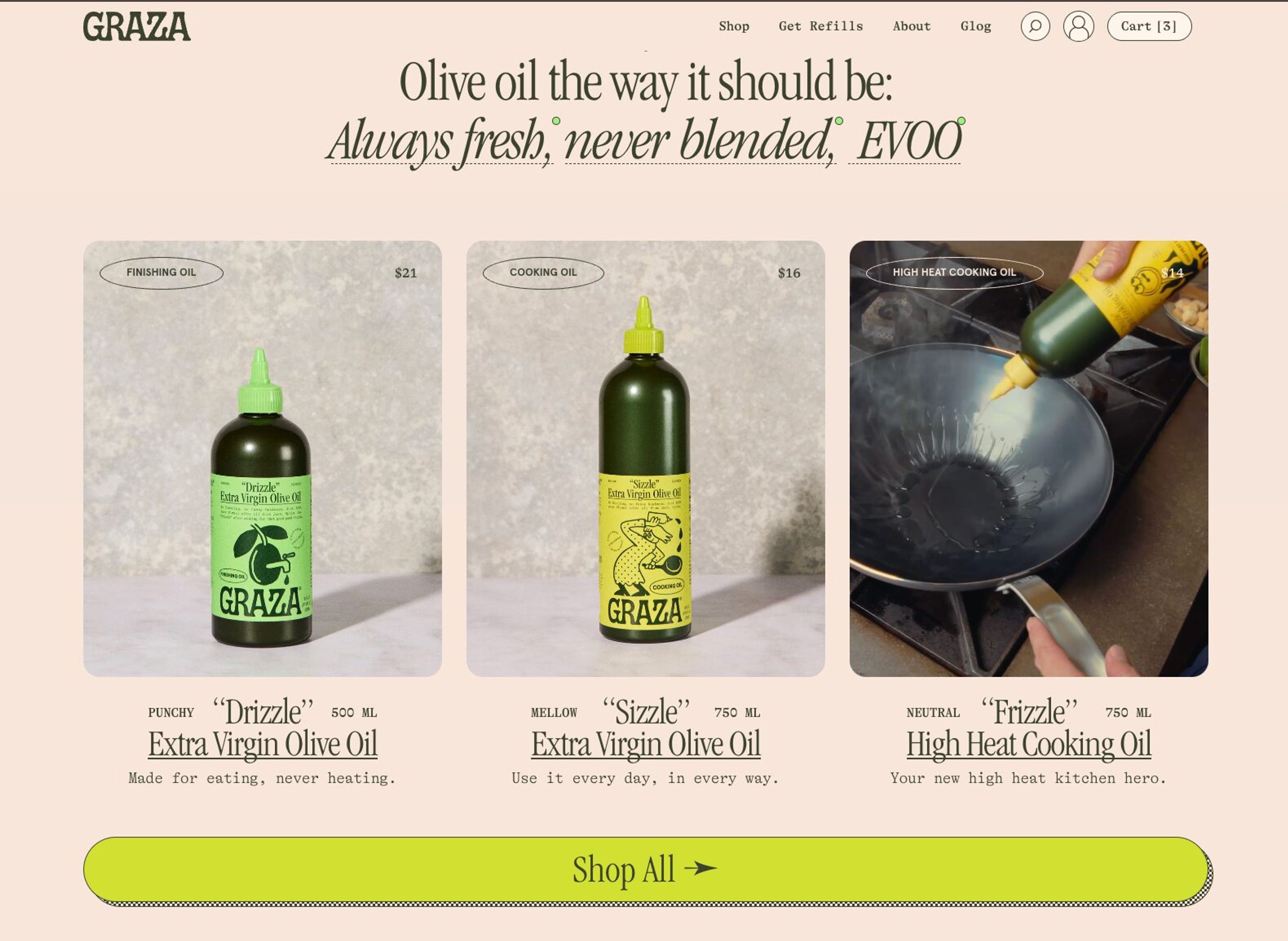
To make it even easier, Graza includes short cooking videos that demonstrate how each product shines in real kitchen scenarios.
Graza’s product page is a well-optimized system that guides customers through a smooth, intuitive journey. Every detail is designed to simplify decisions, drive repeat purchases, and build trust. From segmentation popups to subscription defaults, this reflects strong conversion optimization for DTC brands.

From the moment you land, the design is clean and focused. Key product details—price, image, and reviews—are immediately visible, making it easy for customers to decide.
Instead of just offering different bottle sizes, Graza provides different bottle types: Squeeze, Glass, and Refill, aligning with how customers actually use the product.
The subscription model is simple and flexible. "Subscribe & Save" is the default, with an easy option to switch to "One-Time Purchase." This approach offers savings and ensures regular replenishment without being pushy, building customer loyalty.

The product description is clear and practical with no jargon. The phrase "Sizzle is 100% Extra Virgin cooking oil" communicates quality simply. The description highlights benefits like everyday use, peak harvest olives, and freshness, focusing on practicality.

Graza’s bundling strategy encourages customers to buy the full trio—Sizzle, Frizzle, and Drizzle. This approach simplifies the decision-making process while offering value.
The review section plays an important role in boosting trust, with over 776 reviews and a 4.9-star rating. Customer feedback and images make the decision easier.
Graza’s SEO strategy goes beyond driving traffic; it’s about building long-term brand authority.
While they rank for branded keywords like “Graza olive oil,” “Graza Sizzle,” and “Graza Drizzle,” they focus on attracting highly targeted traffic that’s likely to convert. This positions Graza as a leading brand in the olive oil space.
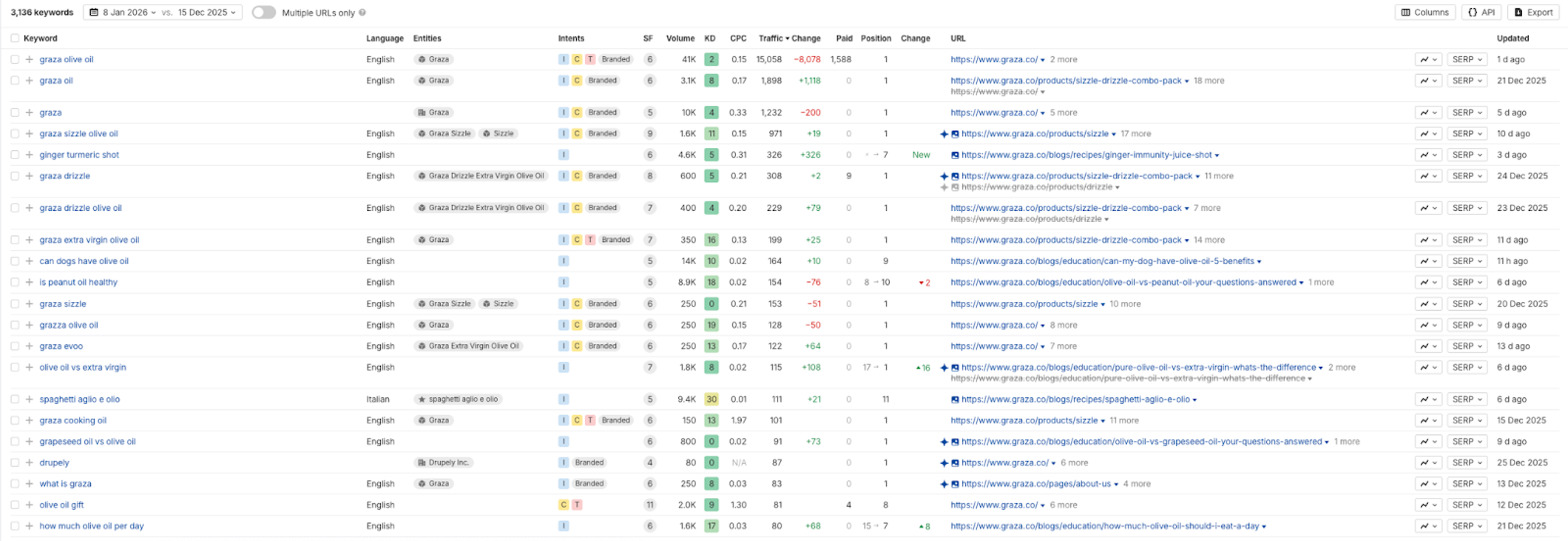
Their blog further strengthens their SEO efforts by offering educational content that answers common questions such as “Can dogs have olive oil?” and “How much olive oil should I eat a day?”

These blog posts not only draw in organic traffic but also guide readers toward products, turning content into conversion opportunities.

Graza’s SEO strategy combines branded authority with practical, content-driven marketing to drive sustainable growth and solidify their strong presence in the olive oil market. This organic visibility plays a major role in Graza’s growth strategy, reinforcing acquisition beyond paid media.
A closer look at Graza’s email marketing strategy breakdown shows that it’s designed to build relationships and foster repeat purchases, not just push promotions. Their emails focus on delivering value, which cultivates long-term customer loyalty.

The brand takes a segmented approach by tailoring email content based on purchase behavior.
For example, if a customer buys "Sizzle," they might receive an email with recipe ideas, cooking tips, or a special offer for "Drizzle." This ensures that the content feels personalized and directly relevant to the customer’s needs.

Rather than constantly bombarding customers with sales messages, Graza’s emails prioritize engagement and education. They use friendly, approachable language to share useful content, exclusive updates, and occasional offers.
This makes each email feel more like a brand experience than a standard promotional tool, keeping customers interested and engaged without feeling pressured to buy.
Rather than running constant promotions, Graza uses limited bundles and seasonal packaging to trigger FOMO and boost purchases.
Graza's marketing strategy here creates urgency while protecting brand value and keeping demand high across both new and existing customers.
Holiday gift sets like the Sizzle & Drizzle duos reframe the product as an easy, premium gift, not a discounted staple. Larger, limited drops—such as dinner-party bundles that combine oils with wine or hosting accessories—tie purchases to specific moments and use cases.
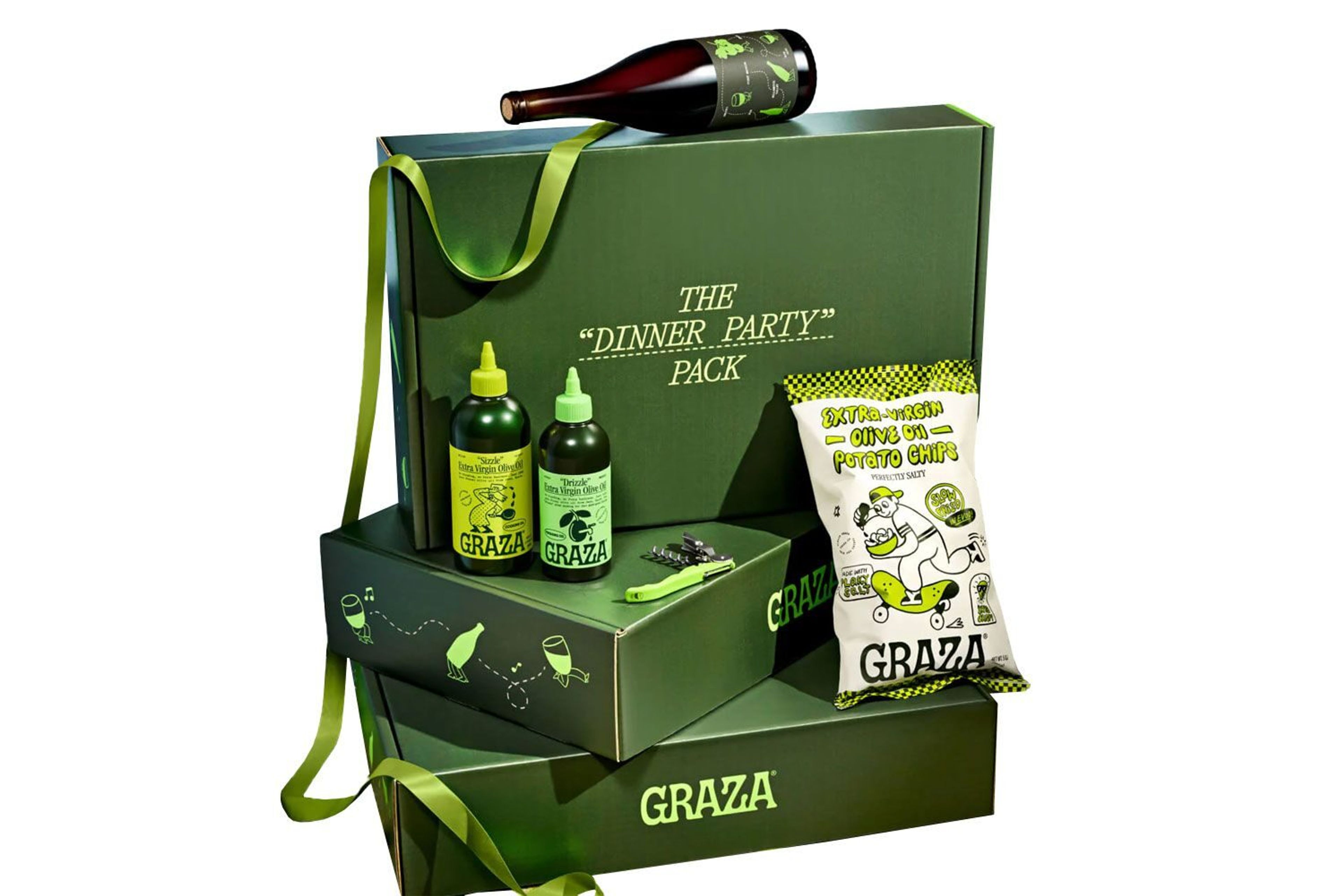
Collaborations follow the same logic. Small-batch bundles with creators or partner brands launch with built-in social proof, already circulating as unboxings and recipes before they’re available to buy. Quantities are limited, availability is short, and sold-out states do the rest.

The result is urgency driven by timing and relevance, not price, giving customers a reason to buy now without training them to wait for a sale.
Altogether, Graza’s marketing strategy demonstrates how clarity, community, and disciplined execution can outperform complexity. Graza’s rapid growth stems from clarity over complexity. They simplified olive oil into easy-to-use products, making it a go-to kitchen staple. By focusing on product clarity and user-driven experiences, they made olive oil something people reach for daily, not something saved for special occasions.
Their success mixes organic growth with strategic paid media, leaning on user-generated content, educational blogs, and personalized emails to build trust and loyalty.
The key takeaway: Simplify decisions, deliver consistent value, and create a seamless, customer-first experience—this is how Graza scaled, and how other brands can do the same!
Looking for more marketing breakdowns? Check out these articles:


How Tarte turns founder storytelling, creator trips, TikTok virality, and smart on-site funnels into a repeatable beauty marketing growth engine.
How Carroten went from unknown to every US Target shelf in under a year — using TikTok virality, creator-led commerce, and heritage brand positioning.

A deep dive into WavyTalk’s marketing strategy, from TikTok Shop and creator-led launches to UGC, cultural moments, and high-converting DTC tactics.